
You are three hours into a debugging session. The code looks right. The logic seems sound. You have checked the same function four times. Then you drag a plastic toy duck next to your keyboard, start explaining the problem out loud, and somewhere in the second sentence you hear yourself say the exact words that reveal the bug. The duck did not help you. You helped yourself, and that distinction matters more than it sounds.
Rubber duck debugging is a real technique, named in the 1999 book The Pragmatic Programmer, and it is practiced seriously by engineers at every level of the industry. But it is also a window into something broader: the cognitive architecture of problem-solving, and why the most effective debugging strategies are often the ones that look the least technical. Understanding this helps explain not just how engineers fix bugs, but why software is so hard to write correctly in the first place. It connects, surprisingly, to the same psychological forces that explain why the most productive remote workers deliberately create digital friction in their workflow.
What Is Actually Happening When You Talk to a Duck
The mechanism is not mystical. It is grounded in well-documented cognitive science. When you read your own code silently, your brain takes shortcuts. It knows what the code is supposed to do, so it reads what it expects to see rather than what is actually there. This is the same reason proofreading your own writing is harder than proofreading someone else’s. Your brain auto-corrects errors before they reach conscious awareness.
Speaking out loud forces a different mode of processing. You cannot narrate code as quickly as you can skim it. Verbalization slows cognition down to a pace where each step has to be explicitly formed as a sentence. That sentence has to be grammatically coherent, which means it has to be logically coherent. And logical coherence is exactly what the bug is violating.
Psychologists call the broader phenomenon “self-explanation effect.” Studies on problem-solving consistently show that people who explain their reasoning as they work solve more problems correctly than people who work silently. The act of explaining activates a kind of error-checking process that passive reading bypasses entirely.

Why the Listener Does Not Matter
Here is the part that surprises most people: the listener is almost entirely irrelevant. Engineers have used rubber ducks, stuffed animals, action figures, a photograph of a colleague, and even a blank wall. The object matters only insofar as it gives your brain a social frame. You are not presenting to it; you are presenting as if to it, and that framing activates the explanation mode.
This is related to a documented phenomenon where people perform cognitive tasks better when they believe they are being observed, even when the observer has no relevant expertise. The social context changes how carefully we narrate our own thinking. A rubber duck creates just enough of that social illusion to shift the cognitive register.
Some engineers prefer a variation: writing the explanation down rather than speaking it. This works through a similar mechanism. Typing or writing forces sequential articulation, which exposes the same kind of logical gaps. The act of trying to explain something clearly is itself a diagnostic tool, which is worth holding in mind the next time you write documentation and wonder why writing the docs sometimes helps you realize the feature is wrong.
This is also why pair programming (two engineers working at the same machine) is so effective at catching bugs. One person writes, the other narrates. The narrating engineer is, functionally, a rubber duck with opinions.
The Deeper Problem Rubber Ducks Expose
Rubber duck debugging works so reliably because it addresses a structural problem in how software is built. Code exists in two forms simultaneously: the form it takes in the engineer’s mental model, and the form it takes in the actual file. These two versions diverge constantly. The engineer believes a variable holds an integer; the runtime has been passing it a string for the last six calls. The engineer assumes a function executes synchronously; the framework runs it asynchronously.
This gap between mental model and reality is not a failure of skill. It is an unavoidable property of complex systems. Modern software has too many interacting layers to hold in a single person’s head at once. As we explored in why software engineers rewrite working code every few years, the drift between what an engineer thinks the code does and what it actually does accumulates over time until the gap becomes unsustainable.
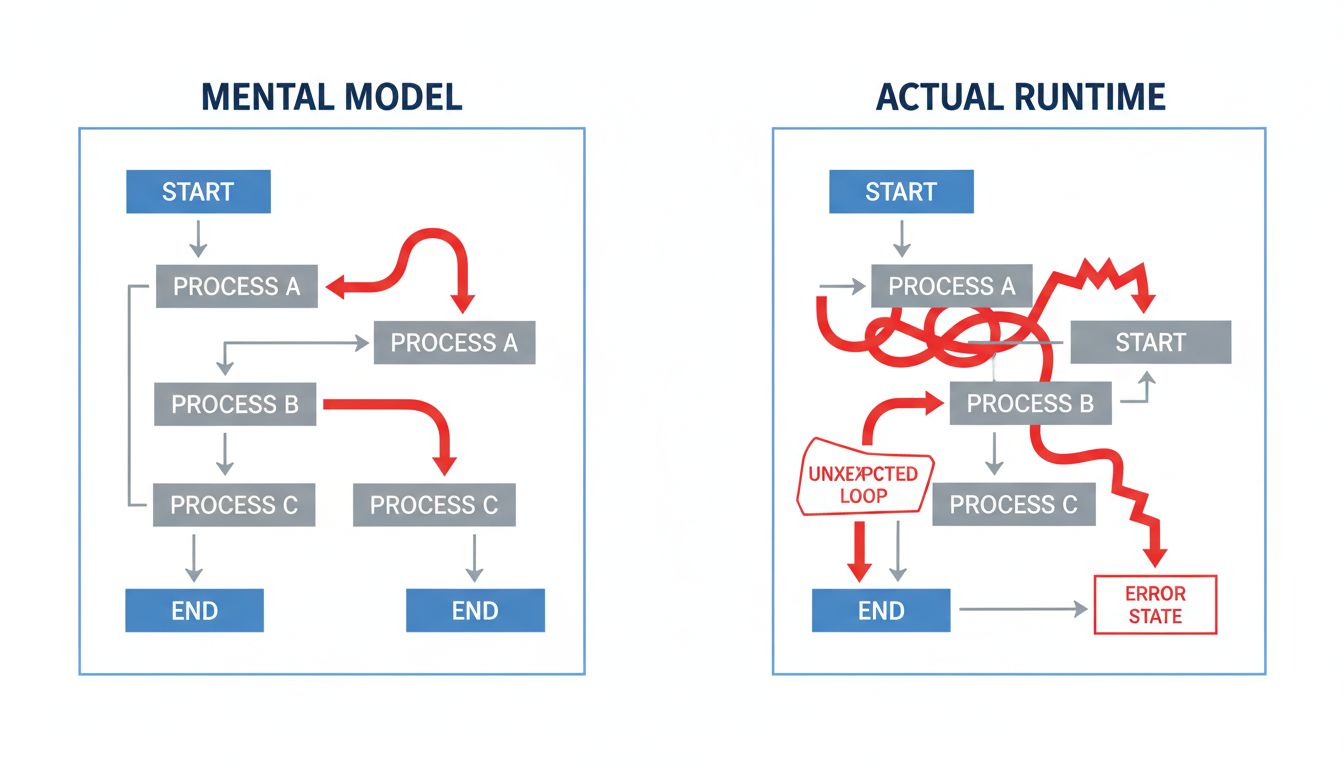
Rubber duck debugging collapses that gap temporarily. It forces you to rebuild your mental model from scratch, out loud, in sequence. And when the spoken model contradicts the written code, the bug announces itself.
How Professional Engineers Actually Use It
In practice, experienced engineers have developed structured variations on the technique. Some use a rubber duck at the start of a debugging session as a first-pass diagnostic, narrating the whole relevant code path before touching anything. Others use it specifically when they feel stuck, treating verbalization as a reset mechanism rather than a first resort.
There is also a team-based version that has become formalized in some engineering cultures. Called a “bug walk,” one engineer narrates a problem to a colleague who is deliberately asked not to help solve it but only to listen and ask clarifying questions when something is unclear. The engineer almost always finds the bug mid-explanation. The colleague’s role is to maintain the social frame that keeps the explanation honest.
This connects to a broader truth about how the best technical thinkers manage cognition. The same instinct behind how top tech executives use the 3-device rule to protect their best thinking applies at the engineering level: the best practitioners are deliberate about which cognitive mode they are in and design small rituals to shift between them intentionally.
The Duck Is Not a Joke
The rubber duck has become a kind of inside joke in engineering culture, a shorthand for the absurdity of highly paid professionals explaining their work to a bath toy. But it is only absurd if you think debugging is purely technical.
Debugging is not just parsing code. It is reconciling two models of reality: the one in your head and the one in the machine. The duck is a tool for making that reconciliation explicit. It forces you to speak the model into the open air where you can actually examine it.
That is not a workaround. That is the job. And the engineers who understand this tend to be the ones who spend less total time stuck, not because they are smarter, but because they treat cognition itself as part of the engineering problem.
The next time you see a rubber duck on an engineer’s desk, know that it is not decorative. It is infrastructure.