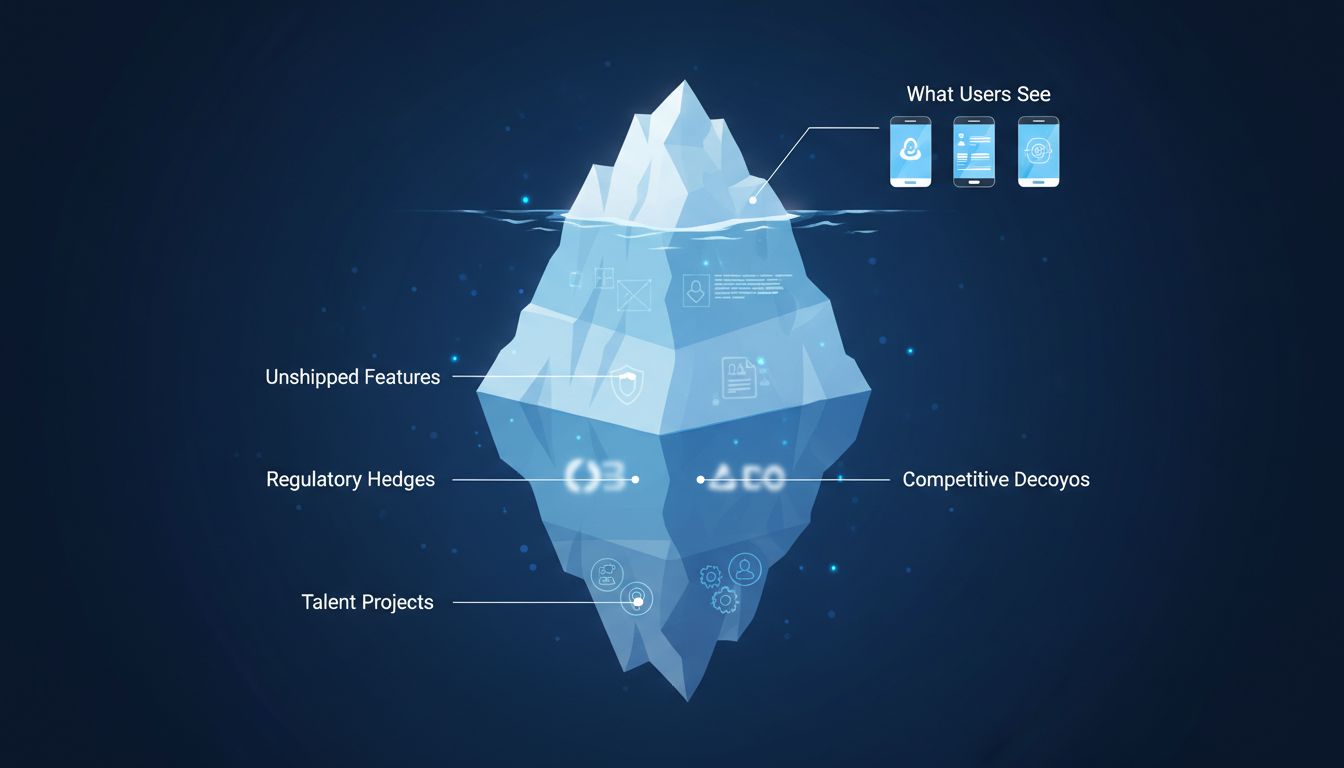
Every major tech product is an iceberg. What you see on screen, the clean interface, the polished workflows, represents maybe twenty percent of what engineers actually built. The rest sits in internal repositories, half-finished and deliberately unshipped, costing real money and generating zero visible revenue. If you assume this represents waste, you are missing one of the most calculated strategies in modern software development.
This pattern connects directly to how the best products earn and keep users. As we’ve explored before, successful apps look simple because years of work were spent removing things. But what happens to everything that gets removed? It doesn’t disappear. It waits.
The Option Value Argument
In finance, an option gives you the right, but not the obligation, to do something later. Software engineers and product strategists, even those who have never read an options pricing model, build features the same way.
Consider what Google does with experimental features inside products like Gmail or Search. Dozens of capabilities get built, tested internally, and then shelved without a public announcement. When competitive pressure changes, when a rival launches something similar, or when user research finally tips in one direction, those shelved features become deployable within weeks instead of months. The engineering cost was already paid. The competitive response time compresses dramatically.
This is not hypothetical. Google’s rapid deployment of AI-powered search features in response to ChatGPT’s rise leaned heavily on work that had been sitting in internal systems for extended periods. The company did not build those features in a panic. It activated them. That distinction is worth billions in market positioning.
Regulatory and Compliance Insurance
A less discussed reason for building-but-not-shipping is regulatory hedging. Tech companies operating across jurisdictions face an unpredictable compliance landscape. Building a privacy feature, a data deletion workflow, or a content moderation tool before a regulator demands it gives a company two advantages.
First, if the regulation passes, deployment is fast and the company looks proactive rather than reactive. Second, if the regulation fails to materialize, the company has lost some engineering time but gained knowledge about its own systems. Neither outcome is catastrophic.
Meta has done this repeatedly. Internal tooling for data portability and ad transparency controls was built well ahead of GDPR enforcement in Europe. When regulators came calling, responses were faster because the engineering groundwork existed. This is the software equivalent of buying insurance before the storm is on the radar.
Competitive Misdirection
Here is where the strategy gets genuinely strange. Some companies build features specifically so that competitors will build them too, burning those competitors’ engineering resources on a direction that the original company never intends to pursue at scale.
The logic works like this. If your product team leaks, through job postings, conference talks, or patent filings, that you are investing heavily in a particular capability, a competing product team will feel pressure to match that investment. If you were never planning to ship that feature as a primary product, you have successfully redirected a rival’s resources toward a fight you chose not to show up to.
This sounds conspiratorial until you look at patent portfolios. The gap between what large tech companies patent and what they actually ship is enormous. Some of that gap reflects genuine failed experiments. But some of it is deliberate landscape painting, staking out territory to shape where competitors invest.
This connects to a broader pattern of tech companies launching products they know will fail, where the real strategy is hiding in plain sight. An unshipped feature is just a quieter version of the same move.
The Talent and Morale Dimension
There is a less cynical reason that often gets overlooked: unshipped features are how companies retain engineers.
Software engineers, particularly senior ones, do not stay at companies purely for compensation. They stay for interesting problems. Letting a talented engineer build something ambitious, even something with uncertain shipping prospects, keeps that engineer engaged and developing skills. If every project had to be immediately justifiable by a revenue model, the most exploratory and technically interesting work would never get greenlit.
This is partly why silicon valley engineers are putting their failures on their resumes and getting hired. The industry has quietly accepted that building things that do not ship is a legitimate form of experience. Companies that understand this attract engineers who know how to think in longer time horizons, which is exactly the kind of engineering talent that produces durable competitive advantages.
What This Means for How You Read a Product
Understanding unshipped features changes how you interpret a product’s behavior in the market. When a company suddenly releases a well-polished capability that seems to have appeared from nowhere, it probably did not. When a product’s settings menu has options that feel oddly mature for a young company, those options likely predate what you think of as the company’s current era.
It also reframes what looks like strategic confusion. A company that builds across many capability areas without fully committing to any single one is not necessarily unfocused. It may be deliberately keeping options open, paying a modest ongoing cost to preserve the ability to move fast when the moment arrives.
This is especially relevant in AI development, where the cost of not having a capability ready when demand spikes can be existential. Companies building AI features that never launch are not wasting compute budgets. They are buying flexibility in a market where the definition of a competitive product changes faster than any roadmap can track.
The features you never see may be doing more strategic work than the ones you use every day. That is not waste. That is infrastructure for a future the company is not ready to commit to yet, but is absolutely planning for.