
Every few months, a developer somewhere discovers a hidden feature buried in an app’s binary, a half-built settings panel behind a feature flag, or a fully functional API endpoint that the product team swears was never announced. The instinct is to assume incompetence, a feature that got abandoned mid-sprint, a pivot that orphaned someone’s hard work. But the more you dig into how large tech organizations actually operate, the more you realize that a surprising amount of this never-shipped work is completely intentional.
This pattern connects to something broader about how software strategy actually works at scale. If you’ve ever wondered why successful startups launch with missing features on purpose, you already have one piece of the puzzle. But unreleased features are a different animal entirely. They aren’t gaps. They’re moves.
The Option Value Problem
Here’s a concept that software engineers rarely get taught but that product strategists think about constantly: option value. In financial terms, an option is the right but not the obligation to do something in the future. The option itself has value even if you never exercise it.
In software, building a feature without releasing it is exactly this. You’ve paid the cost of exploration and implementation. You now hold an option. You can release it when the competitive moment is right, when regulation changes, when a rival announces something similar, or when your business model shifts. The feature sits in your codebase like a card held face-down on the table.
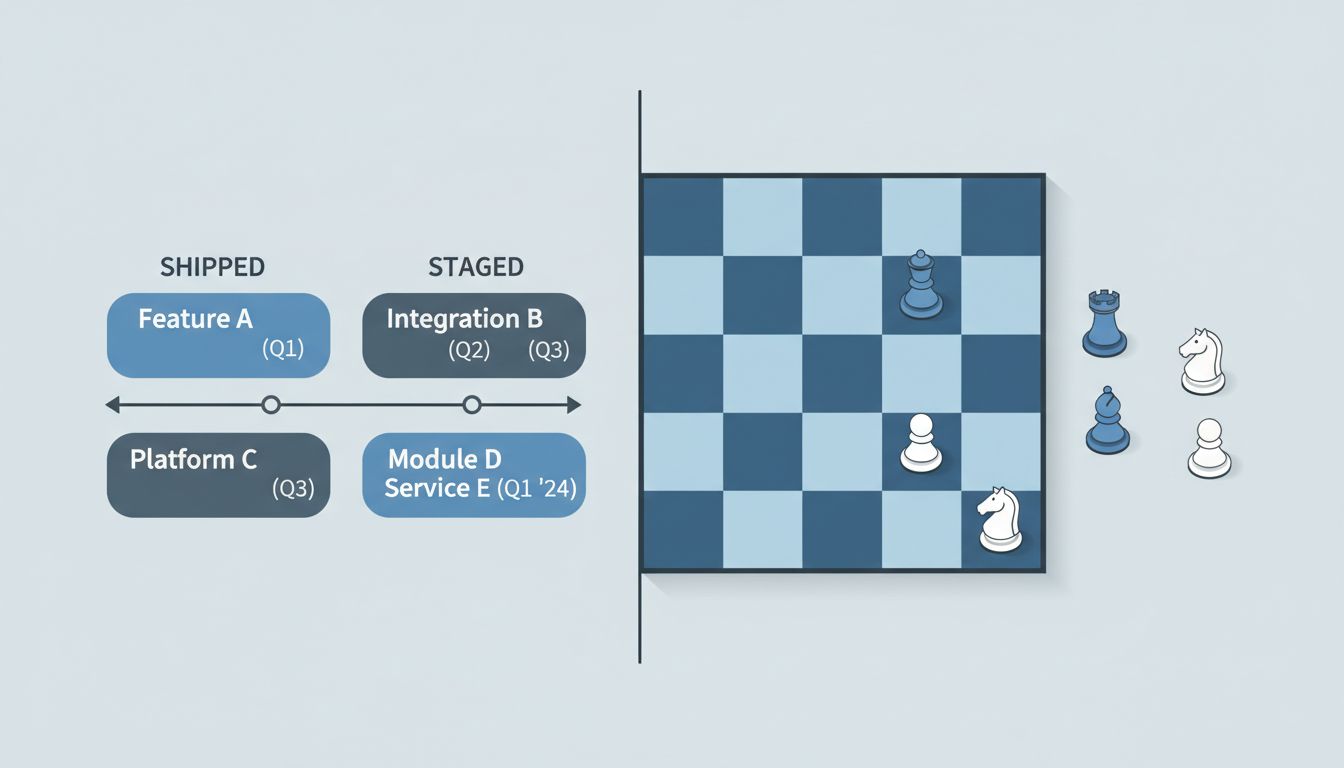
This isn’t abstract. When a major platform detects a competitor gaining traction in a niche, the fastest response isn’t a hackathon. It’s checking what’s already been built and staged. Speed matters enormously in platform competition, and pre-built work eliminates the most expensive part of the clock.
Shadow Infrastructure and Competitive Signaling
There’s a second layer to this that’s even more interesting. Sometimes a feature gets built specifically so that its existence can be leaked.
This sounds cynical, and it is, but it follows a coherent logic. If a competitor is about to announce a new capability, a well-timed developer conference demo of a similar feature, even one that never ships, can freeze buying decisions. Enterprise customers waiting on a purchase will pause. Developers building on a competing platform will hesitate to commit. Investors will ask harder questions.
This is called a vaporware strategy when it’s done cynically, but the reality is more nuanced than that label suggests. Most companies aren’t lying about building the feature. They built it. They just haven’t decided whether the cost of maintaining, supporting, and scaling it is worth taking on. The signal gets sent regardless.
This connects directly to how platform companies make competition structurally impossible rather than just winning individual feature races. The threat of a feature can be as effective as the feature itself.
The Engineering Signal You’re Actually Getting
Here’s where it gets interesting from a pure engineering standpoint. When a company builds a feature it doesn’t release, the engineering team learns things that can’t be learned any other way.
Consider what happens when you actually implement end-to-end encryption for a messaging product. You discover exactly how much your existing infrastructure assumes plaintext. You find the three internal analytics hooks that would break. You learn which third-party integrations would need to be renegotiated. You figure out the UX problems around key recovery. None of that is knowable from a whiteboard.
So even if the feature never ships, the team now knows the true cost and complexity. That knowledge shapes architecture decisions for years. The codebase gets subtly adjusted to make future implementation cheaper. It’s like running a full fire drill that also renovates the building while it’s happening.
// Feature flag pattern, common in production codebases
if (featureFlags.isEnabled('e2e_encryption', userId)) {
  return encryptPayload(message, recipientPublicKey);
} else {
  return message; // legacy path
}
That flag might stay set to false in production for eighteen months. The code is real. The learning is real. The release decision is just deferred.

Regulatory Rehearsal
This one doesn’t get discussed enough. In heavily regulated spaces (financial services, healthcare, anything touching children’s data), building a feature and releasing a feature are two completely separate compliance problems.
A company that wants to eventually offer, say, AI-powered financial recommendations may spend a year building the technical capability before a single lawyer has blessed the go-to-market approach. That’s not waste. That’s sequencing. The technical work and the regulatory work run in parallel because serializing them would cost twice as long.
The feature exists in staging. It gets tested internally. It gets refined. And when the legal path clears, the release is weeks away instead of years.
This is also why some features appear to launch suspiciously fast after a regulatory change. They didn’t build it in three weeks. They built it eighteen months ago and spent fourteen of those months talking to lawyers.
The Talent Retention Angle Nobody Talks About
There’s one more reason that almost never appears in product strategy discussions but that any senior engineer will immediately recognize: ambitious engineers need interesting problems.
Keeping a great engineer engaged on maintenance work is hard. Letting them explore a speculative feature, one that might ship, one that pushes the technical boundary of what the platform currently does, is an entirely different proposition. The output might never reach users, but the engineer grows, the codebase gets stress-tested in new directions, and the retention problem gets quietly solved.
This connects to a broader pattern in how tech companies hire overqualified engineers on purpose. You don’t hire someone with that depth of skill just to have them close tickets. You hire them so the exploratory work is done well even when no one is sure it will ever ship.

What This Means If You’re Building Something
If you’re working at or running a smaller company, the instinct is to think this kind of strategic ambiguity is a luxury only large teams can afford. That’s partially true. You probably can’t fund speculative R&D at the same scale.
But the underlying logic, building to learn before building to ship, using feature flags to stage work without committing to a release, treating technical exploration as an asset rather than a cost, applies at any size. The discipline of asking “what are we actually optimizing for by building this right now” is free.
The features that never ship aren’t always failed experiments. Sometimes they’re the most deliberate work in the entire codebase.