
If you’ve spent an afternoon wrestling with an API that seemed designed to frustrate you, you weren’t imagining things. You were experiencing a carefully constructed obstacle course, one that exists not despite the company’s best efforts but because of them. Understanding why this happens, and what it actually costs you, is one of the more useful things you can know about the software industry right now.
The Free Tier Is Not a Product. It Is a Demo With Teeth.
Most developer-facing companies offer a free tier. It looks generous. OpenAI, Stripe, Twilio, Google Maps, AWS, all of them put a free tier front and center in their pricing pages. The message is clear: come build with us, no credit card required.
But free tiers are architected with precision. Rate limits are set just low enough to make any real application unworkable. Certain endpoints, often the ones you need most, are paywalled. Support is absent or routed through community forums where the answers are six versions out of date. The documentation for free-tier features is complete, while the documentation for the things you’ll actually need is vague, scattered, or missing key examples.
This is not an accident of resource allocation. Companies with hundreds of engineers choose what to document and what to leave thin. The gap between free-tier docs and paid-tier docs is a choice.
The result is a developer who spends real time getting something partially working, realizes it won’t scale under the free limits, and now has sunk cost pulling them toward the paid plan. You’ve already written the integration. Switching means rewriting it. The company has you.
Complexity as a Moat
There’s a second mechanism running alongside the free-tier trap, and it’s subtler. Genuine technical complexity gets layered with unnecessary complexity, and the combination makes your integration code deeply coupled to that specific vendor.
Consider authentication flows. OAuth 2.0 is already non-trivial. But many APIs add proprietary token structures, custom scoping systems, or unique refresh logic that doesn’t map cleanly to anything else. You don’t just learn how to call their API. You learn their particular dialect of the language, one that has no transferable value.
Same with SDKs. A good SDK should be a thin, transparent wrapper that helps you get to the underlying HTTP calls quickly. Many SDKs are instead sprawling abstractions that hide the underlying calls entirely. When something breaks, you’re debugging the SDK, not the API. When you want to switch providers, you’re not just swapping an endpoint URL. You’re rewriting entire layers of your application.
This is planned obsolescence applied to APIs. The complexity isn’t incidental. It’s the lock-in mechanism.
The Support Funnel Nobody Talks About
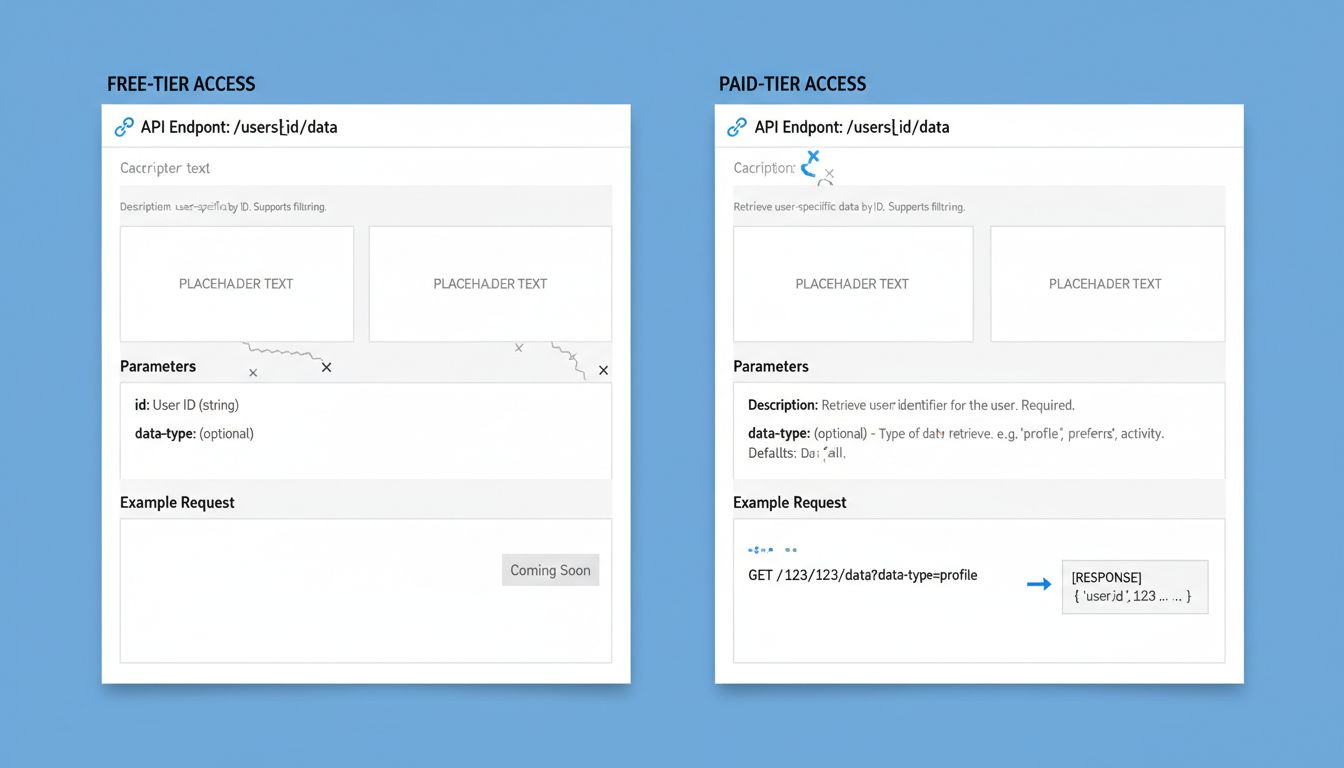
Here’s a dynamic worth watching closely. When a developer hits a wall with a free-tier API, the support path is deliberately thin. Stack Overflow, GitHub issues, a Discord server where the company’s developer relations person shows up occasionally. This creates real friction.
But the moment you upgrade to a paid tier, things change. Dedicated support channels open up. Response times drop. Sometimes a human engineer is actually reachable. The documentation gets supplemented with direct help.
This isn’t just good customer service at the paid tier. It’s a demonstration that the friction you experienced was always optional. The company had the capacity to provide clear documentation and responsive support. They chose where to direct those resources based on who was paying.
For you as a developer, this means the painful integration experience you had on the free tier was a preview of what it feels like to be a customer they don’t care about yet. Once you pay, you get to experience what a functional developer relationship feels like. The contrast is the sales pitch.
Versioning as Planned Churn
API versioning is where things get genuinely expensive for teams that aren’t paying attention. Most APIs go through major version changes on multi-year cycles. When a new version drops, the old one gets a deprecation timeline, sometimes generous, sometimes not.
The problem is that deprecation cycles create mandatory engineering work. Your team has to allocate time to migrate, test, and redeploy. This is often framed as the natural cost of progress, and sometimes it is. But sometimes it’s a mechanism that keeps you engaged with the vendor’s sales and support team on a predictable schedule.
When Salesforce, Google, or Twilio deprecates an API version, large customers with paid support contracts get migration guides, dedicated engineers, and early access to the new documentation. Free and lower-tier customers get a deprecation notice and a link to changelog. The same mandatory event affects different customers very differently depending on how much they pay.
If you want to avoid this, the most practical thing you can do is build an abstraction layer between your application logic and the third-party API calls. Keep that boundary thin and well-documented internally. When migration time comes, you’re changing one file instead of dozens.
What Good API Design Actually Looks Like
To be fair, not every confusing API is deliberately confusing. Some are just bad. Stripe is the canonical example of an API that is genuinely well-designed, with consistent patterns, complete documentation, and predictable behavior across tiers. Twilio, ironically, is often cited as a counterexample where the developer experience degrades noticeably as you move into more complex use cases.
The way to tell the difference between malicious and merely incompetent API design is to ask one question: does the documentation improve meaningfully when you pay more, or is the documentation just uniformly good or bad across all tiers?
If the paid tier unlocks better docs and better support, that’s the friction-as-funnel model. If the docs are equally unhelpful at all price points, you’re probably just dealing with an engineering org that doesn’t prioritize developer experience. Both are frustrating, but only one is strategic.
How to Build Against This Without Getting Burned
You can’t opt out of using third-party APIs. The alternative is building everything yourself, which is almost never the right call. But you can build with more awareness of what you’re actually signing up for.
Read the pricing page before you write a line of code. Not just the tier names and prices, but the rate limits, the support entitlements, and the list of features available at each tier. If the thing you’re building needs something that’s only in the paid tier, price that in from the start.
Test your actual use case on the free tier before integrating. Don’t build a proof of concept that uses five API calls. Simulate the load and the variety of calls your production system will need. Hit the rate limits on purpose. See what the error handling looks like. This is the most useful thing you can do before committing.
Build abstraction layers. Keep API calls isolated in your codebase. One module per integration, with a clear internal interface. When you need to migrate to a new version, or swap providers entirely, the blast radius stays small.
Document your integration while you build it. Not just what the calls do, but why you made the choices you made and what the gotchas were. Deprecation cycles will come. The developer who built the original integration might not be around. Future you (or future colleague) will be grateful.
Factor support costs into vendor comparisons. If two APIs charge similar rates but one includes dedicated support and one doesn’t, that difference has real dollar value. Technical issues at 2am cost more than the monthly subscription fee you’re trying to save.
What This Means
Friction in developer tools is not a neutral engineering artifact. It is a business decision, made by people who understand exactly where the pain points are and have chosen which ones to solve and which ones to leave in place. The free tier that almost works, the documentation that covers 80% of what you need, the SDK that ties your code to their patterns, these are features, not bugs.
None of this means you shouldn’t use third-party APIs. It means you should approach them the way you’d approach any vendor relationship: with a clear sense of what you’re committing to, what the exit costs are, and what the company’s incentives actually are. The companies that are most transparent about pricing, documentation, and support quality at every tier are the ones worth trusting. The ones that make the free tier feel like a trial by ordeal and the paid tier feel like relief have told you exactly how they think about you as a customer.
That information is useful. Build accordingly.