
Open almost any software documentation page and you will find a quiet disaster. The code samples reference a deprecated API. The screenshots show a UI that was redesigned two years ago. The “getting started” guide assumes a dependency that was quietly removed in version 4.2. Nobody is surprised by this anymore, which is exactly the problem. Stale documentation has become so normal that developers just accept it as the cost of working with software, the same way commuters accept traffic. But the staleness is not accidental and it is not inevitable. It is the predictable output of a set of incentives that almost every software organization builds into itself.
This connects to a broader pattern worth understanding: tech companies often make their APIs difficult to use for reasons that are more strategic than accidental. Documentation quality sits right at the intersection of those same forces.
The Accountability Gap
Here is the core structural problem. When an engineer ships a feature, there is a clear owner. A ticket gets closed, a pull request gets merged, a metric moves. When that same feature’s documentation goes stale six months later, nobody’s dashboard changes. No alert fires. The engineer who built the feature has moved on to three other projects. The technical writer (if the company even has one) was never looped in on the update. The product manager considers documentation someone else’s responsibility.
This is not a people problem. The engineers are not lazy. The writers are not incompetent. The managers are not oblivious. They are all responding rationally to how their work is measured. Shipping code moves your performance review forward. Updating a markdown file that three people will read does not.
Studies of developer productivity consistently show that teams spend between 20 and 30 percent of their time searching for information, a number that climbs when documentation is unreliable. Stripe’s developer experience team has cited internal research suggesting that clear, accurate documentation is one of the top three factors influencing whether developers adopt a product at all. Yet most organizations treat documentation as a deliverable you produce once and archive, not as a living system you maintain.
Why the Problem Gets Worse as Products Grow
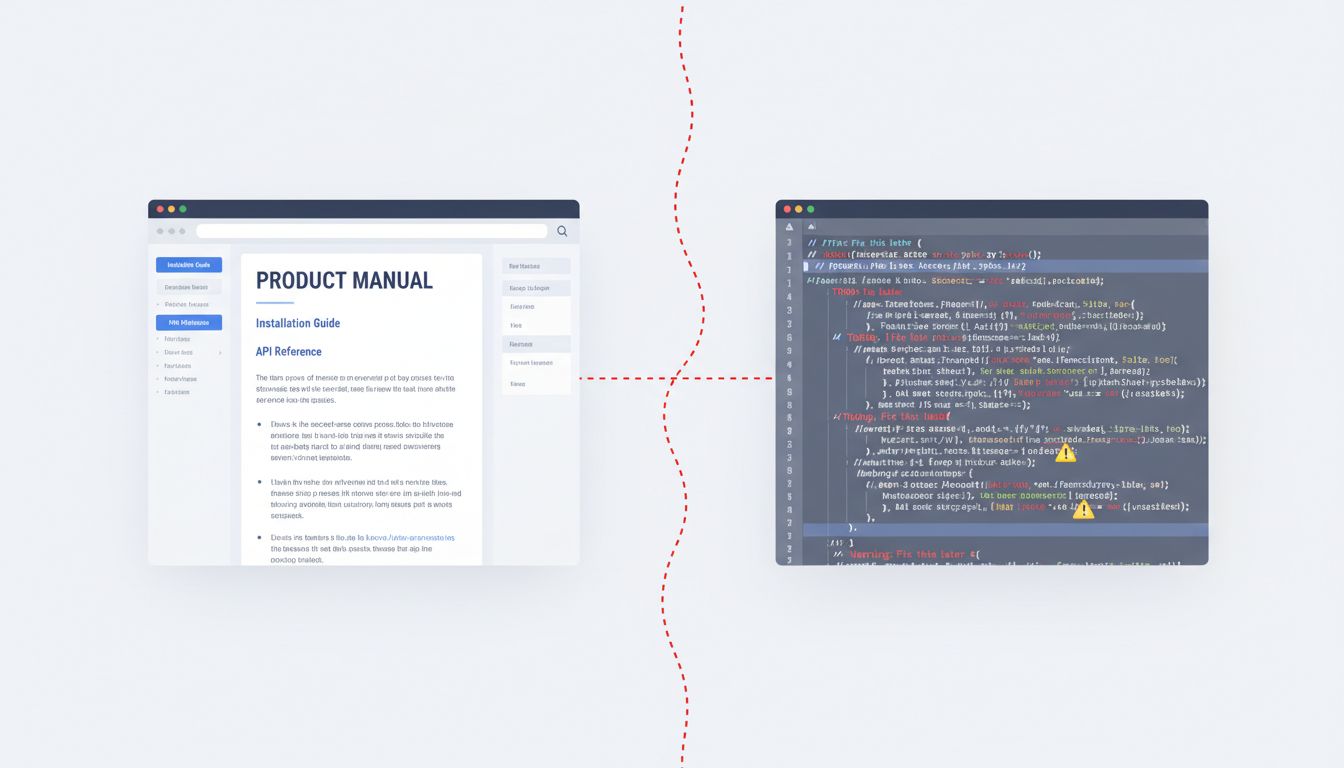
Small teams often have surprisingly good documentation. When four engineers are building a product, tribal knowledge is low-cost. Everyone knows what changed and when. The moment a team crosses a certain size threshold, something breaks. The people who wrote the original docs are no longer the same people making changes. The surface area of the product grows faster than anyone’s ability to track it.
This is compounded by the economics of software releases. Software companies often release products before they are fully polished, which means the documentation written before launch is already partially wrong on day one. Features get cut, renamed, or rerouted through different menus in the final sprint. The docs reflect the plan, not the product.
The velocity problem is real. A mature SaaS product might push dozens of updates per month. Each update is a potential documentation debt event. At that pace, a team would need a dedicated, continuously-updated documentation system just to stay even, let alone accurate. Most companies do not have that. They have a wiki someone set up in 2019 and a Confluence instance that three different people have “ownership” of, which means no one does.
The Hidden Cost Nobody Measures
Organizations dramatically underestimate how much outdated documentation actually costs them. The calculation seems simple: a developer gets confused, spends an hour figuring out the right answer, moves on. But the real cost has layers.
First, there is the support cost. Every question that a developer has to file a ticket for, post on Stack Overflow about, or raise in a Slack channel is a question that good documentation could have answered in 45 seconds. Support teams at API-heavy companies estimate that 40 to 60 percent of inbound developer questions are already answered in documentation that the developer either could not find or did not trust because previous documentation had misled them.
Second, there is the trust erosion. This is harder to quantify but arguably more damaging. Once a developer has been burned by documentation that confidently described a function that no longer works that way, they stop trusting the documentation entirely. They go straight to the source code, or they post on forums, or they just avoid the feature. The best developers treat documentation like source code, and the teams they work on tend to ship faster and with fewer integration bugs as a result.
Third, there is the onboarding multiplier. New engineers use documentation more than experienced ones. Every hour a new hire spends chasing down inaccurate documentation is a direct tax on ramp-up time, which is already one of the most expensive phases of employment.
What Actually Works
The organizations that consistently maintain good documentation share a few structural features, and none of them are primarily about writing quality.
Documentation lives next to the code. The most reliable documentation systems treat docs as part of the codebase itself. When you change the function, you change the doc in the same commit. Pull requests that touch functionality without touching the relevant docs get flagged or blocked. This is how elite software teams manage to ship faster without accumulating the kind of knowledge debt that slows teams down later.
Someone owns accuracy, not just content. There is a difference between a technical writer who produces documentation and a documentation owner who is accountable for its correctness over time. The latter requires authority to pull engineers back into a doc review when their feature changes. Without that authority, documentation maintenance is always somebody’s lowest priority.
Staleness is made visible. Some teams timestamp every documentation section and automatically flag anything that has not been reviewed in 90 days. Others run automated tests against code samples in their docs. The specific mechanism matters less than the principle: stale documentation should create friction for someone, or it will never be updated.
Users are treated as a signal source. The developers using your documentation will tell you what is wrong with it, often loudly, if you give them a way to do so. A simple “was this helpful” widget with a free-text field will surface inaccuracies faster than any internal review process.
The Documentation Debt Spiral
The deepest reason documentation stays broken is that broken documentation creates the conditions for more broken documentation. When no one trusts the docs, no one reads them carefully enough to notice errors. When no one reports errors, they compound. When errors compound, the docs become genuinely unreliable, and engineers stop even attempting to keep them current because “everyone knows the docs are wrong anyway.”
Breaking that spiral requires treating documentation not as a cost center but as infrastructure. The same organizations that would never let test coverage drop below a threshold or let a build stay broken for days will tolerate documentation that has been inaccurate for years. That is not a reflection of priorities so much as a reflection of measurement. You fix what you measure. Nobody is measuring this.
The fix is not a better wiki tool. It is not a new AI assistant that auto-generates docs (though that helps at the margins). It is building the organizational expectation that documentation accuracy is a professional responsibility, not a bonus task for when someone has extra time. That expectation has to be encoded into processes, pull request templates, and performance conversations before it changes anything. Anything short of that is just rearranging the deck chairs on a ship that will be out of date by the time it launches.