
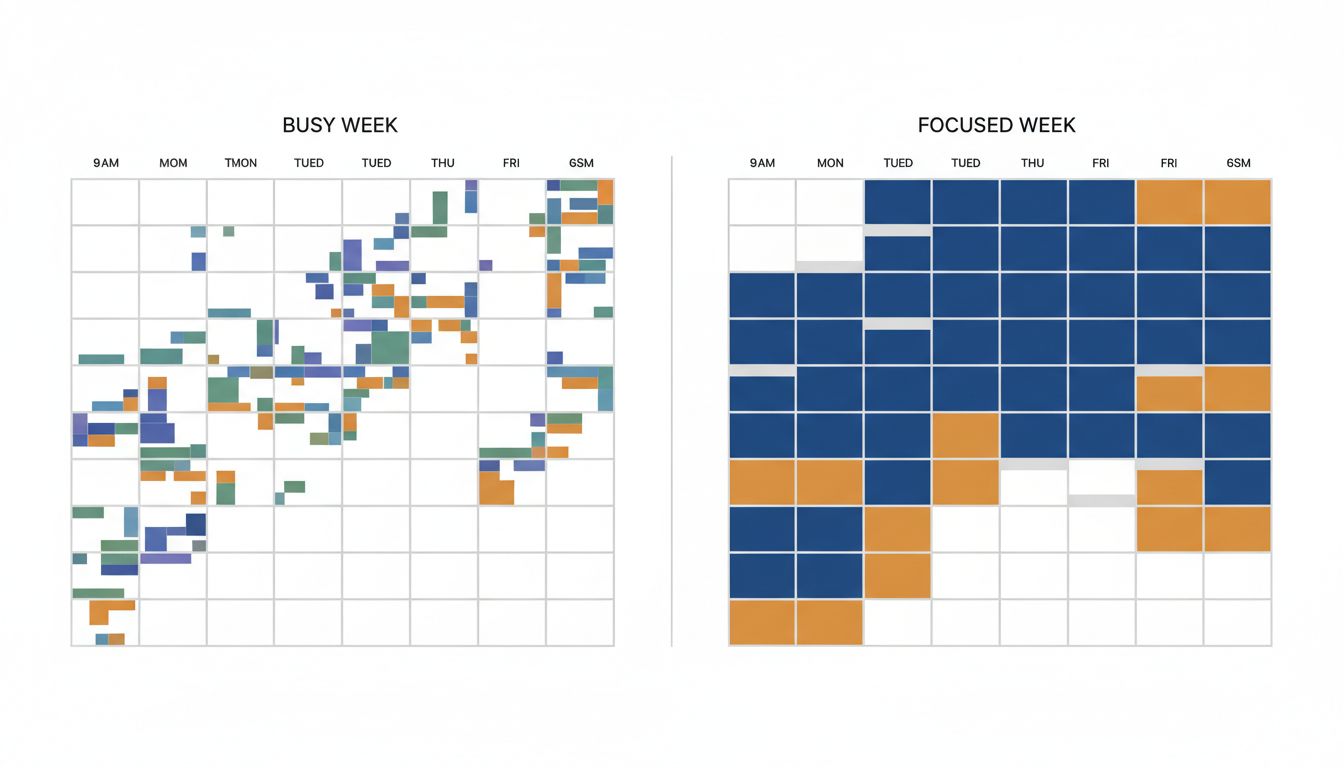
Most calendars are built the wrong way around. You open the week as a blank slate, meetings pour in from every direction, and by Thursday you are staring at two hours of fragmented time wondering why nothing got shipped. The calendar did not fail you. You just built it in the wrong order, responding to requests instead of designing a system. The reverse calendar method treats your week the way a good software architect treats a system design: you define the constraints first, protect the critical paths, and only then decide what traffic gets routed through.
[This connects to something worth understanding about digital calendars more broadly: the tools themselves have structural biases baked in. If you have not read about how digital calendars are quietly making you late, it reframes how you think about the scheduling software you use every day.]
What the Reverse Calendar Method Actually Is
The core idea is straightforward, but the execution requires discipline that most people underestimate at first. Instead of opening your calendar and filling in what needs to happen, you start by blocking everything that matters most. Deep work blocks go in first, the same way database schema should be designed before you write application logic. Once those are locked, you schedule supporting work around them. Meetings, reviews, check-ins, and administrative tasks fill the remaining space, not the prime real estate.
Think of it as a memory allocator for your week. In systems programming, a good allocator reserves contiguous memory for the processes that need it most, rather than handing out blocks on a first-come, first-served basis until nothing useful fits together. Your attention works exactly the same way. Context-switching between a 30-minute meeting and a coding session does not cost you 30 minutes, it costs you the setup time on both ends, which researchers at UC Irvine have estimated at around 23 minutes to fully regain focus after an interruption. Do that four times a day and you have lost a working day to nothing more than the overhead of context restoration.

The Implementation: Building Your Week Like a System
Here is how this looks in practice. Start on Friday afternoon for the following week, or Sunday evening if that is your preference. The timing matters less than the sequencing.
First, identify your three to five highest-value tasks. Not urgent tasks, not tasks someone else put on your plate, but the work that only you can do at the level it needs to be done. For a senior developer this might be a complex architectural decision, a gnarly debugging session, or writing documentation that will save the team 40 hours of confusion later. Block two to four hours per task in your calendar, placing them during the windows when you historically do your clearest thinking. Most people find this is morning, but personal chronobiology varies and it is worth paying attention to your own patterns.
Second, batch your meetings. This is non-negotiable. Meetings should live together in clusters, not scattered across the week like memory leaks. Tuesday and Thursday afternoons work well for many developers. The specific days matter less than the principle: when you are in meeting mode, be in meeting mode. When you are in deep work mode, be in deep work mode. The cognitive cost of mode-switching is real and measurable.
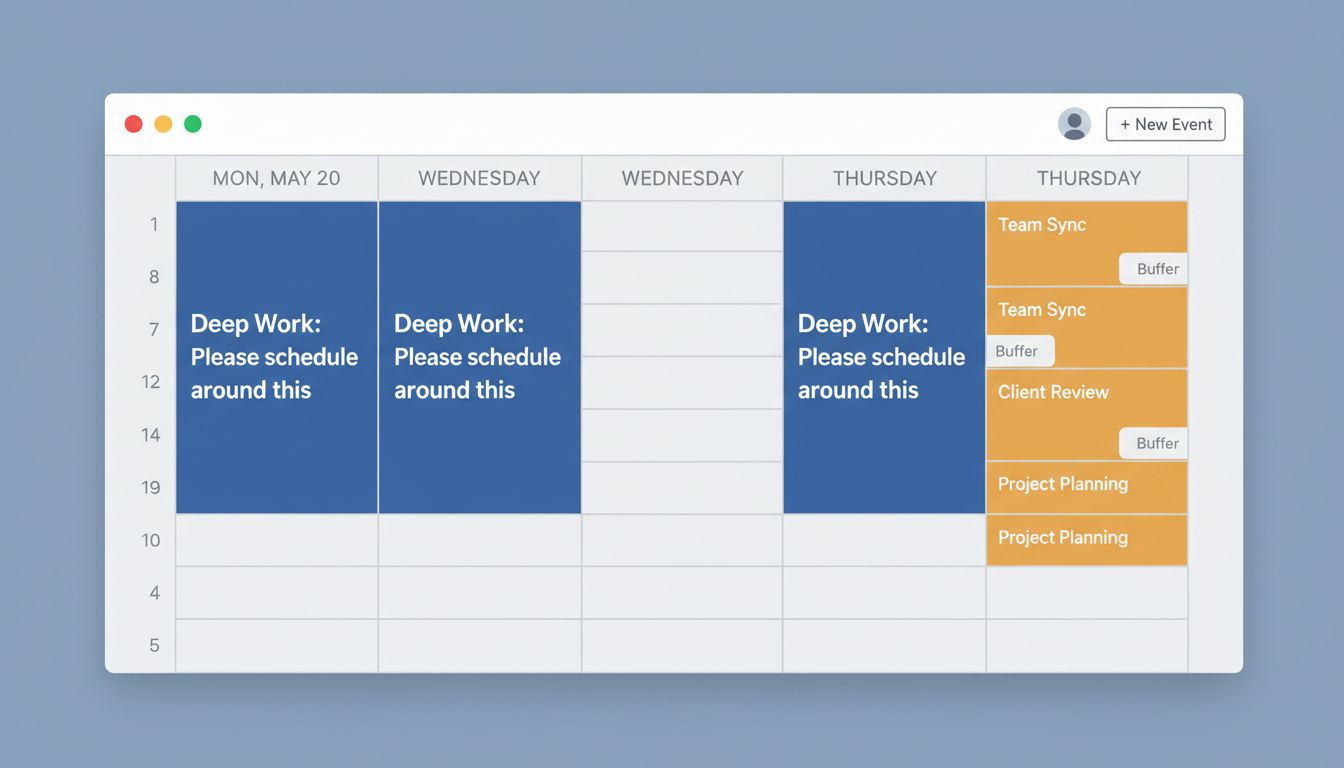
Third, and this is the part most people skip, schedule buffer time explicitly. Not as vague white space that will get colonized by Slack notifications, but as actual named calendar blocks. “Processing and response” for 30 minutes at 10am. “Review and triage” for 20 minutes at 4pm. This is where you handle the work that arrives throughout the day without letting it interrupt the work you planned.
[The research on scheduled interruptions is genuinely counterintuitive here. Top performers schedule their interruptions instead of fighting them, and the reason has to do with cognitive load management rather than simple time blocking.]
Why 15 Hours Is a Conservative Estimate
The 15-hour figure comes from tracking where time actually goes before and after implementing this method. The number is not magic. It breaks down roughly like this.
Fragmented deep work sessions that now run uninterrupted account for about five to six hours of recovered productive time per week, because the same task that takes three hours in fragments often takes 90 minutes in a clean block. Reduced meeting overhead (fewer prep cycles, less mental gear-shifting) recovers another three to four hours. Batched communication, where you are not context-switching to Slack every 11 minutes (the average, according to several workplace studies), returns another two to three hours. And the reduction in decision fatigue, which is a real cognitive phenomenon where earlier decisions degrade the quality of later ones, accounts for the rest.
The interesting thing is that these gains compound. When you are less cognitively depleted by 3pm, you make better architectural decisions. Better architectural decisions mean fewer bugs. Fewer bugs mean fewer emergency debugging sessions eating your Thursday morning. The system stabilizes.
The Hard Part Nobody Tells You
Implementing this method inside a team or company requires a kind of social negotiation that the productivity articles usually gloss over. Your reverse calendar only works if the people around you respect it, and that requires clear communication about how you work and why.
The most effective approach is transparency. Put your deep work blocks in a shared calendar with a label that explains them. Something like “Deep Work: Please schedule around this” does more work than you might expect. Most colleagues are not trying to fragment your day, they just do not know what your constraints look like. You are essentially publishing your API contract so others can integrate with you correctly.
[This connects to a broader pattern around how top performers structure their relationship with distraction. Digital minimalists consistently outperform productivity app power users, and the reason comes down to how they design their environment rather than how hard they try to focus within a broken one.]
You will also face the inevitable collision between your reverse calendar and an organization that has not heard of it. Some meetings will land in your deep work blocks. Handle these with a light touch, suggest a 30-minute shift rather than a lengthy explanation, and track how often it happens. If it is frequent, that is a signal about organizational culture, not a flaw in the method.
Starting Small Before You Rebuild Everything
If rebuilding your entire week feels like too large a refactor, start with a single protected block. Pick the most important work you need to do next week. Block two hours. Defend it. See what happens. Iterate from there.
This is the same instinct behind good software development: do not rewrite the whole system when you can ship a small, observable change and measure the result. The reverse calendar method is not a rigid framework, it is a set of principles you tune to your own work patterns. The goal is not a perfectly structured week. The goal is a week where the most important work actually gets done, and where the overhead of everything else stops eating the hours you need to do it.