Most people use their calendar the way junior developers use a codebase they inherited: reactively, defensively, trying not to break anything. They accept meeting invites the way they accept pull requests, without reading them carefully. They let other people commit directly to their main branch. Then they wonder why nothing important ever ships.
The metaphor isn’t decorative. If you actually sit with it, the structural parallels between well-maintained code and a well-maintained calendar are close enough to be instructive.
Your Calendar Is Already a Program
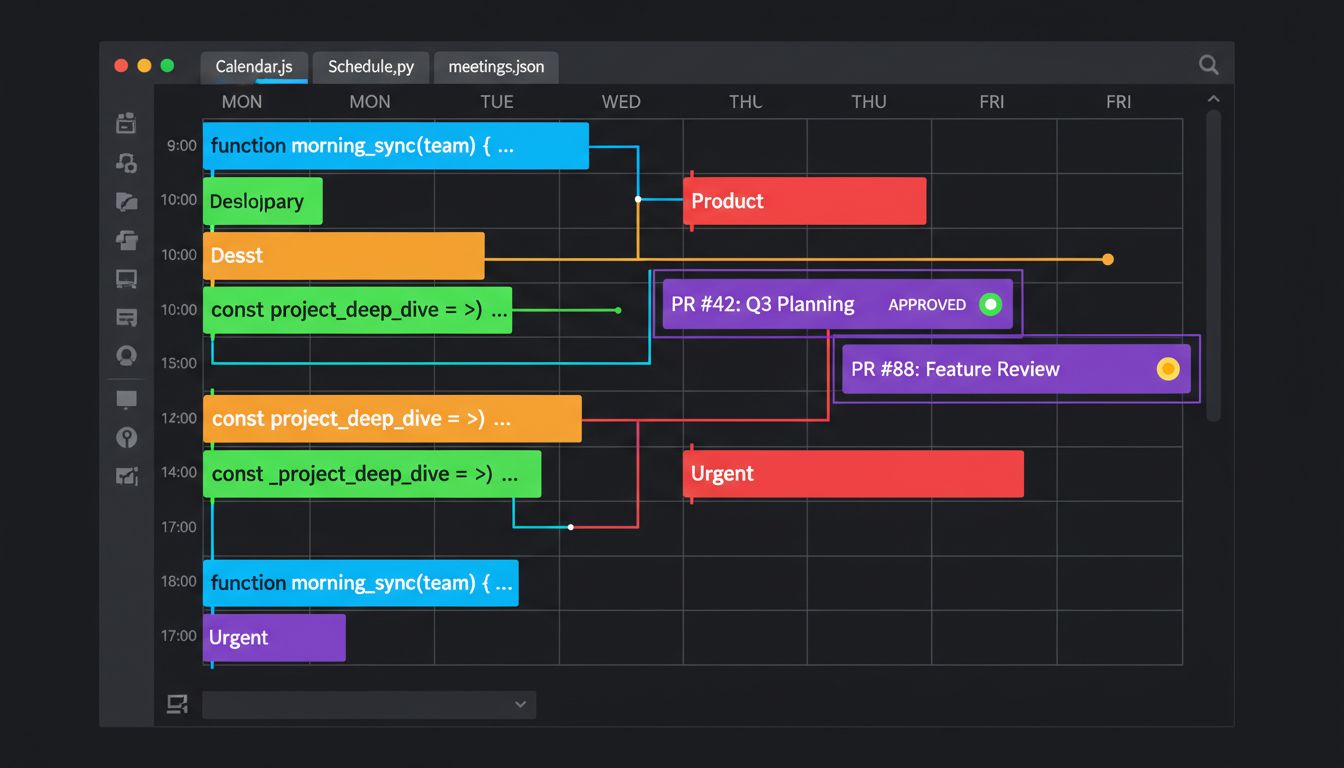
A calendar, at its core, is a sequence of instructions that your future self will execute. Tuesday at 2pm: run the standup subroutine. Thursday morning: context-switch into deep-work mode. Friday at 4pm: do the retrospective loop.
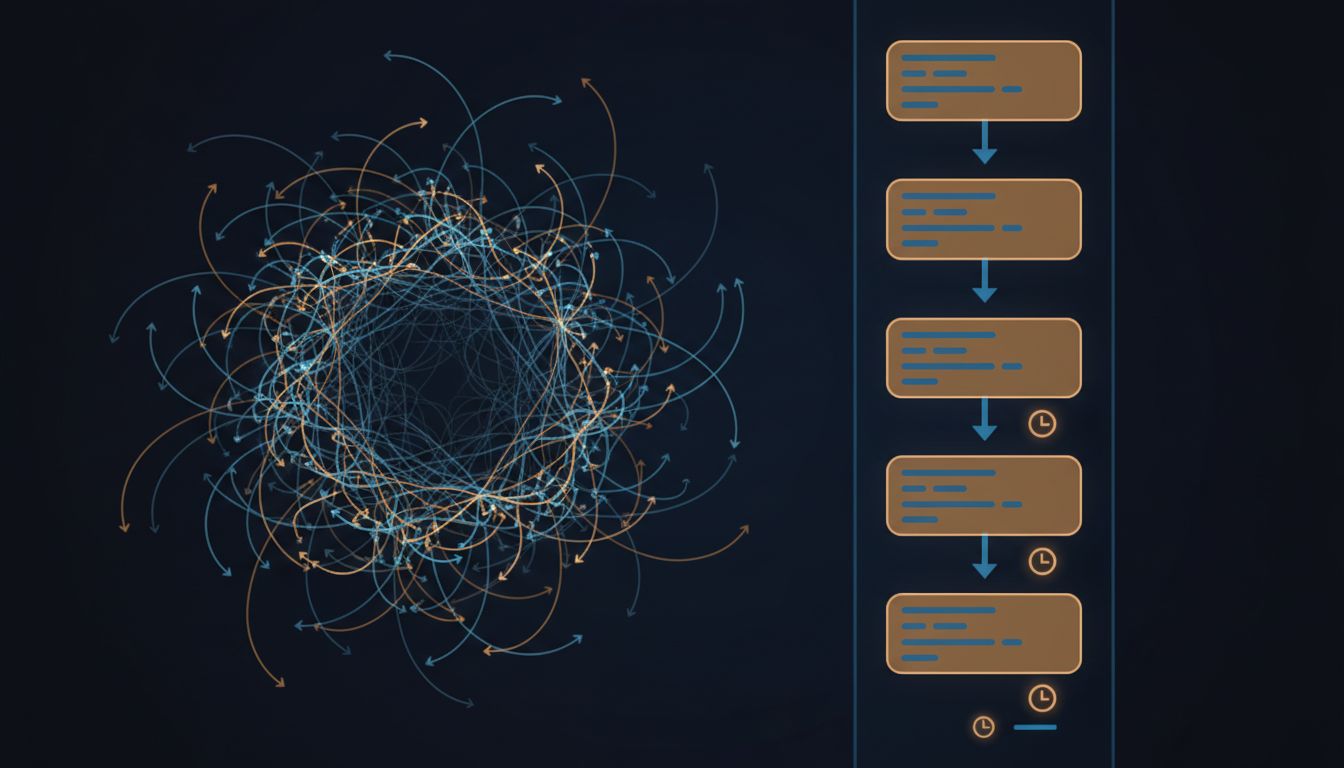
This framing matters because it makes certain problems immediately legible. When your code has no structure, you get spaghetti. When your calendar has no structure, you get the same thing: a tangle of context-switches, interruptions, and half-completed tasks that all depend on each other in ways nobody planned. The calendar equivalent of callback hell is a day that looks like: 9am meeting, 10am heads-down work, 10:30am another meeting, 11am respond to emails, 11:30am yet another meeting. Your cognitive stack keeps overflowing and you’re constantly reloading context that you just paged out.
Good developers recognize that code structure is not bureaucracy. Structure is what lets you move fast without breaking things. The same principle applies to time.
Version Control for Time
One of the most underrated practices in software development is committing small, atomic changes with clear messages, so that the history of a codebase tells a coherent story. When something breaks, you can bisect that history and find exactly where things went wrong.
Productivity researchers who study high performers have found something structurally similar in how they treat time allocation. The weekly review (a practice common across many systems, from GTD to various engineering management frameworks) functions like git log. You’re not just planning forward; you’re inspecting the diff between what you intended and what actually ran.
This sounds simple, but it has real teeth. If you block Friday afternoon for review and planning, you accumulate enough signal to ask: where did my intentions diverge from my execution this week? Was it one big interruption, or a pattern of small ones? Was the code (your plan) bad, or was the runtime environment (your actual week) unpredictable? You can’t debug what you’re not logging.
The people who skip this step are running code in production with no observability. They’re surprised every Sunday night by the shape of the week ahead, even though it’s been sitting in their calendar for days.
Access Controls and the Invitation Problem
In any reasonably secure system, you don’t give every user write access to every resource. You define permissions carefully, because unauthorized writes are one of the most reliable ways to corrupt a system. Your calendar, though, ships with a default configuration that’s closer to chmod 777 than anything you’d want in production.
Most knowledge workers receive meeting invites that, unless actively declined, simply execute. Someone else writes to your calendar, you accept, and suddenly Tuesday morning belongs to them. Multiply this across a dozen colleagues and you’ve handed out write access to the most valuable resource you have.
The engineers and researchers who are genuinely productive at a high level tend to treat incoming invites the way a careful reviewer treats a pull request. What is this for? Is it necessary? Does it belong in the schedule, or could it be resolved asynchronously? Can I propose a shorter time block? Is the stated agenda what will actually happen?
This isn’t about being difficult to work with. It’s about recognizing that an uncritical yes is how calendars turn into other people’s programs that happen to run on your CPU.
Time Blocking as Typed Code
Dynamically typed languages are forgiving. You can put anything into a variable and figure out what it is at runtime. This is convenient until it isn’t, and then debugging becomes archaeology.
A calendar without time blocking is dynamically typed. “I’ll do the deep work somewhere in here” is like writing var x = doSomething(). Maybe it works. Probably it doesn’t, because something else claimed that memory at runtime and you find out too late.
Time blocking is strong typing. You’re making a declaration: this two-hour block is of type DeepWork, and the compiler (your future self, your colleagues, your meeting-booking software) should treat it as already occupied. The type annotation prevents a category of errors at scheduling time rather than at execution time.
Paul Graham’s essay on maker schedules versus manager schedules articulates the underlying problem well: creative and technical work requires long uninterrupted stretches, while coordination work naturally fragments time into smaller chunks. When the two schedules collide without explicit design, the maker schedule loses almost every time, because meetings are visible on the calendar and deep-work intention is not. Time blocking makes the intention as concrete as the meeting.
The trap people fall into is blocking time but not defending it. That’s like writing a type annotation and then immediately casting it away. The block has to be treated as a real commitment, or it isn’t a type, it’s a comment.
Refactoring as a Regular Practice
Even well-written code degrades. Codebases accumulate technical debt: workarounds that made sense at the time, abstractions that no longer fit the problem, dependencies that outlived their usefulness. The response to this isn’t to accept the entropy; it’s to schedule refactoring as a first-class activity.
Calendars accumulate the same kind of debt. A recurring meeting that was useful six months ago might now be redundant, underpowered, or simply attended by the wrong people. A daily habit block that fit your Q1 priorities might be occupying real estate that belongs to a Q3 project. Most people never audit this. They just add new events on top of old infrastructure and wonder why the system feels slow.
High-output researchers, executives, and developers who write about their systems consistently describe something like a quarterly calendar audit. They go through every recurring event and ask whether it still deserves the slot it holds. They delete things. They resize things. They move things to asynchronous formats.
This is refactoring. It’s not glamorous and it doesn’t feel productive in the moment. But a calendar that’s been refactored recently has noticeably less friction than one that hasn’t been touched since it was first set up.
The same instinct that makes a good engineer uncomfortable with unused variables and dead code paths should make you uncomfortable with recurring meetings nobody could justify from first principles.
Dependencies and the Hidden Cost of Context
In software, dependency management is a genuine discipline because dependencies have costs that aren’t obvious at the point of installation. A package that does one small thing can pull in a tree of transitive dependencies that bloat your build, introduce security vulnerabilities, and create upgrade constraints you didn’t anticipate.
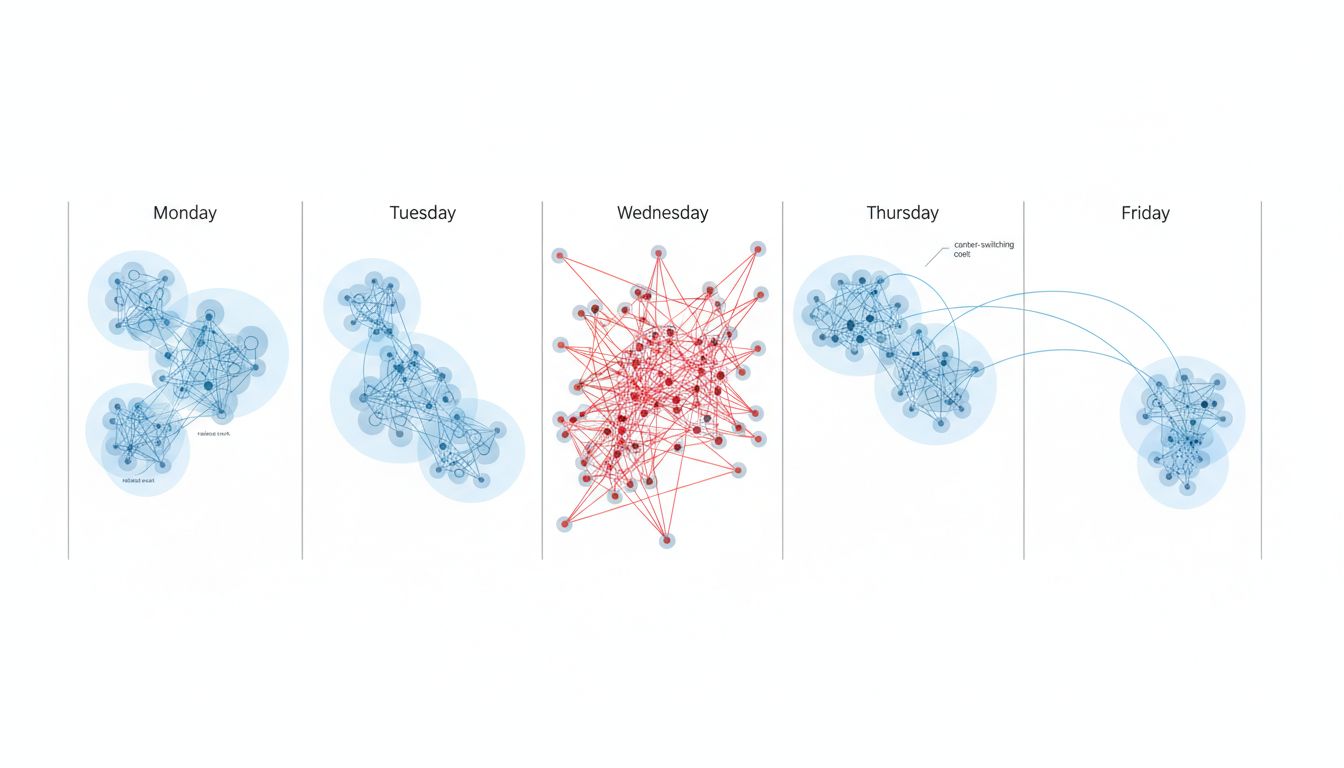
Meetings have dependency graphs too, and most people don’t draw them. A 30-minute status meeting might seem cheap in isolation. But if attending it requires you to exit a deep-work state, spend 10 minutes reloading context, attend the meeting, spend 15 minutes recovering context afterward, and field 3 follow-up Slack messages, the real cost is closer to 90 minutes of effective work time. That’s a transitive dependency cost, and it’s invisible in the calendar view.
This is why the developers and researchers who protect their time most effectively tend to cluster similar work together. Not because it’s more pleasant (though it often is), but because the dependency cost of context-switching compounds across a day in ways that are easy to underestimate and hard to recover from. Keeping mornings free for focused work, for instance, isn’t about morning being magical. It’s about batching your high-dependency cognitive work into a single uninterrupted process so you only pay the startup cost once.
What This Means
The calendar-as-code frame isn’t just a clever analogy. It’s a way of making legible a set of problems that feel vague and motivational when described in productivity-culture terms but become precise and solvable when described in engineering terms.
You have a resource (time) that other processes want to write to. You have tasks that require different execution environments. You have accumulating technical debt in the form of stale recurring events. You have invisible dependency costs from context-switching. You have no observability if you skip the weekly review.
These are real problems with known solution patterns: access controls, strong typing via time blocking, regular refactoring cycles, dependency batching, logging and review. None of this requires exotic willpower or a personality transplant. It requires treating your schedule as a system worth designing rather than a record of things that happened to you.
The counterintuitive thing is that a more structured calendar usually feels less restrictive, not more. Well-factored code is easier to change than spaghetti, even though it has more rules. When your time has clear structure, you know where things go, you can say no to what doesn’t fit, and you can make deliberate changes instead of reactive ones. The structure is what gives you freedom to move.
If you’ve tried productivity systems that worked for a month and then collapsed, this framing might explain why. A system that’s only a list of rules is like a linter without a compiler: it catches some problems but doesn’t change the underlying architecture. The architecture is the calendar itself, and until you treat it as something you actively design and maintain, the rules don’t stick.