

There is a habit that separates the consistently high-performing engineers, designers, and product managers from everyone else, and it has nothing to do with waking up at 5am or using a specific task manager. The most productive people in tech deliberately disrupt their own workflows every 90 days. Not because something is broken. Because something is working too well.
This sounds counterintuitive until you understand what sustained optimization actually does to your brain. When a routine becomes automatic, it stops requiring conscious attention. That’s great for efficiency, but it’s quietly terrible for growth. You stop noticing what you’re doing. You stop questioning whether what you’re doing is still the right thing. And before long, you’re executing a system that was designed for a version of your work that no longer exists. If you’ve ever wondered why some teams seem to deliberately create friction in their own workflows, this is exactly why.

Why 90 Days Is the Sweet Spot
The 90-day cycle isn’t arbitrary. It maps closely to how habits calcify and how most organizational planning works. Research on habit formation suggests that complex behavioral patterns become deeply grooved after about 66 days, which means by the time you hit the three-month mark, your workflow has likely become fully automatic. That automation is both your greatest asset and your biggest blind spot.
Think about how quarterly planning works at most companies. Goals are set, priorities are locked in, and teams execute. But the mistake most people make is treating their personal workflow as permanent infrastructure rather than as a tool that should evolve alongside the work. Your 90-day routine audit is your chance to step back and ask whether your tools, rhythms, and systems still fit the problems you’re actually solving.
This is the same logic that makes paper notebooks 40% more effective for some tech workers than digital apps. It’s not that paper is objectively better. It’s that switching forces you to re-engage consciously with how you’re capturing and processing information, instead of running on autopilot.
The Four-Part Quarterly Reset Framework
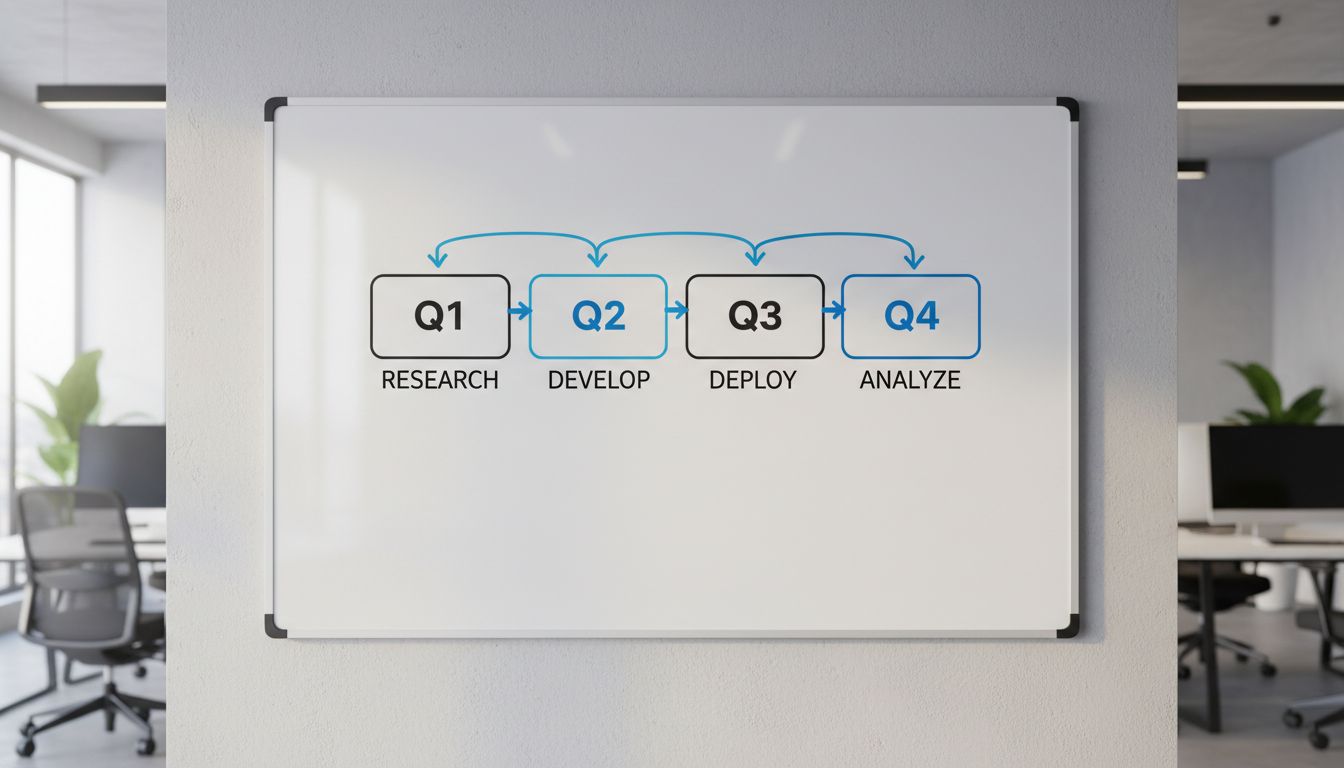
Here’s the practical framework you can apply immediately. It takes about two to three hours once a quarter, and the return on that investment is significant.
Step 1: Audit your tool stack. List every app, platform, and system you use regularly. For each one, ask two questions. First, am I using this because it’s genuinely the best tool for this job, or because I set it up six months ago and never reconsidered? Second, what would I lose if I removed it for 30 days? You’ll often find that two or three tools have quietly become redundant and are now generating noise rather than signal.
Step 2: Review your communication channels. This is usually where the biggest gains hide. Most people accumulate Slack channels, email threads, and group chats the way code accumulates technical debt. They seem useful when they’re created, but they compound into a significant cognitive load over time. Teams that deliberately prune their communication channels consistently report faster decision-making and less end-of-day fatigue.
Step 3: Identify your peak-performance windows and check whether your schedule still honors them. Your calendar three months ago was designed around a different set of priorities. Meetings migrate, deadlines shift, new projects arrive. Most people never realign their deep work blocks to match the new reality. During your quarterly reset, look at the past month of your calendar and identify when your best thinking actually happened. Then rebuild your default week around those windows.
Step 4: Introduce one deliberate constraint. This is the uncomfortable part that most people skip, and it’s the most important one. Pick something you rely on heavily and remove it for two weeks. This might be your project management app, your standing meeting cadence, or your usual approach to planning your day. The goal isn’t to prove you can survive without it. The goal is to surface the assumptions baked into how you currently work.
What You’re Actually Looking For
The point of the quarterly reset isn’t change for its own sake. It’s pattern recognition. When you deliberately step outside a system you’ve been running automatically, you start to see its shape. You notice which constraints are load-bearing and which ones are just habit. You identify the tools that genuinely extend your capabilities versus the ones you’re maintaining out of inertia.
This is exactly the same dynamic that plays out at the product level when companies examine what they’ve built. Top tech executives often apply similar discipline to their own thinking habits, using structured frameworks like the 3-device rule to protect cognitive space from being colonized by reactive work. The quarterly routine audit is your personal version of that same protective instinct.
One concrete signal to watch for: if you can describe your entire workday without pausing to think, your system has become too automatic. Productive workflows should require some active engagement. The moment your day is something that just happens to you, you’ve probably optimized past the point of usefulness.
Building the Habit of Breaking Habits
The meta-skill here is learning to hold your own systems lightly. The best engineers do this naturally with code. They refactor not because the old code is wrong, but because better understanding leads to better architecture. Your personal productivity system deserves the same treatment.
Set a recurring calendar event every 90 days labeled something simple like “workflow review.” Block two hours. Bring a physical notebook if you can (the act of writing by hand slows your thinking down in a useful way). Work through the four steps above without the pressure of fixing everything at once. Your only goal is to see your system clearly and make two or three deliberate changes.
The workers who sustain high performance over years aren’t the ones who found the perfect system. They’re the ones who stayed curious about whether their current system was still the right one. That curiosity, practiced quarterly, is one of the most practical productivity habits you can build.
Start the clock now. When is your next 90-day reset?