Security optimists build walls. Security pessimists build systems that survive when the walls fail. The pessimists win every time.
This is not a philosophical preference. It is an observable pattern across decades of security engineering. The teams that produce genuinely resilient software are the ones who treat a successful breach not as a failure to prevent, but as an event to plan for. The mindset has a name: assume breach. And most development teams still refuse to adopt it, because it feels like admitting defeat before the game starts.
That framing is exactly wrong, and I want to explain why.
Prevention Is a Bet You Will Lose
Every security model built purely around prevention is a single-point-of-failure system. You are betting that every library you import has no unpatched vulnerabilities, that every engineer on your team will make no mistakes, that every third-party service you depend on will never be compromised, and that attackers will never find the one configuration error that slipped through code review.
That is not a security posture. That is optimism with a firewall in front of it.
The Log4Shell vulnerability in late 2021 is instructive here. A single flaw in a logging library that had been in production for years, used by an enormous fraction of Java applications, gave attackers remote code execution on anything that logged untrusted input. Organizations that had built their security entirely around perimeter defense were suddenly exposed because their interior assumed trust. Organizations that had already segmented their networks, applied least-privilege principles internally, and monitored for lateral movement had a much smaller blast radius.
The difference was not better prevention. The difference was a design that expected prevention to fail.
Defense in Depth Is Not Redundancy, It Is a Philosophy
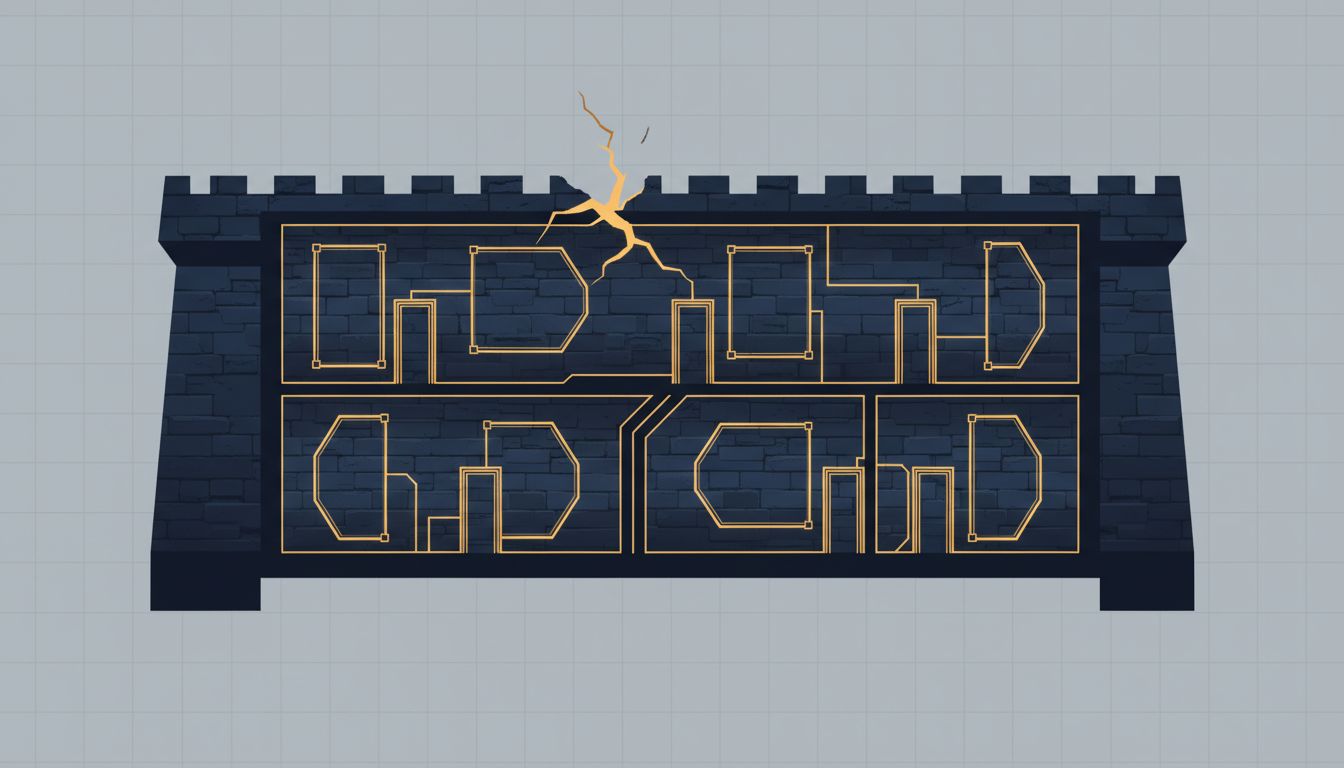
When developers hear “defense in depth,” they sometimes picture concentric walls: a firewall, then a WAF (web application firewall), then another firewall. That is redundancy, not depth. Real defense in depth means that every layer operates under the assumption that all outer layers are already compromised.
Consider how this changes code-level decisions. If you assume the network perimeter holds, you might skip encrypting data at rest because it never leaves your “secure” environment. If you assume the perimeter is already gone, you encrypt everything, store secrets in a dedicated secrets manager rather than environment variables, and you never let a service account have more permissions than it needs for its specific function.
The principle of least privilege, applied rigorously, only makes sense under assume-breach thinking. Why would you restrict an internal microservice’s database access to read-only on a single table if you trusted your network? You do it because when (not if) that service is compromised, you want the attacker to find a walled-off room, not a master key.

This is also why zero-trust architecture has moved from buzzword to genuine engineering standard at organizations that have been through serious incidents. Zero-trust, at its core, is the formal adoption of assume-breach at the network design level. Every request must authenticate and authorize, regardless of where it originates. The interior of your network is treated as hostile by design.
Monitoring Only Matters If You Expect to Find Something
Here is a practical test for whether a development team has internalized assume-breach thinking: look at their logging and alerting infrastructure. Teams that believe prevention is sufficient build minimal logging, because they expect nothing to breach the walls. Teams that assume breach build comprehensive audit trails, anomaly detection, and incident response runbooks, because they know they will need them.
The Equifax breach in 2017 sat undetected for approximately 78 days after initial compromise. The attackers were inside, moving data, and the monitoring infrastructure either was not there or was not being watched. Prevention had failed, but so had the detection layer that should have been the next line of response.
The security teams doing this right have mean time to detect (MTTD) as a metric they actually care about. They run tabletop exercises that start not with “prevent the attack” but with “you’ve been breached, it’s 2am, here’s what you know.” That preparation is only worth doing if you genuinely believe a breach is a matter of when.
The Counterargument
The pushback I hear most often goes like this: if you design assuming you’ll be hacked, you’re implicitly telling your engineers that security doesn’t matter at the prevention layer. You create a culture where people feel less responsible for shipping secure code because, hey, the system handles it.
This is a real concern and worth taking seriously. There is a version of assume-breach thinking that becomes an excuse for lazy input validation and skipped security reviews. I’ve seen it.
But this is a failure of implementation, not philosophy. Assume-breach is not “prevention doesn’t matter.” It is “prevention is necessary but not sufficient.” You still write parameterized queries to prevent SQL injection. You still validate and sanitize inputs. You still use prepared statements and avoid string concatenation in security-sensitive contexts. The difference is that you also design your database access controls as if those defenses have already failed, because some percentage of the time they will.
The two orientations are not in conflict. They operate at different layers. Prevention minimizes the probability of compromise. Assume-breach design minimizes the impact when probability isn’t zero, which it never is.
The Real Cost of Optimism
Software security done well is expensive. It slows down feature development, requires specialized expertise, and produces infrastructure that most users will never see or appreciate. This creates constant pressure to cut corners, and the corners that get cut first are usually the ones that only matter after a breach: the monitoring, the segmentation, the incident response planning, the internal access controls.
Those cuts feel safe because prevention has not visibly failed yet. The assume-breach mindset makes those cuts feel exactly as dangerous as they are, because it forces you to ask not “has this been exploited” but “what happens when it is.”
Teams that ask that question consistently, and design to the answer, build software that survives the real world. The real world is one where attackers are patient, supply chains are compromised, and every non-trivial system has surface area that someone will eventually find. Building for that world is not pessimism. It is engineering.