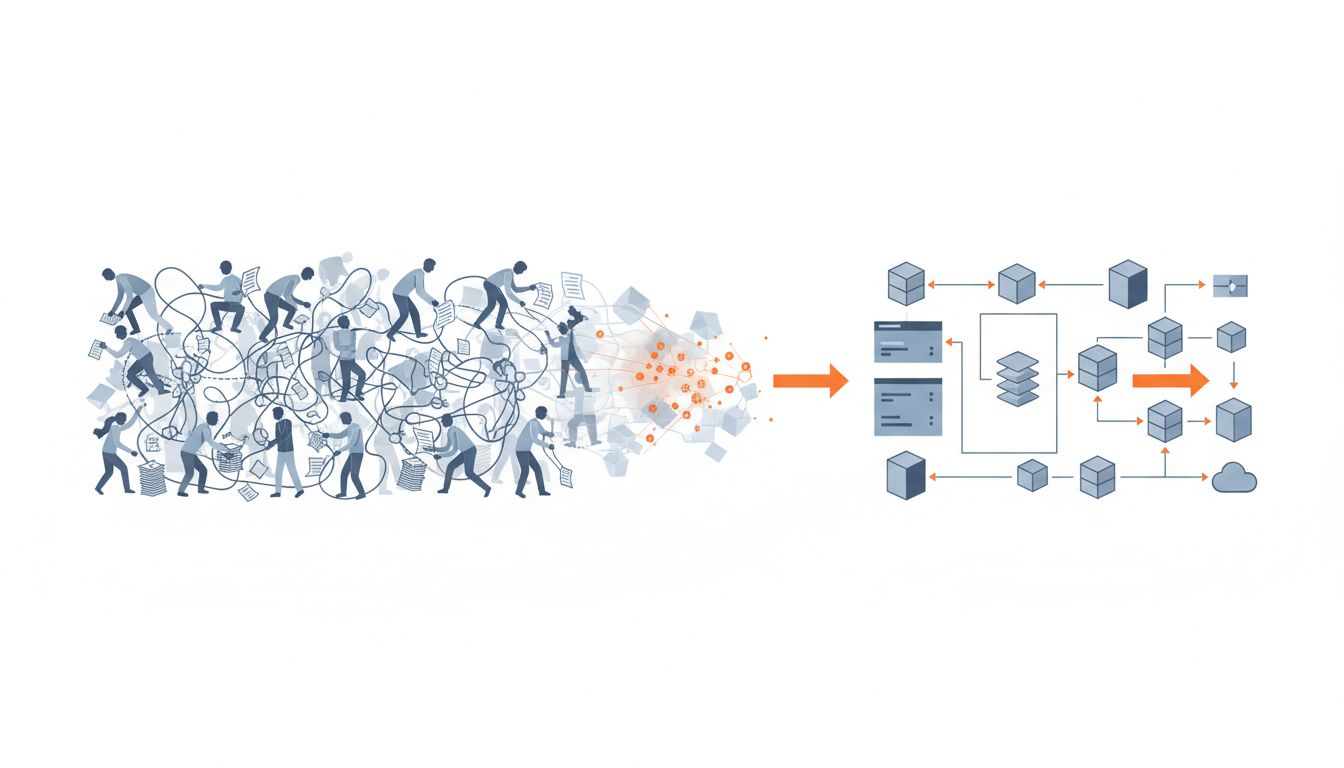

The simple version: Companies that grow slowly at first tend to scale faster later because they figured out what they were actually building before they hired an army to build it wrong.
That’s the whole thing. Everything below is just unpacking why this keeps being true, and why the startup world keeps ignoring it.
The Pressure to Hire Is Almost Always Premature
Picture a seed-stage founder in 2019. They’ve closed a $2M round, they have 200 paying customers, and their investors are asking when they’re going to “build out the team.” So they hire a head of sales, two engineers, a marketing manager, and an office manager for an office they didn’t need. Twelve months later, half those people are doing work that doesn’t map to what the product actually needs, and the founder is spending 40% of their time managing instead of learning.
This scenario plays out constantly. The pressure to staff up comes from multiple directions at once: investors who equate headcount with progress, founders who feel like they’re “doing it wrong” by staying lean, and a hiring market that signals seriousness through org charts. None of those pressures have anything to do with whether the company is ready to scale.
The companies that resist this pressure, genuinely resist it rather than paying it lip service, tend to enter their growth phase with something most scaling companies lack: a clear understanding of what drives retention, what the actual sales motion is, and which parts of their product people care about. You can’t buy that clarity with a Series A.
What Small Forces You to Learn
When a company has five people and 300 customers, every customer problem lands directly on someone who has the context to understand it. The founder takes support calls. The engineer who built the feature hears the complaint. The person writing the marketing copy has actually watched people use the product.
This is not romantic. It’s exhausting. But it generates something that scales terribly: signal.
Once you hire a support team, the signal gets filtered. The patterns that should reshape your product roadmap get summarized in a weekly ticket report. The nuance that would have told you your onboarding flow has a fatal flaw three steps in gets averaged out across hundreds of tickets. Small companies are inefficient at handling customer problems, and that inefficiency is exactly what makes them good at learning from them.
Stripe kept its founding team tiny for years while building the developer experience that became its core competitive moat. The obsessive attention to API design and documentation that still defines Stripe’s reputation came from a small team that was close enough to the problem to care about details that a larger org would have rationalized away. When Stripe did scale, they were scaling something that worked, not iterating on something that almost worked.

Premature Scaling Creates Technical Debt You Can’t See
Software engineers have a term for code that works but will eventually cause serious problems: technical debt. Scaling organizations too early creates the same thing, except it’s organizational debt, and it’s much harder to refactor.
Here’s how it happens. A company hires a VP of Sales before they have a repeatable sales process. That VP, reasonably, builds a process. But the process is built on whatever deals happened to close in months one through six, which may not represent the actual customer base the company should be going after. Now you have a sales motion, a team trained on it, a CRM configured for it, and a comp structure that rewards it. Changing course later requires dismantling all of that, and people whose livelihoods depend on the existing structure will resist.
The same thing happens in product, marketing, and operations. Every hire who joins before you understand the problem becomes a partial owner of the wrong solution. Staying small keeps your options open in a way that’s genuinely undervalued.
The Metric That Actually Matters Early
Most early-stage metrics are proxies for things that feel important but aren’t. Revenue is real. Customer count is real. But neither of those tells you whether you’ve figured out the thing that will let you grow repeatably.
The metric that matters is something closer to: can we acquire a customer, make them successful, and have them stay? Not occasionally. Consistently. With the same basic motion, regardless of who on the team executes it.
Companies that crack this at small scale and then grow are building on bedrock. Companies that grow without cracking it are building on sand, and they usually know it somewhere in the back of their minds, which is why their internal culture tends to feel anxious in ways that have nothing to do with the market.
HubSpot is a reasonable example here. They spent years in the mid-market before making any serious push upmarket or downmarket. The category they called “inbound marketing” was refined at a specific customer size before the company tried to be something to everyone. By the time they scaled aggressively, the playbook was documented and transferable.
Staying Small Is a Decision, Not a Default
The founders who do this well are not the ones who couldn’t raise money or couldn’t find talent. They’re the ones who made a deliberate choice to stay close to the problem longer than their peers thought was reasonable.
That choice is harder than it sounds. It means telling a candidate you’re not ready to hire them yet. It means pushing back on an investor who wants to see headcount grow. It means accepting that you’ll look less impressive on paper for longer, while competitors are announcing team milestones and office expansions.
But the companies that come out of that period with genuine product-market fit, real retention numbers, and a sales motion they can explain to anyone, those companies scale differently than the ones that hired their way to scale. They’re not figuring out the fundamentals while managing 60 people. They already figured them out.
The irony is that the startup world celebrates scale as the goal, when scale is just the result. Get the fundamentals right in a small container first, and scale follows almost mechanically. Get them wrong, and no amount of growth capital fixes it.
The fastest-scaling companies aren’t the ones that grew the fastest from day one. They’re the ones that earned the right to grow.