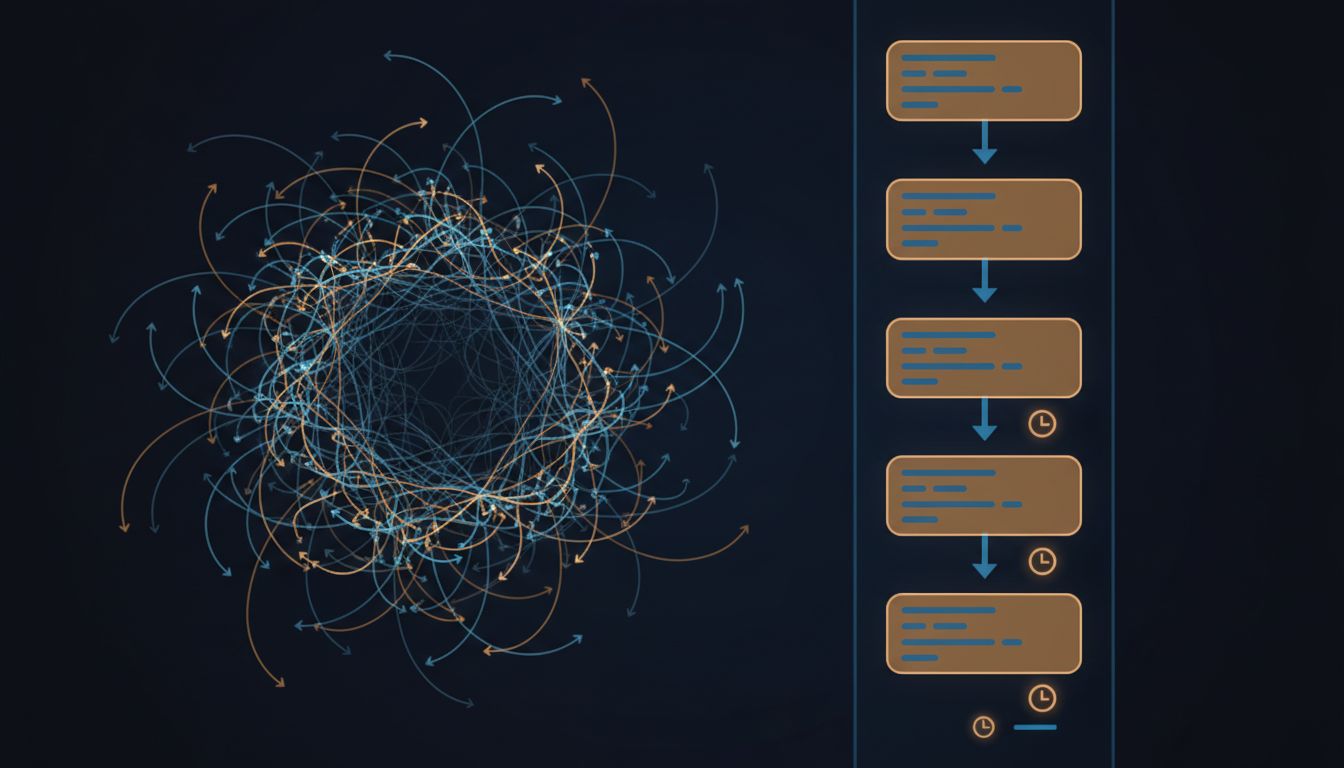
There’s a concept in systems programming called priority inversion, where a low-priority process accidentally holds a resource that a high-priority process needs, so the important work sits blocked while unimportant work runs. Your task list does this to you every day, and unlike the operating system, you don’t have a watchdog timer to catch it.
The tasks you defer longest are almost never the ones that take the most time. They’re the ones that carry the most consequence. That distinction matters, because every productivity framework I’ve encountered optimizes for the wrong variable.
1. Avoidance Is Not Random, It’s a Signal
When you skip a task for the third day in a row, your brain is telling you something specific. Usually one of three things: the task is genuinely ambiguous (you don’t know what “done” looks like), it requires a conversation you’re not ready to have, or the outcome matters enough that failure would sting.
None of those are laziness. They’re information. The mistake is treating the avoidance as a discipline problem and responding with more scheduling pressure, stricter time blocks, louder reminders. That’s the equivalent of adding more logging to a system that has a fundamental design flaw. You’ll get more output from the symptom without touching the cause.
The more useful question is: what specifically makes this task feel sticky? Answering that takes about two minutes and usually makes the task shrink considerably.
2. Completion Rate Is a Vanity Metric
Most task management systems are built around a single feedback loop: add task, complete task, feel good, repeat. The dopamine hit of checking something off is real, and software designers know it. The problem is that this loop selects for completable tasks, not important ones.
If your system makes it equally easy to add “reply to that email” and “decide whether to keep the infrastructure contract,” you will clear the email seventeen times before you touch the contract once. Your to-do list is optimized for adding tasks, not finishing them, and that structural bias compounds over weeks into a backlog where everything urgent is done and everything important is perpetually deferred.
The fix isn’t a new app. It’s accepting that completion rate is only meaningful if the completed tasks were the right ones. A day where you finished eight small things and avoided the one that actually mattered was not a productive day.

3. Important Tasks Are Structurally Different From Urgent Ones
Urgent tasks have a deadline that exists in the world. Someone is waiting. A system will break. A contract expires. The deadline is external and legible.
Important tasks usually have a deadline that only exists in your head, or worse, no deadline at all. “Figure out the architecture before we scale” has no calendar entry. “Have the conversation with the contractor about scope creep” has no ticket number. These tasks don’t page you at 2am. They just slowly become more expensive the longer you ignore them.
This is why Eisenhower-style urgent/important matrices, while conceptually correct, don’t actually change behavior for most people. You already know the important-but-not-urgent quadrant matters most. Knowing that doesn’t make the urgent tasks less loud. What helps is giving important tasks artificial urgency, not by adding fake deadlines, but by making the cost of delay visible. “Every week I don’t address the data model, we add roughly two days of migration work later” is a real number you can estimate. Make it concrete and it starts competing with urgent tasks on honest terms.
4. Starting Is a Different Skill Than Finishing
For high-stakes tasks, the block is almost always at the entry point, not in the middle. Once you’re genuinely working on the hard thing, it tends to pull you forward. The resistance is the first five minutes.
This is not a motivational observation. It’s a practical one. If you treat “work on architecture decision” as a task, you will skip it. If you treat “open a blank doc and write one sentence about what we’re deciding” as the task, you will probably do it, and then keep going. The first version asks you to be productive. The second version asks you to just exist in the vicinity of the problem.
Programmers sometimes call this the “blank file problem,” the paralyzing moment before any code exists. The solution isn’t to feel more motivated. It’s to lower the activation energy of the first action until it’s trivially small. A function stub. A comment block. Anything that means the file is no longer blank.
5. Delegation Is Not the Same as Avoidance, But They Feel Identical
Some tasks belong on someone else’s list. Genuinely. And some tasks are on your list because you’re the right person and you know it, but handing them off would feel like progress without requiring you to do the hard thing.
The tell is discomfort after delegating. If you feel relief, the delegation was probably appropriate. If you feel a lingering unease, like something is still unresolved, you probably handed off the work without handing off the decision, which is not delegation, it’s deferral with extra steps. The other person will come back to you with questions, or worse, make a call you won’t like, and then you’ll own the cleanup.
Actual delegation requires you to do real work upfront: clarifying the outcome, defining the constraints, and accepting that you’re genuinely not the one making the final call. That work is often harder than just doing the task yourself, which is why the important task that got “delegated” three weeks ago is still sitting unresolved.
6. The Pattern Compounds
One deferred important task is a nuisance. A habit of deferring important tasks is a career and organization-level problem. Teams develop institutional versions of this: the codebase that everyone knows needs refactoring, the product decision that keeps getting punted to the next planning cycle, the team structure conversation that nobody wants to initiate.
These aren’t avoided because people are incompetent. They’re avoided because the cost of avoidance is diffuse and future-dated, while the cost of engaging is immediate and personal. Every individual is making a locally rational choice, and the aggregate is dysfunction. Why your most important work keeps getting scheduled last is partly a personal discipline question, but mostly a structural one about how you’ve designed your environment and your team’s defaults.
The task you keep skipping probably isn’t that hard. It’s just load-bearing in a way that makes failure feel expensive. That’s not a reason to avoid it. That’s the reason it’s worth doing first.