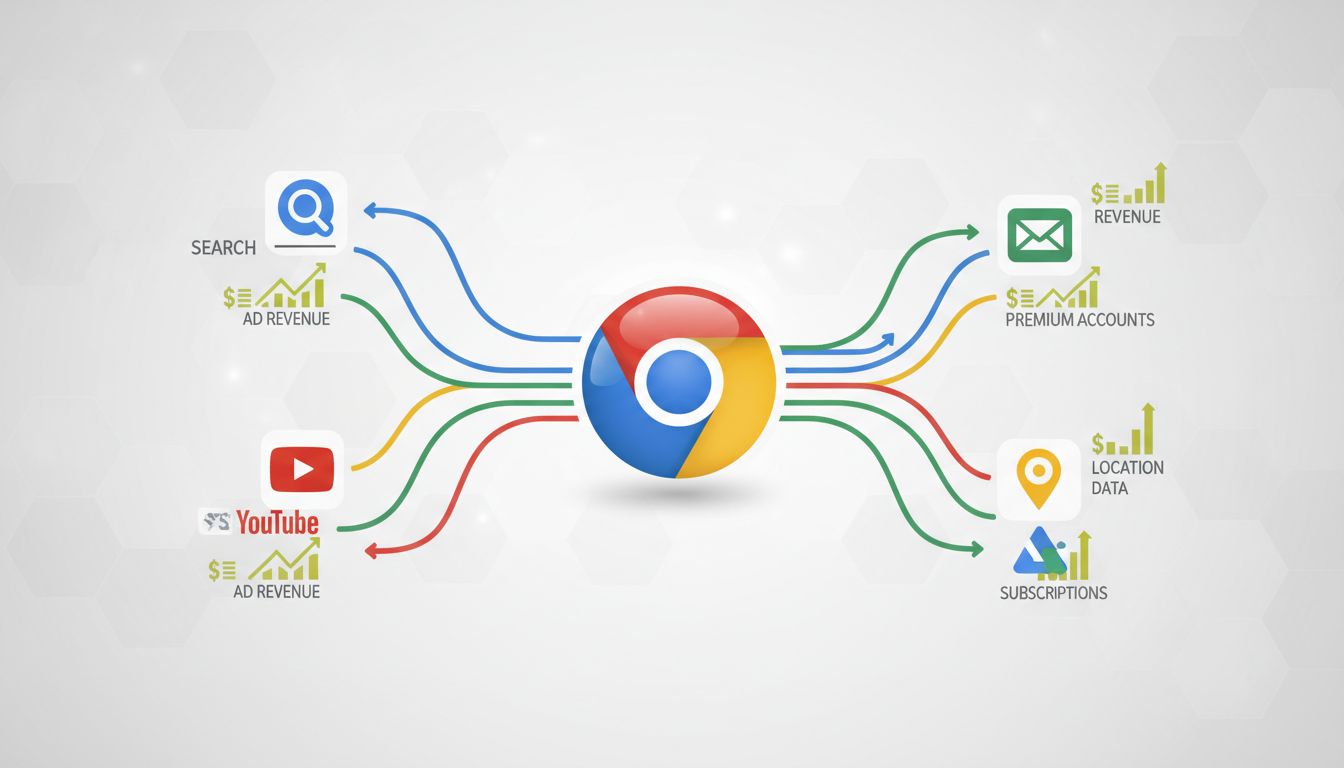

Google gives away Chrome, which costs them hundreds of millions annually to develop. Microsoft hands out VS Code for free, despite it being one of the most sophisticated development environments ever built. Meta open-sourced React, essentially gifting competitors the same tools they use internally. If you think this is corporate altruism, you’re missing the biggest business strategy in Silicon Valley.
The “free software” phenomenon isn’t new, but its strategic sophistication has reached levels that would make Sun Tzu jealous. Just like the brutal reality facing AI startups, the software industry operates on winner-take-all dynamics where giving away your core product can be the fastest path to market domination.
The Platform Play: Building Your Digital Kingdom
The most obvious strategy behind free software is platform creation. When Google launched Chrome in 2008, Internet Explorer held 60% market share. Today, Chrome commands over 65% globally. This wasn’t an accident.
Chrome isn’t just a browser—it’s a data collection engine wrapped in a user interface. Every search, every website visit, every form you fill out feeds Google’s advertising machine. The browser that “costs” Google $1 billion annually generates an estimated $50+ billion in advertising revenue by ensuring users stay within Google’s ecosystem.
Microsoft perfected this playbook decades earlier with Internet Explorer, bundling it with Windows to crush Netscape. The difference now is that platform strategies have become far more sophisticated and global in scope.
The Ecosystem Lock-In Strategy
Consider Visual Studio Code, Microsoft’s free code editor that has captured over 70% of the developer market since 2015. VS Code isn’t just free—it’s genuinely excellent, often outperforming paid alternatives.
But here’s the strategic genius: VS Code subtly guides developers toward Microsoft’s cloud services. The integrated terminal defaults to PowerShell on Windows. Extensions for Azure deployment are prominently featured. GitHub integration (Microsoft owns GitHub) is seamless. IntelliSense works best with TypeScript (also Microsoft-created).
Microsoft doesn’t make money from VS Code directly. They make money when developers, comfortable in the Microsoft ecosystem, choose Azure over AWS for their next project. A single enterprise Azure contract can exceed $10 million annually. Suddenly, that “free” text editor looks like the best marketing spend in tech history.
The Commodity Strategy: Making Your Competition’s Advantage Worthless
Sometimes companies give away software to deliberately destroy entire markets. This is exactly what Meta did with React.
Before React, building sophisticated user interfaces required either expensive proprietary frameworks or significant in-house development. Smaller companies couldn’t compete with tech giants who had the resources to build custom UI frameworks.
By open-sourcing React, Meta eliminated this competitive advantage industry-wide. Now everyone has access to the same high-quality UI framework. The playing field leveled, but in a way that benefits Meta—they’re no longer competing on UI framework quality but on other factors like data network effects and advertising reach.
This strategy extends far beyond individual companies. Much like how tech giants continue using programming languages from the 1970s, there’s strategic value in commoditizing the foundational tools while competing on higher-level differentiators.
The Data and Network Effects Play
Free software often serves as a massive data collection operation. Android, Google’s mobile operating system, is “free” to device manufacturers. In reality, it’s the most successful data harvesting operation in human history.
Android runs on over 70% of smartphones globally, feeding Google information about user location, app usage, communication patterns, and behavior. This data powers Google’s $280 billion advertising business. The “free” operating system generates more revenue than most Fortune 500 companies’ entire operations.
The network effects are equally powerful. The more people use Android, the more valuable it becomes to app developers, phone manufacturers, and accessory makers. This creates a self-reinforcing cycle that’s nearly impossible for competitors to break.
The Developer Mindshare Strategy
Perhaps the most subtle strategy involves capturing developer mindshare early. Companies give away development tools, libraries, and frameworks to ensure the next generation of programmers thinks in their ecosystem.
Amazon Web Services offers generous free tiers specifically targeting students and small projects. The calculation is simple: a developer who learns cloud computing on AWS will likely advocate for AWS when they’re making enterprise decisions years later.
This mirrors traditional business strategies in other industries, but with a crucial difference: software has near-zero marginal distribution costs. Once you build VS Code, giving it to one million developers costs roughly the same as giving it to one developer.
The Mathematics of “Free”
The economics work because software exhibits extreme economies of scale. Developing Chrome costs Google approximately $1 billion annually. But serving it to an additional 100 million users costs virtually nothing. Each new user potentially generates $20-30 annually in advertising revenue.
This creates a mathematical inevitability: if your “free” software can generate more than a few dollars per user annually through indirect means, you can outspend any competitor trying to charge directly for similar software.
The strategy has become so dominant that charging for basic software tools increasingly signals either extreme specialization or strategic myopia. Even traditionally paid software categories like design tools (Figma’s free tier) and project management (Slack’s freemium model) have adopted these patterns.
The Winner-Take-All Endgame
Free software strategies work because they accelerate winner-take-all dynamics. In markets with network effects and high switching costs, the company that achieves dominant market share first often maintains it indefinitely.
This explains why venture capitalists fund companies that give away software for years without obvious monetization. They’re betting that market dominance, once achieved, provides numerous paths to monetization. History suggests they’re often right.
The next time you download free software, remember: you’re not the customer, but you’re definitely part of the product. The question isn’t why tech companies give away software for free—it’s why anyone still expects software to cost money at all.