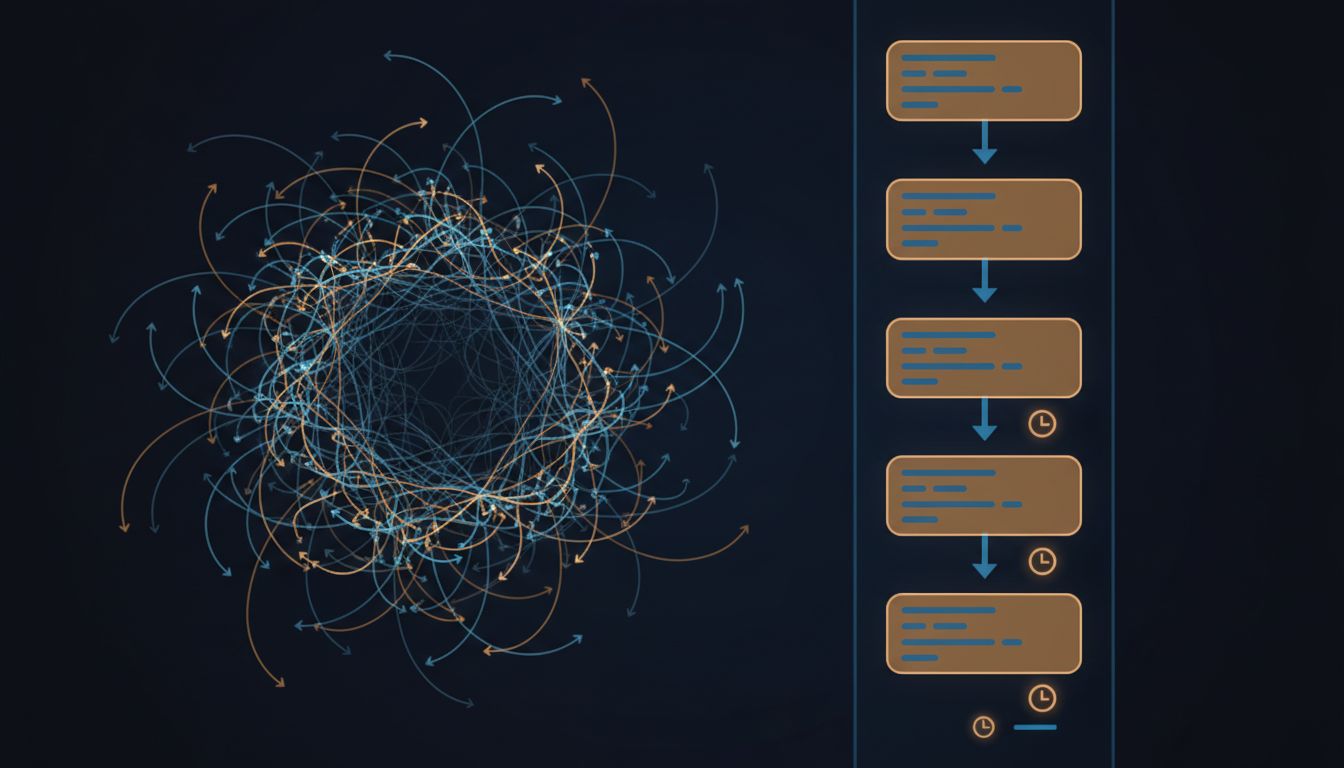
You’ve been told your whole career that procrastination is the enemy of productivity. Block it, fight it, shame yourself out of it. But here’s what the research and the habits of genuinely high-output people actually show: the best creative thinkers don’t eliminate procrastination. They weaponize it. Strategic procrastination is the practice of deliberately delaying certain types of work so your brain can do its best processing in the background, then returning to that work at the right moment with dramatically better output. Done well, it can unlock a level of creative performance that brute-force hustle simply cannot match.
This connects to something worth understanding about how top performers structure their cognitive environment. As we explored in Top Performers Use Something Called the ‘Context Switch Tax’ to Structure Their Entire Workday, the best producers aren’t working more hours, they’re protecting the quality of their mental state during the hours they do work.
What Strategic Procrastination Actually Is (and Isn’t)
Let’s be clear about what we’re not talking about. Doom-scrolling instead of writing your proposal is not strategic procrastination. Neither is avoiding a difficult conversation until it becomes a crisis. Regular procrastination is avoidance driven by anxiety or distraction. Strategic procrastination is intentional, time-boxed, and aimed at a specific cognitive goal.
The concept has roots in research by psychologist Adam Grant, who found that people who delayed starting creative tasks produced ideas rated significantly more original than those who started immediately or waited until the deadline. The sweet spot, it turns out, is the middle. You load the problem into your brain, step away from it deliberately, and let your default mode network (the part of your brain active when you’re not consciously focused) do the heavy lifting.
Practically, this means you start a project just enough to load the context, then intentionally set it aside for a defined period before returning to execute.
The Three-Phase Framework
Here’s the system high performers actually use. It has three distinct phases, and skipping any one of them collapses the whole thing.
Phase 1: The Load
Spend 15 to 30 minutes actively engaging with the problem you need to solve. Read the brief. Write a rough outline. Sketch three possible directions. The goal isn’t to produce anything usable. The goal is to prime your subconscious with the right questions. Think of it like starting a download before you go to sleep. The file transfers while you’re doing other things.
Phase 2: The Drift
This is the procrastination part, but it has rules. You’re not checking notifications or watching videos. You’re doing low-cognitive work: a walk, a shower, cooking, light exercise, organizing your physical space. These activities keep your conscious mind occupied just enough to stop it from forcing solutions, while your background processing continues. Most people report their best ideas arriving during exactly these kinds of activities. That’s not a coincidence.
The duration matters. For most creative problems, a drift window of two to four hours produces the best results. Overnight works particularly well for strategic or structural challenges, which is why the advice to “sleep on it” has survived as long as it has.
Phase 3: The Execute
You return to the work with a time constraint. Set a timer for 90 minutes and go. The combination of background processing plus deadline pressure tends to produce output that feels qualitatively different from what you’d have produced by sitting down and grinding through it from the start. Writers report drafts that feel more alive. Designers report solutions that feel more elegant. Developers report architectures that feel more coherent.
Why Your Brain Needs Permission to Wander
One reason this feels counterintuitive is that most productivity culture is built around the idea of continuous, visible effort. If you’re not typing, you’re not working. If you’re not in meetings, you’re not contributing. This is a particularly acute problem in environments built around real-time collaboration, where the pressure to be always-on actively undermines deep creative work. (It’s worth reading about how the most productive teams stopped using real-time collaboration tools and what their output looked like afterward.)
The science here is solid. Your brain’s default mode network is not idle when you’re not focused. It’s integrating information, making unexpected connections, and running simulations. When you force constant conscious effort, you actually suppress this process. Strategic procrastination is essentially a way of protecting time for your brain to do work that your conscious mind is not capable of doing.
This is also why digital minimalists often outperform heavy tool users on creative tasks. As explored in Digital Minimalists Outperform Power Users in Creative Work, when you reduce the cognitive noise in your environment, your background processing becomes cleaner and more effective.
How to Build This Into Your Actual Workday
Theory is only useful if you can implement it on a Tuesday afternoon. Here’s how to make this practical.
First, identify two or three tasks each week that are genuinely creative or strategic. These are the candidates for strategic procrastination. Execution tasks, things where you already know exactly what to do, don’t benefit from the same approach.
Second, schedule your Load sessions for early morning or just after lunch. These are moments when you have enough energy to prime the problem but can then hand off to a different part of your day. Do your Drift phase during your natural energy trough (for most people, mid-afternoon). Then schedule your Execute sessions for the following morning when your pre-frontal cortex is freshest.
Third, protect your Drift phase from your phone. This is non-negotiable. The moment you introduce a social feed or a notification stream, you interrupt the background processing. Your brain’s attentional resources get pulled toward novelty, and the incubation stops. A walk without your phone for 45 minutes is worth more than two hours of half-distracted rest.
The Counterintuitive Payoff
Here’s what surprises most people when they first try this systematically. You don’t just get better ideas. You get faster execution. Because you’ve already done the hard connective work in the background, when you sit down to produce, the resistance is dramatically lower. Writers describe the experience as “the draft was already there.” Designers talk about knowing immediately which direction to take.
The 300% improvement in creative output that researchers and practitioners point to isn’t about working three times as many hours. It’s about producing three times the quality in the same time, because you stopped fighting the way your brain actually works and started working with it instead.
Procrastination has a bad reputation. But like most things that get oversimplified, the reality is more interesting. The question isn’t whether to delay, it’s whether your delay is strategic or accidental. Make it intentional, give it structure, and it stops being a productivity failure and starts being one of the most powerful tools in your creative workflow.