
There is a counterintuitive pattern that shows up repeatedly among the most effective people in tech: they spend less time online than their peers, and they do it on purpose. Not because they are burned out, not because their therapist told them to, but because they have diagnosed the actual bottleneck in their productivity system and traced it back to a resource that does not show up in any sprint velocity metric. That resource is cognitive bandwidth, and it turns out you can run out of it the same way you can run out of memory on a heap that never gets garbage collected.
This connects directly to something we have explored before on this site: digital minimalists consistently outperform power users, and the mechanism is not discipline or willpower. It is architectural. Your brain allocates attentional resources the same way an operating system allocates processing threads, and chronic connectivity keeps too many of those threads in a perpetually pending state, never resolving, never releasing their locks.
What a Digital Sabbath Actually Is (and Is Not)
The term comes from a religious tradition, but the implementation used by high-performing engineers, founders, and researchers has nothing to do with theology. Think of it instead as a scheduled system flush. One contiguous block of time, typically 24 hours but sometimes as short as a half-day, where no work-related digital tools are touched. No Slack, no email, no GitHub, no news aggregators, no doom-scrolling.
The critical distinction is that this is not a vacation and it is not a detox. A vacation involves context-switching to a different kind of stimulation. A digital sabbath is closer to letting a database run its maintenance jobs: compaction, index rebuilding, consistency checks. The system is not doing nothing. It is doing the work that it cannot do while handling live traffic.
Cal Newport, who has written extensively about deep work, describes something similar using the metaphor of cognitive residue. Every task you switch away from leaves a residue of unresolved attention on it. By the end of a typical workweek, most knowledge workers are carrying the residue of dozens of half-finished threads. The sabbath does not just rest the brain. It clears the queue.
The Technical Analogy That Actually Explains It
Here is a way to think about it if you are more comfortable in code than in productivity self-help.
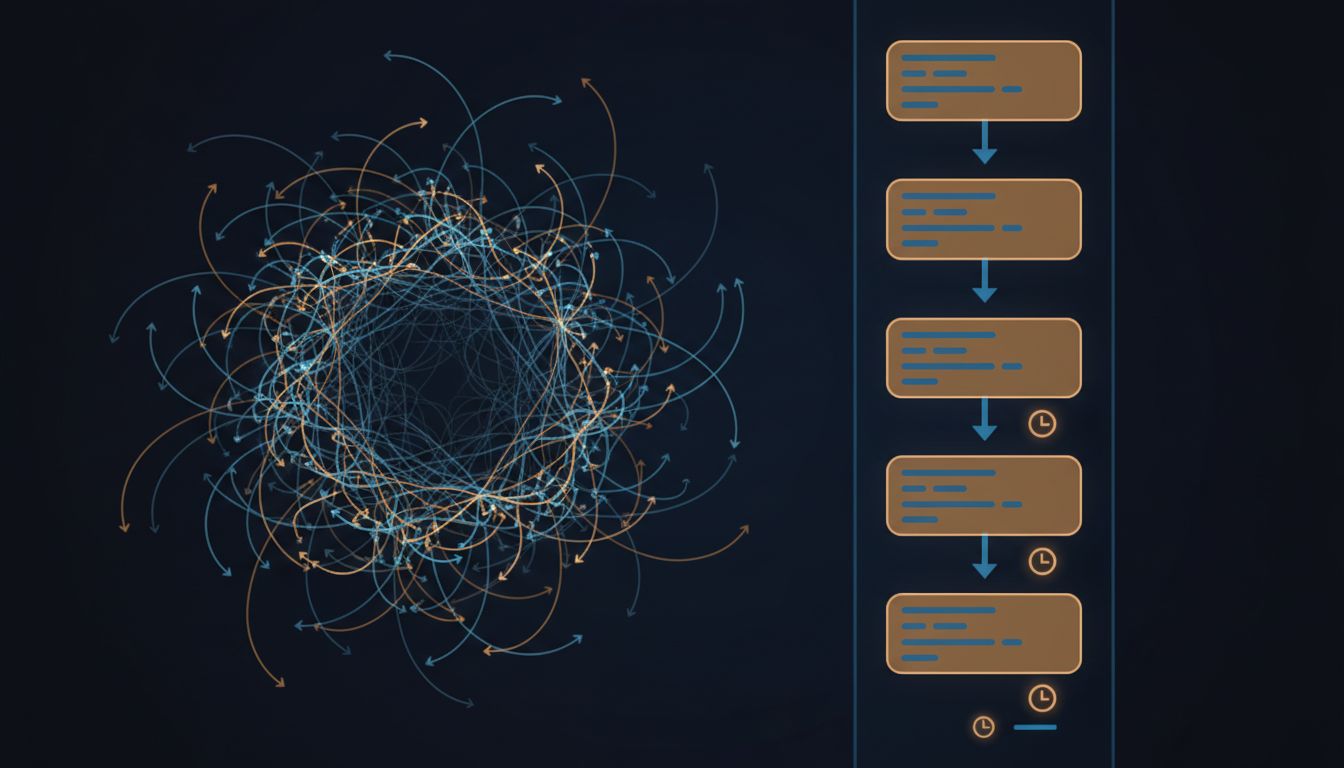
Imagine your prefrontal cortex as a single-threaded event loop (similar to how JavaScript’s runtime works). It processes one thing at a time, but it maintains a task queue. Every notification, every partially-read article, every unresolved conversation thread is an entry in that queue. The queue does not get processed during sleep the way you might hope. Sleep handles memory consolidation, not task resolution. You wake up with the same queue you had when you crashed.
A digital sabbath is what happens when you stop pushing new items onto the queue long enough for the event loop to actually drain it. The tasks do not disappear, but the system gets to reach a point of genuine quiescence rather than just low-load.
This is also why people who try to “rest” by switching from work Twitter to personal Instagram never actually feel rested. The queue keeps filling. The event loop never drains. You are just changing the source of the input, not reducing the throughput.
How Top Performers Actually Implement It
The implementation details matter more than the concept. Here is what the pattern tends to look like in practice among people who report it actually working.
First, they are precise about the start and end time. Ambiguity is an enemy here because a vague boundary means your brain keeps one foot in the digital world, checking whether it is time yet, wondering if something important is happening. A hard commit, the same way you would set a cron job to run at a specific time, removes that overhead.
Second, they front-load preparation. Before the sabbath window, they do a deliberate brain dump: write down anything that feels unresolved, set auto-replies, and do a final pass through communication channels. This is analogous to writing pending state to disk before a graceful shutdown. You are not losing context, you are persisting it to a medium that does not require active maintenance.
Third, and this is the part most people skip, they actually do something generative with the offline time. Not passive consumption, but something that uses different cognitive circuits: cooking something complicated, a long walk with no destination, a physical creative project. This is not idle time. It is cross-training for the brain, activating default mode network processing that correlates with insight and creative problem-solving.
Notably, this maps to a pattern we see in how the best-performing engineering teams structure their work cycles. Elite software teams use specific cognitive science techniques to ship faster, and a common thread is deliberate spacing of intense work with genuine recovery, not just lower-intensity work.
The Paradox of Doing Less to Accomplish More
The reason this feels counterintuitive to most people in tech is that our industry has a strong prior toward maximalism. More data, more features, more iteration cycles. But there is a growing body of evidence, both from cognitive science and from the practices of high-output individuals, that this prior is wrong when applied to human attention.
Consider the irony: the same companies engineering the platforms we feel compelled to check constantly are deliberately using century-old psychology to make their apps feel effortless and sticky. The variable reward schedules, the infinite scroll, the notification cadence, all of it is optimized for engagement, not for your output. Knowing this is an important part of why the digital sabbath is not just a wellness practice but a strategic choice.
It is also worth noting that the most productive tech workers do not just take sabbaths; they also periodically break their routines on purpose every 90 days. The digital sabbath fits into a broader philosophy of deliberate disruption of habitual patterns, which prevents the kind of autopilot behavior that looks like productivity but is really just comfortable inertia.
Starting Your Own Implementation
If you want to try this, start smaller than you think you need to. Do not commit to a full 24-hour blackout on your first attempt. Run a half-day experiment first, a Sunday morning from when you wake up until 1pm, with a hard boundary and a prepared context dump from the night before.
Track what happens on Monday. Not with an elaborate journaling system, but with one simple question: does Monday morning feel different? Most people who run this experiment report that the first two or three hours of their next online day have a quality of focus that they had not experienced in years. That is the cleared queue feeling. That is what you are optimizing for.
The goal of a digital sabbath is not to spend less time online. It is to make every hour you do spend online count for more. Think of it as performance tuning, not for your code, but for the system that writes it.