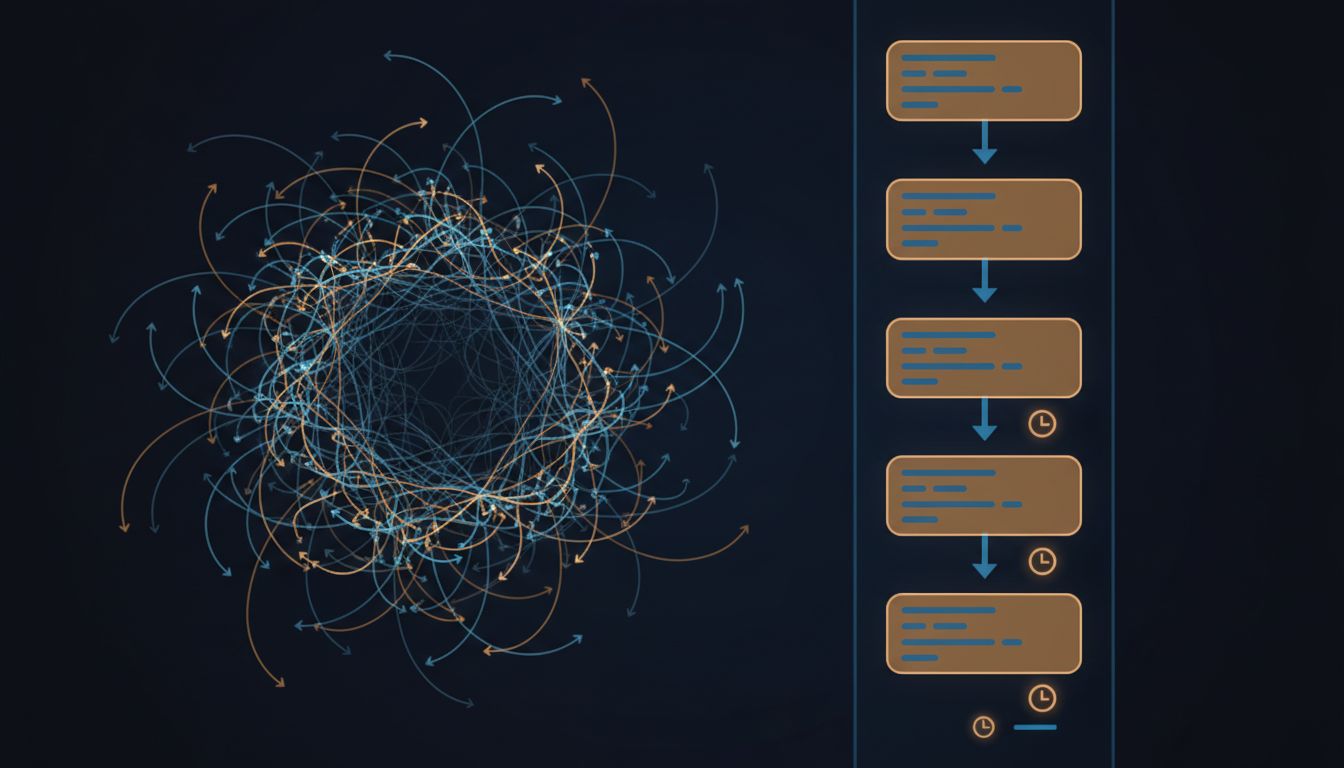

There is a concept in systems engineering called slack, and it does not mean what productivity culture has trained you to think it means. In distributed systems, slack is the intentional buffer capacity built into a pipeline so that when load spikes, the system does not thrash, drop packets, or crash. Engineers build it in on purpose. They would never design a CPU to run at 100% utilization continuously, because a system with no headroom has no capacity to respond to anything unexpected. And yet, somehow, we design our own working days with exactly zero slack and then wonder why we feel like an overloaded server at 3pm on a Tuesday.
This is not a soft productivity tip. It is an architectural decision. Top performers schedule their interruptions instead of fighting them, and the logic behind scheduled idleness follows the same counterintuitive principle: you do not protect focus by cramming more into your calendar. You protect it by deliberately leaving space.
The Utilization Trap (And Why 100% Efficiency Is a Bug)
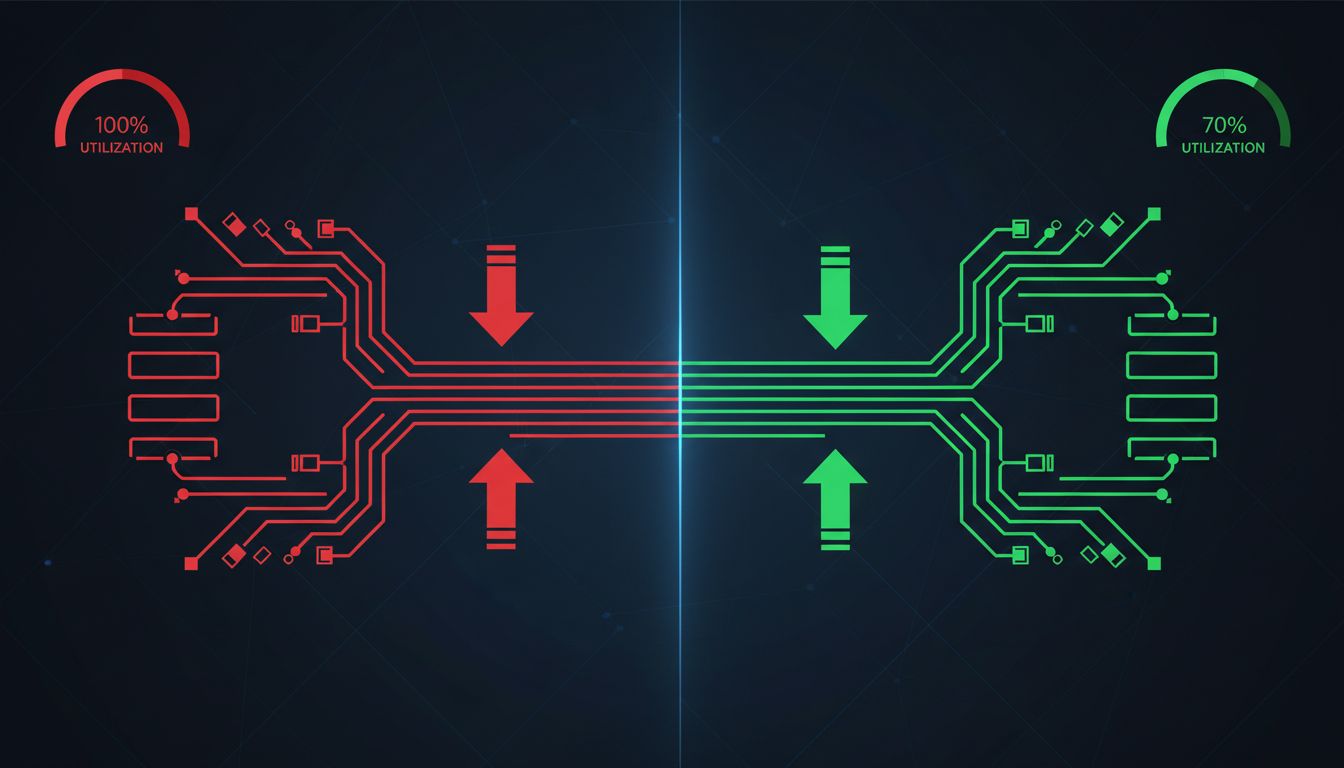
Let me give you a concrete analogy from queuing theory, specifically Little’s Law. In any system where work arrives and gets processed, throughput degrades sharply as utilization approaches 100%. A server handling requests at 70% capacity can recover from a burst. The same server at 95% capacity has almost no buffer. A small spike causes queue depth to explode, latency to balloon, and in bad cases, the whole thing falls over.
Knowledge work behaves identically. Research from the Draugiem Group, which analyzed time tracking data across thousands of workers, found that the highest-performing individuals were not the ones who worked the most continuous hours. They were the ones who worked in focused bursts with deliberate recovery periods, typically around 52 minutes of work followed by 17 minutes of rest. The ratio matters less than the principle: they were running at 75% utilization, not 100%, and that headroom is where their output actually came from.
The trap is that a calendar full of back-to-back meetings and task blocks looks productive. It is legible. You can point to it and feel like you are taking work seriously. But it is the same illusion as software demos that always work perfectly because they are not actually the software. The calendar is the demo. Your cognitive state at hour seven of context-switching is the production environment.
What “Doing Nothing” Actually Means Neurologically
When neuroscientists talk about the default mode network (DMN), they are describing the brain’s activity during rest, specifically during unstructured, undemanding time. For decades, researchers assumed the DMN was just background noise. Then they realized it was doing some of the most important processing in the brain: consolidating memory, making non-obvious connections between disparate ideas, running what you might call garbage collection on unresolved cognitive threads.
This is not metaphorical. The hippocampus, which is central to memory consolidation, does a significant portion of its indexing work during rest states. Insight problems, the kind where the answer suddenly appears in the shower, are almost universally solved during DMN activation, not during focused task execution. You are not getting lucky in the shower. You scheduled the computation, you just did not realize it.
Practically, this means that idle time is not the absence of work. It is a different type of work running on a different substrate. The mistake is treating it as wasted cycles.

How to Actually Implement This Without It Feeling Like Procrastination
The reason most people fail at this is that unstructured time, when scheduled by a productivity-anxious person, immediately gets colonized by low-grade busywork: checking Slack, scanning email, opening tabs. That is not rest. That is deliberately designing your attention to require constant updates, and it forecloses the DMN activation you actually need.
The implementation that works looks like this:
Constraint, not guidance. Block the time and remove the inputs. Making your most distracting apps invisible is a precondition, not an optional step. Idle time with a phone face-up on the desk is not idle time. It is interrupted time with extra steps.
Duration matters. Short breaks (five minutes) are useful for acute fatigue. But the DMN consolidation work that produces insight and creative output requires longer unstructured periods, typically 15 to 30 minutes minimum. Think of it as a garbage collection cycle that needs enough time to actually run.
Do not fill it with “productive” rest. Listening to a podcast about productivity during your idle block is like recompiling your code during what was supposed to be a build cache warm-up. You are adding load to the exact system you were trying to rest.
A walk without headphones. Sitting with coffee and no screen. Staring out a window. These feel wasteful because we have been conditioned to treat cognitive throughput as the only valid output. It is not.
The Output Doubling Claim Is Not Hyperbole
The 2x output claim in productivity literature comes from a few different directions. Microsoft Research published internal studies showing that context-switching between tasks (which is what a zero-slack calendar produces) could cost up to 40% of productive time due to resumption lag, the cognitive overhead of reloading working memory when switching tasks. Recovering even half of that loss by reducing context-switching frequency compounds significantly.
There is also the quality dimension. A developer who spends 30 minutes in unfocused rest before a design review produces architecturally different thinking than one who walks in from back-to-back standups. This connects to why the programmer who stops every 25 minutes solves bugs faster than the one running continuous sessions. The interruption is not the cost. The interruption is the mechanism.
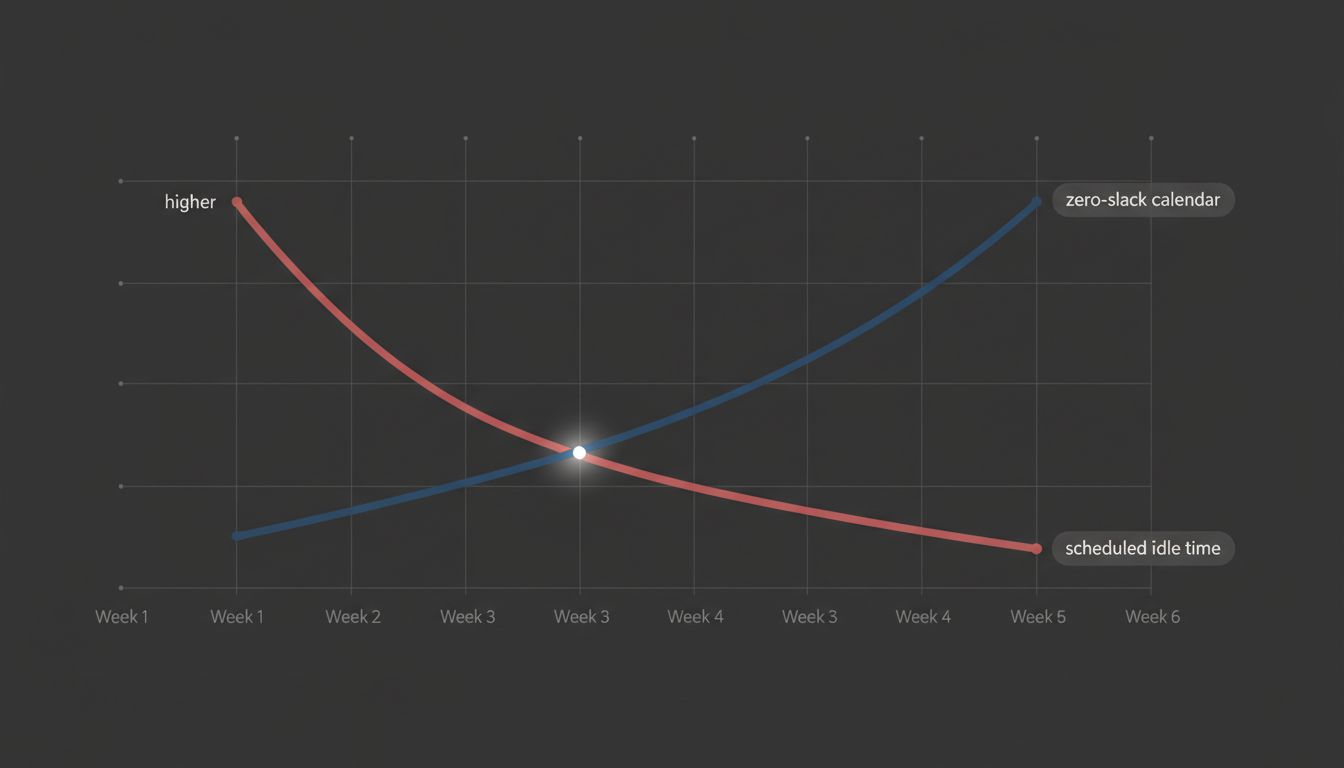
And the compounding effect is real. Workers who consistently protect idle time report that the quality of their focused work improves over weeks, not just hours. The DMN is not just solving today’s problems. It is building the associative scaffolding that makes future problems easier.
The Uncomfortable Conclusion
The thing nobody wants to hear is that if your calendar has no slack, you have not built a productive system. You have built a fragile one. And fragile systems do not fail gracefully. They degrade invisibly until something breaks.
Scheduling time to do nothing is not a lifestyle choice. It is a systems design decision. You are choosing to run at 70% utilization so that the other 30% is available for the work your brain cannot do under load: the synthesis, the insight, the recovery that turns 10 hours of frantic effort into 6 hours of clear thinking that actually ships.
The irony is that this is the same logic we apply without hesitation to the machines we build. It is only when the system in question is ourselves that we forget everything we know about architecture.