A founder I know spent eight months iterating on her B2B analytics tool because her first thirty customers kept asking for Salesforce integrations. She built them. Polished them. Made them the centerpiece of her sales pitch. Then she talked to the customers she actually wanted, the ones who would pay serious money, and none of them cared about Salesforce. They had different CRMs, different workflows, different problems entirely. She had optimized for the wrong cohort and built herself into a corner.
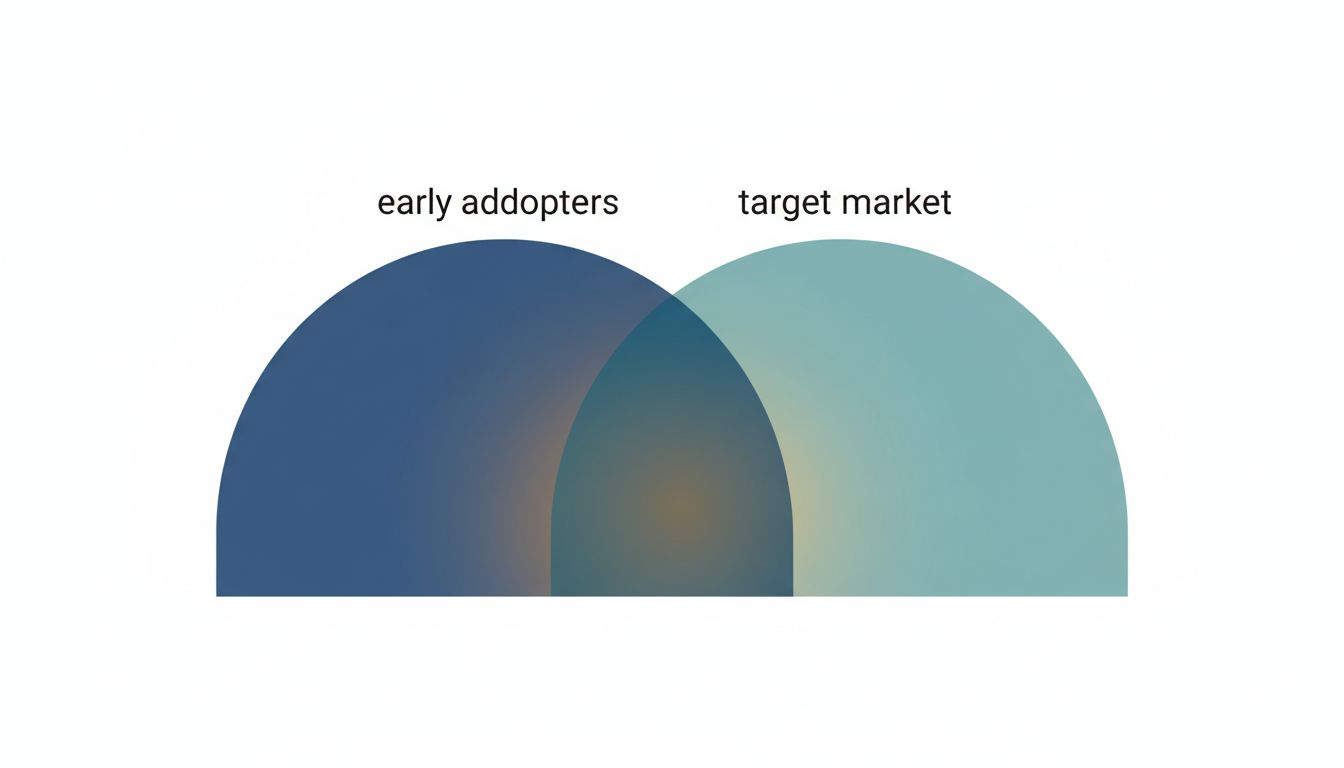
This is not a cautionary tale about listening too hard. It’s a cautionary tale about expecting the wrong thing from early customers. Her mistake wasn’t taking feedback seriously. It was believing her first customers were a preview of her real market, when they were actually something else entirely: a learning instrument.
Your first hundred customers are supposed to be wrong. That’s the position I’m staking out here, and I’ll defend it.
Early Adopters Self-Select for Tolerance, Not Fit
The people who sign up for an unproven product in its first months are a specific personality type. They’re experimenters, the kind of person who backed a Kickstarter for a product that never shipped and still considers themselves ahead of the curve. They have a higher tolerance for rough edges, missing features, and broken workflows than any subsequent customer will. That tolerance is a gift to you in one sense (they won’t leave immediately) and a trap in another (their tolerance masks real problems).
When an early adopter workarounds your clunky onboarding with a spreadsheet and doesn’t complain, that’s not validation. That’s patience you don’t deserve and won’t get again. The customers at customers fifty through five hundred will just leave.
The implication is uncomfortable: the behavior of your first cohort is not representative data. It’s directional signal embedded in a lot of noise. Treat it accordingly.
Wrong Customers Reveal What the Product Actually Does
Here’s the useful thing about customers who misuse your product: they show you what the product actually does, versus what you think it does. This is more valuable than you’d expect.
Slack’s earliest users at Tiny Speck used it as an internal communication tool while building a game. The game failed. The communication tool survived because it turned out other people had the same problem. The product’s early users were technically wrong (they were a game company using an internal tool, not a workplace communication company) but their behavior revealed the actual value being created.
You are not going to have that kind of clarity from the customers who match your original thesis. The customers who arrive sideways, who use your product for something you didn’t intend, who ask for things that confuse you, are performing a service. They’re telling you what you actually built.
Churn in Year One Is Information, Not Failure
Founders treat early churn as an emergency. It often isn’t. A customer who leaves after three months and can tell you exactly why is worth more than a customer who stays out of inertia and never refers anyone.
The math on this is simple: if you have a hundred early customers and forty of them leave, the question is whether those forty told you something before they walked out. If they did, that’s cheap tuition. If they left silently, that’s a process problem, not a product problem. Build offboarding surveys. Call the churned accounts. The conversation you avoid having with a lost customer is almost always the most important one.
Churn in year one is your product telling you where the fit isn’t. The goal is not to prevent that signal from reaching you.
The Customers You Want Are Watching
There is a certain category of buyer who will not touch your product until other people have proven it works. Enterprise buyers, regulated industries, risk-averse operators. They are watching what you build, how you respond to problems, and who you serve. Your first hundred customers are, in part, a public proof-of-work for this audience.
This means the quality of your response to early customers matters more than the customers themselves. How you handle a broken feature, how transparent you are about roadmap, how quickly you learn and adapt: these are the signals that eventually close the customers who wouldn’t talk to you in year one. Being honest about what you can’t do yet, counterintuitively, tends to build more credibility than overselling. Admitting what you can’t do usually wins the deal.
The Counterargument
The obvious pushback here is that some founders use “early customers are learning instruments” as cover for not finding product-market fit. If you’re still claiming your customers are “teaching you” at customer number three hundred, something has gone wrong. There’s a horizon on this argument.
The other real risk is that you dismiss early customers too quickly, treating legitimate demand as the wrong kind. If fifty customers are paying you and asking for the same feature, that’s not noise. That’s a pattern. The discipline is in distinguishing a genuine pattern from the idiosyncratic preferences of a few loud users, which is genuinely hard and requires more rigor than most early teams apply.
But the cure for those failure modes is better analysis, not more reverence for early customers.
What You Should Actually Do
Your first hundred customers are a research cohort, not a revenue strategy. Treat them like one. Talk to them obsessively, but code the conversations. Look for patterns across accounts, not individual feature requests. Track who leaves and why with the same attention you give to who stays.
And resist the temptation, which is enormous, to optimize for the customers you have rather than the customers you want. The founder I mentioned at the top eventually unwound her Salesforce integrations, took six months of painful refocusing, and rebuilt toward the right buyer. She made it. Most founders who fall into the same trap don’t, because by the time they see it, they’ve hired for the wrong product and can’t turn around.
Your first hundred customers will probably be wrong. That’s fine. The founders who survive are the ones who knew that going in.