
The simple version
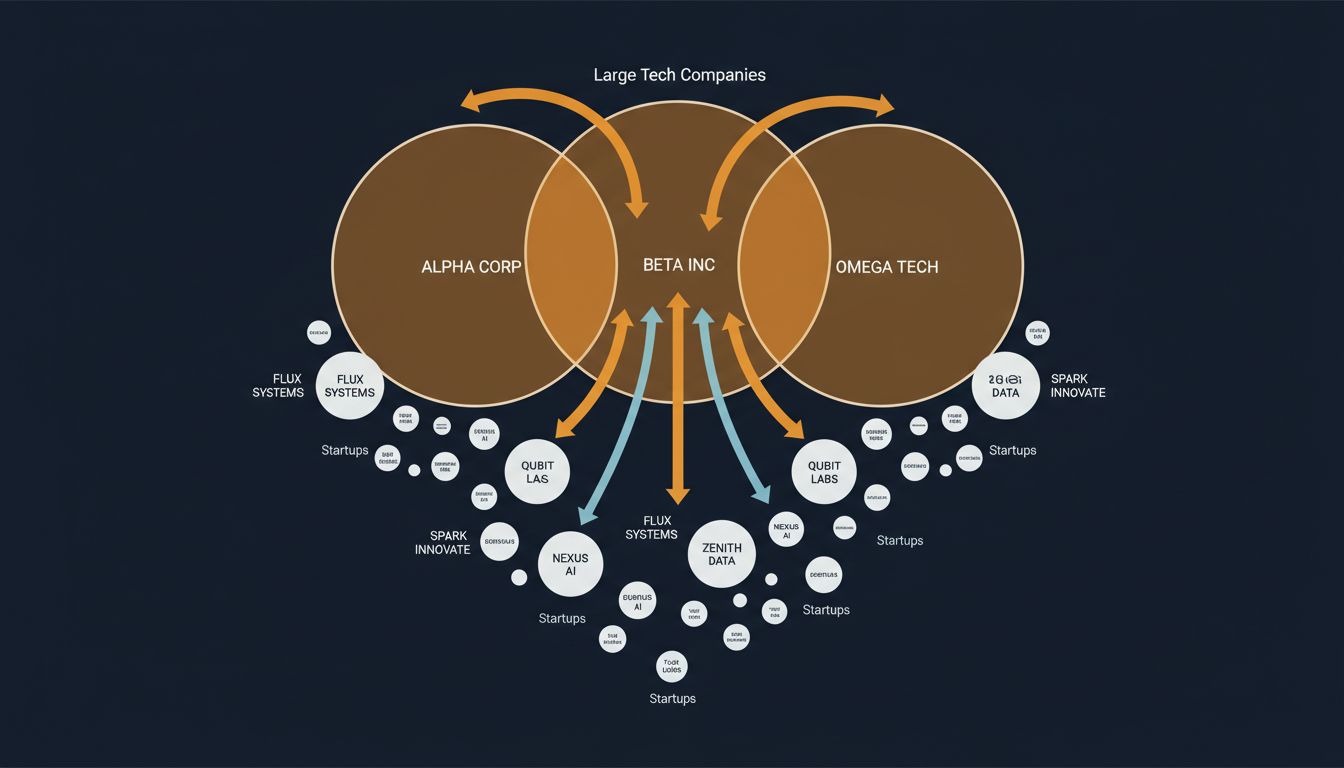
When a big tech company invests in a startup that competes with its own products, it usually isn’t being generous or hedging its bets. It’s buying influence over a future it can’t fully control.
The investment that looks backwards
In 2019, Microsoft invested $1 billion in OpenAI. At the time, OpenAI was building the exact kind of general-purpose AI that Microsoft’s own research division was supposedly pursuing. By 2023, Microsoft had committed roughly $13 billion total. Google, meanwhile, invested in Anthropic, an AI safety company founded largely by former OpenAI employees, despite Google having its own large language model research through DeepMind and Google Brain.
On the surface, this looks like powerful companies throwing money at things that could hurt them. The actual logic runs in the opposite direction.
These investments aren’t passive financial bets. Microsoft’s deal with OpenAI came with something more valuable than equity: a licensing agreement that made Azure the exclusive cloud provider for OpenAI’s commercial products. Every ChatGPT API call, every enterprise deployment, every compute-hungry training run flows through Microsoft’s infrastructure. Microsoft didn’t invest in a competitor. It acquired a very large, very committed customer while the customer was still small enough to need the deal.
The three things an investment actually buys
When you strip away the press release language, big tech investments in competitors tend to purchase one or more of three things.
Distribution lock-in. The Microsoft-OpenAI structure is the clearest example. The startup gets capital and credibility. The investor gets guaranteed infrastructure revenue and, often, preferred access to the technology before it reaches the open market. The startup becomes dependent on the investor’s platform at exactly the moment it starts scaling.
Regulatory positioning. This one is underappreciated. When a dominant company funds multiple players in a space, it becomes harder for regulators to argue the dominant company is monopolizing that space. Google funding Anthropic makes it easier to argue that AI is a competitive market with multiple well-resourced players, even if Google’s own products are the ones most people use. Investing in competitors is, among other things, a form of antitrust insurance.
Early signal on what’s actually working. A board seat or information rights inside a fast-moving startup is worth more than any market research report. You get real data on which technical approaches are gaining traction, which enterprise customers are biting, where the startup’s roadmap is heading. If the startup’s approach turns out to be better than yours, you’ve already bought a front-row seat to understand why.

Why building it yourself often doesn’t work
The obvious question is why these companies don’t just build the competing technology themselves. Some of them do try. Google has built and shuttered more AI projects than most companies have launched. The problem isn’t resources, it’s organizational physics.
Large tech companies are optimized for operating products at scale, not for the kind of unconstrained, high-failure-rate experimentation that produces genuinely new capabilities. A team inside Google working on a speculative AI project has to fight for compute, justify its roadmap to product managers, and operate under the assumption that if it doesn’t ship something defensible, it gets absorbed or shut down. A well-funded startup has none of those constraints and all of the urgency that comes from betting the company on a single idea.
This is a structural problem that money alone doesn’t solve. Tech Companies Build Products They Know Will Die Because the Death Is the Point gets at a related tension: large companies sometimes build things designed to fail because the learning justifies the loss. But there’s a limit to how well a big company can simulate the genuine existential pressure a startup operates under. Investing in the startup is sometimes cheaper than trying to fake that pressure internally.
The control that isn’t control
Here’s where the strategy gets complicated. These investments purchase influence, not control, and the distinction matters.
When Microsoft invested in OpenAI, OpenAI remained a separate entity with its own board and its own mission (the nonprofit structure added another layer of complexity). The chaos of late 2023, when OpenAI’s board briefly fired Sam Altman and Microsoft scrambled to respond, was a reminder that a minority investor doesn’t get to make decisions. Microsoft had committed billions to a company it couldn’t actually direct.
The same dynamic applies to Google’s Anthropic investment. Anthropic has Amazon as its primary cloud partner, meaning Google funded a competitor that runs on a rival’s infrastructure. The investment bought Google some information rights and some goodwill, but not the kind of strategic alignment that comes with acquisition.
This is the actual risk in the strategy: you can pay for a seat at the table without getting a vote. The startup takes your capital, uses your platform while it’s convenient, and has no obligation to stay once it’s large enough to renegotiate. The investment that looked like it purchased a long-term relationship may have purchased a short-term dependency.
What this means for the companies being funded
Founders taking money from a strategic investor in a space where that investor is also a competitor are accepting a complicated deal. The capital is real, the distribution can be genuinely accelerating, and the credibility that comes from a major tech company’s backing opens doors with enterprise customers.
But the investor’s interests and the startup’s interests are only aligned up to a point. The investor wants a return, wants platform lock-in, and wants early visibility into where the technology is going. The startup wants independence, optionality, and eventually the ability to compete or be acquired on its own terms. These goals coexist until they don’t.
The real reason top founders turn down millions in early acquisition offers addresses a related calculation: control is often worth more than an early check, even a large one. Strategic investment from a competitor is a version of that same trade, just structured differently. You keep the company but accept an influential party at the table whose interests run parallel to yours, not identical.
The companies getting this right are the ones who understand exactly what they’re selling when they take the investment, and price it accordingly.
The honest summary
Big tech funding its competitors is not altruism, not confusion, and not a hedge in any simple sense. It’s a multi-tool: infrastructure revenue, regulatory cover, competitive intelligence, and a chance to shape the market even if you can’t win it outright. The investor often gets more from the deal than the press release suggests. The startup gets more capital than it would elsewhere, along with strings that only become visible later. Both sides know this. The interesting question isn’t whether the strategy is cynical. It’s whether, given the alternative of building everything internally, it’s actually the smarter move. For markets moving as fast as AI, it probably is.