
The most instructive moments in tech competition often happen in the negative space, in the deals that were floated but never closed, the investments extended with strings attached, the offers generous enough to distract but structured to ensure nothing threatening ever shipped.
This is a story about one of those moments.
The Setup
In 2010, Google was facing a problem. Twitter had something Google didn’t: a real-time index of human thought, updated by the second, built on the voluntary labor of hundreds of millions of users. When news broke, Twitter knew before Google crawled. When sentiment shifted, Twitter registered it before any algorithm could catch up.
Google had tried to build social products. Orkut had found traction in Brazil and India but nowhere it mattered for Google’s core advertising business. Wave and Buzz were engineering marvels that users actively fled. The search giant understood, with uncomfortable clarity, that it could not simply build its way out of this one.
So Google licensed its way in instead. In 2009, Google signed a deal with Twitter to access the Firehose, the raw full stream of tweets, in real time. The deal, reportedly worth around $15 million annually, let Google index tweets and surface them in search results under the “Real-time Search” feature. Bing signed a similar deal.
On the surface, this looked like a standard data licensing arrangement. Underneath, it was something more strategic.
What Happened
Google’s Real-time Search was genuinely useful. When a news event broke, Google could surface Twitter reactions, links, and commentary in a dedicated stream below traditional results. For users hunting for immediate context, it was valuable.
But Google let the deal lapse in 2011. Real-time Search disappeared. The official explanation was vague, gesturing at the technical challenges of maintaining the integration. The real reason became clearer in hindsight: Google was about to launch Google+, and a prominent real-time feed powered by Twitter directly contradicted that strategy. Why show users Twitter content when you want them to generate Google content?
The Firehose deal had served its purpose. During the years it ran, Google had learned the structure of real-time social data, had indexed the patterns, and had bought time while building its own alternative. Twitter, for its part, had taken the licensing revenue, validated its data as commercially valuable, and told itself a reassuring story about being an open platform everyone needed.
When Google walked away, Twitter lost not just revenue but the signal that its data had mainstream search-level importance. The relationship had subtly repositioned Twitter from potential rival (what if Twitter builds search?) to vendor (Twitter sells data to search companies).
Why This Pattern Repeats
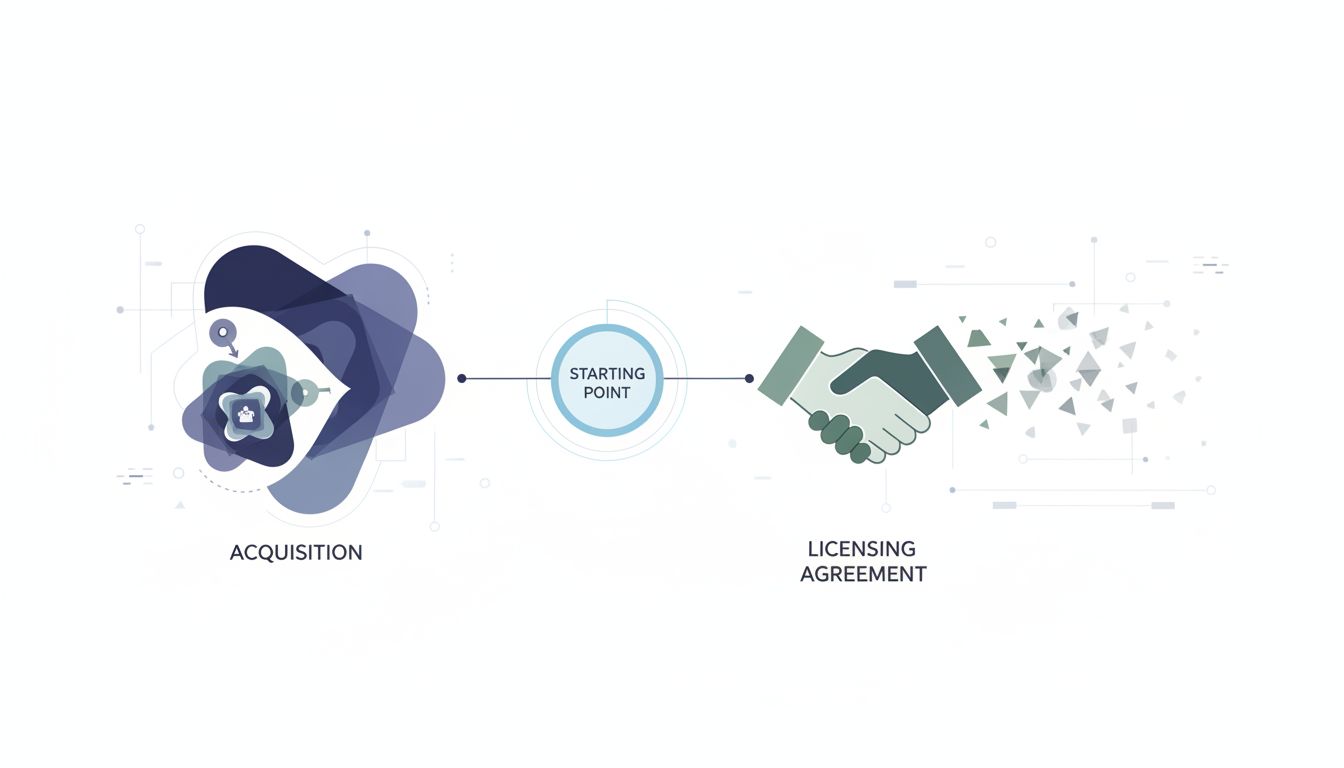
The Google-Twitter dynamic belongs to a recognizable category that sits outside the standard acquisition playbook. Call it competitive leasing: you don’t buy the company, you rent access to its most threatening capability under terms that simultaneously compensate and contain it.
The economics make sense in a specific set of circumstances. When a startup has something a tech giant genuinely needs, an acquisition faces three obstacles. Regulators may scrutinize it. The founder may refuse. And sometimes, the acquisition would be too obviously defensive, drawing attention to the threat the startup poses.
A licensing deal or minority investment solves all three. It gets you access to the capability. It creates financial dependency in the target. And it often comes with exclusivity clauses or data-sharing terms that shape what the smaller company can do with its own product.
Microsoft played a version of this with OpenAI, though the dynamics there are far more complex and the outcome still unresolved. The multi-billion dollar investment gave Microsoft deep integration access and some governance influence without triggering the acquisition scrutiny that outright ownership would have invited. Whether that arrangement ultimately benefits or constrains OpenAI remains the most interesting open question in tech.
Facebook did something blunter and more direct when it acquired Instagram in 2012. That was a genuine acquisition, not a neutralization lease. But the internal emails that surfaced during antitrust proceedings revealed that Mark Zuckerberg had explicitly framed the acquisition in competitive terms, writing that Instagram could “hurt us meaningfully” if left independent or acquired by Google. The acquisition was openly a removal of a threat. The $1 billion price looked expensive in 2012 and looks like the best capital allocation decision in tech history now.
What separates the outright acquisitions from the neutralization leases is usually founder resistance and regulatory risk. When you can’t buy, you lease. When you lease, you structure the terms to get the defensively useful parts without needing to close the deal.
The Harder Lesson
For founders building in the vicinity of a tech giant’s core business, the licensing offer deserves the same scrutiny as an acquisition offer, possibly more. An acquisition at least forces honest negotiation about valuation and terms. A licensing deal wraps competitive containment in the language of partnership.
The tells are consistent. The offer comes with unusual data-sharing requirements. The exclusivity clause applies specifically to the domain where you’re most threatening. The revenue is meaningful enough to shape your roadmap priorities. The relationship gets announced publicly in terms that position you as an infrastructure layer rather than a product company.
Twitter signed the Firehose deal when it was pre-IPO, capital-hungry, and still working out what kind of company it was. The $15 million per year mattered. The framing, Twitter as the real-time data layer that search companies plug into, was comfortable. It felt like validation.
What it actually did was channel Twitter’s strategic identity away from search and toward the media and advertising model that would define and eventually constrain the company for the next decade. Twitter never seriously competed with Google on search. The licensing relationship had made that positioning feel natural.
This is the subtler cost of the neutralization lease. It doesn’t just limit what you build. It shapes how you think about what you are. By the time the deal expires and the larger company moves on, the startup has often reorganized its identity around the commercial relationship rather than the threat that made it interesting in the first place.
As Nortel’s patent story illustrates, sometimes the most valuable thing a company builds is also the thing its partners work hardest to keep inert. The Firehose was Twitter’s most strategically potent asset. Google paid fifteen million dollars a year to make sure it stayed pointed away from search.
That was money well spent. Just not for Twitter.