

When Amazon Web Services quietly opens a new availability zone in a mid-tier city, most people shrug. Another data center, another press release. But the companies paying close attention, including hedge funds, supply chain analysts, and a growing number of enterprise strategists, know that data center geography tells a story about where economic activity is heading, sometimes months before traditional indicators catch up.
This is not a niche observation. It is becoming a competitive intelligence discipline. And understanding how it works requires stepping back from the software layer and looking at the physical infrastructure underneath it all. Much like how tech companies deliberately hide their best features to protect strategic advantages, cloud providers rarely advertise the full value embedded in their infrastructure decisions.
Why Data Center Location Is an Economic Signal
Cloud providers do not place data centers randomly. Every location decision involves years of planning, regulatory negotiation, power infrastructure deals, and demand forecasting. When Google announces a new region in Poland or Microsoft expands into Malaysia, those decisions reflect internal models showing that enterprise and consumer cloud demand in those areas is about to spike.
The key insight is that cloud capacity must be built ahead of demand. You cannot spin up a physical data center in six weeks to respond to a sudden market surge. Lead times for major facilities run two to five years. That means a cloud provider announcing a Southeast Asian expansion today is publishing, in plain sight, a confident forecast about regional economic activity half a decade out.
For market analysts, that is gold. Data center announcements cluster around regions experiencing manufacturing shifts, fintech growth, and digital infrastructure investment. When AWS added three new regions in Asia Pacific between 2019 and 2022, it preceded a measurable surge in enterprise software adoption across those markets by roughly 18 to 24 months.
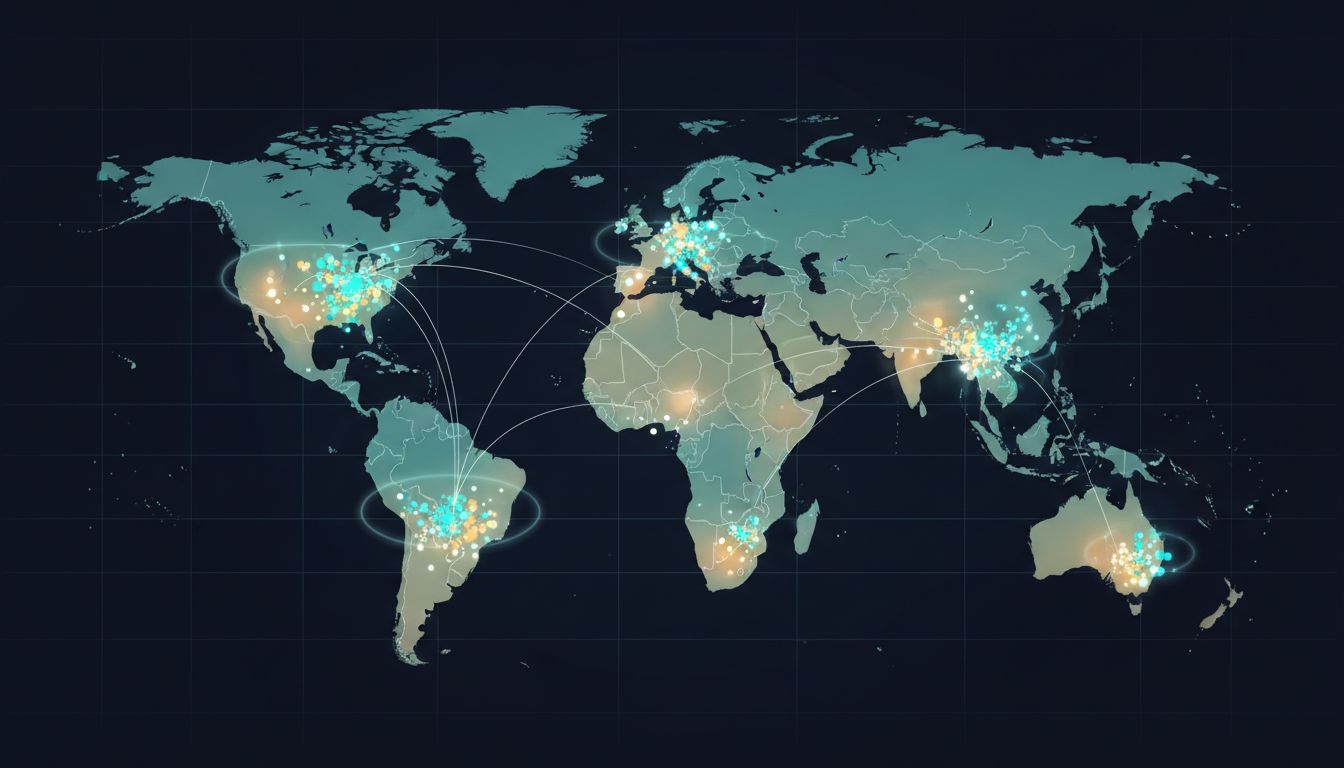
The Latency Map as a Demand Heat Map
Beyond announcements, the operational behavior of existing data centers carries its own signals. Cloud providers publish latency benchmarks, and the pattern of which regions are adding capacity, upgrading interconnects, or reporting congestion tells a detailed story about where compute demand is accelerating.
Think of it this way. Latency in a cloud region degrades when demand outpaces available capacity. When a region consistently reports higher-than-average latency over a sustained period, it signals that local demand has surprised even the provider’s own forecast models. Analysts tracking these metrics across AWS, Azure, and Google Cloud have identified latency spikes as leading indicators of sector-specific growth, particularly in financial services and manufacturing verticals.
This kind of infrastructure-as-signal thinking connects to something broader about how tech systems encode information in their architecture. The server room temperature debate is a small example of how operational decisions reflect priorities and constraints that are rarely spelled out explicitly.
How Companies Actually Operationalize This Data
So who is actually using geographic data center signals, and how?
Hedge funds and quantitative research firms have been the early adopters. Firms like Two Sigma and Citadel invest heavily in alternative data, and data center activity metrics fit squarely into that category. By tracking construction permits for data centers, public utility filings for large power draws, and cross-referencing those with cloud provider announcements, analysts build regional economic models that traditional GDP data simply cannot match in timeliness.
Supply chain companies use it differently. A logistics firm watching cloud infrastructure expand in a particular corridor, say the Gulf region or Eastern Africa, can anticipate increased digital commerce activity and position warehouse and last-mile delivery assets accordingly. The infrastructure investment signals a future need before customer demand makes it obvious.
Enterprise software companies watch it to calibrate go-to-market sequencing. If Azure is building out in a new market, that means Microsoft’s sales teams are already there, which means enterprise software buyers in that region are being activated. A well-timed market entry can ride the wave of cloud adoption rather than trying to build one from scratch.

The Limits and Risks of This Approach
It would be tidy to claim that data center geography is a clean crystal ball. It is not.
First, cloud providers sometimes build in regions for geopolitical or regulatory reasons that have little to do with organic demand forecasts. China, for instance, requires local data residency, which means regional infrastructure investment reflects compliance requirements as much as market opportunity.
Second, the signal has become noisier as more analysts have started watching it. When a metric becomes widely known as a predictor, the behavior it measures can be distorted. Cloud providers are also less transparent than they used to be about specific capacity expansions, partly because that information is commercially sensitive.
Third, data center construction can reflect competitive positioning as much as demand signals. If AWS opens a region in a market, Google and Azure will often follow within 18 months regardless of their own demand forecasts, simply to avoid ceding territory. That competitive dynamic can create false positives for analysts trying to read underlying economic trends.
Thinking about these limits is similar to how early-stage startups win by knowing less than their competitors, being selective about which signals to trust rather than treating all data as equally useful.
What This Means for the Next Decade
The broader principle here is that physical infrastructure encodes strategic intent in a way that financial disclosures and press releases often do not. Data centers are expensive, long-lived, and geographically constrained. They represent genuine conviction about where the future will be computed.
As edge computing matures and AI workloads push infrastructure even closer to end users, the geographic signal will get more granular and more useful. Instead of tracking which countries are receiving new cloud regions, analysts will track which cities are receiving edge nodes, and that will map directly onto where autonomous systems, real-time logistics, and AI-driven commerce are being deployed first.
For now, the takeaway is straightforward. The cloud is not a formless abstraction. It has a physical skeleton, and that skeleton moves in predictable directions before the market does. The companies paying attention to where the servers are going, not just what they are running, will have a durable edge in reading what comes next.