
The Simple Version
A 4TB external hard drive costs around $80 at retail. Storing 4TB in the cloud costs several hundred dollars per year, indefinitely. The difference isn’t the cost of spinning magnetic platters. It’s everything else that makes storage useful.
You’re Buying a Service, Not a Device
The confusion starts with a category error. When you buy a hard drive, you buy a physical object that depreciates toward zero and sits in a drawer. When you buy cloud storage, you are purchasing ongoing access, redundancy, retrieval, and availability from anywhere, at any time, forever. These are not remotely the same product.
Consider what actually happens when you upload a file to a major cloud provider. Your file doesn’t live on one disk. It gets copied across multiple servers, often in multiple geographic regions, so that if a data center floods or a drive fails, your data survives. Amazon S3, to use the most-studied example, is designed for what it calls “eleven nines” of durability, meaning the probability of losing a stored object in any given year is approximately one in a hundred billion. Achieving that durability requires substantial hardware redundancy that a single consumer drive cannot approach.
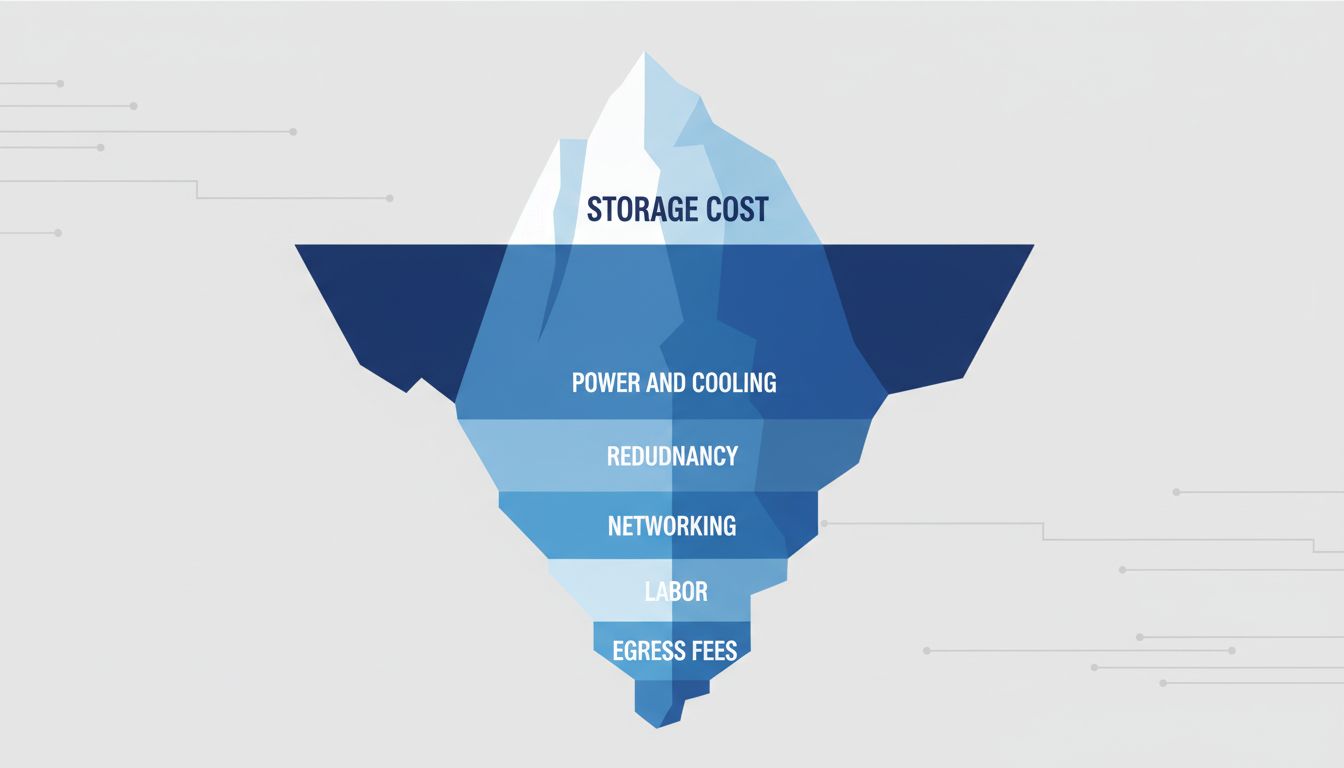
The drives themselves are actually cheap. The infrastructure surrounding them is not.
The Real Cost Is Labor, Power, and Real Estate
A cloud storage facility isn’t a warehouse full of hard drives. It’s a hard drive warehouse with a cooling system that costs as much as the drives, a power infrastructure with backup generators, a networking layer capable of serving millions of simultaneous requests, and a team of engineers available at 3 a.m. when something breaks.
Power alone is significant. A modern data center might draw tens of megawatts continuously. The cooling required to prevent that hardware from destroying itself often consumes as much energy as the hardware does. Then factor in the physical security, the redundant internet connections, the compliance certifications that enterprise customers require, and the amortized cost of hardware replacement cycles.
None of this appears on the spec sheet of the $80 drive sitting on your desk. When people say cloud storage is overpriced, they’re comparing the wrong things. They’re comparing the material cost of storage to the total cost of a managed service.
Bandwidth Is Where Providers Actually Make Their Money
Here’s the part the pricing pages don’t make obvious: most cloud providers charge very little to upload data. The painful costs come when you retrieve it.
Amazon Web Services charges nothing to put data into S3. Getting it back out costs money per gigabyte, and moving it to a different cloud provider costs even more. Google Cloud and Microsoft Azure follow similar patterns. This structure isn’t accidental. It’s a deliberate pricing architecture designed to make switching expensive once you’re committed.
The technical term is “egress fees,” and they represent one of the more straightforward examples of a lock-in mechanism in modern tech. Your data is free to enter and expensive to leave. This is worth understanding before committing significant data to any single provider, particularly for businesses whose storage needs might change. The economics of digital services often reward the provider for behaviors that don’t obviously benefit the customer, and egress pricing is one of the cleaner examples.
Why Competition Hasn’t Closed the Gap
If cloud storage is so profitable, why haven’t competitors driven the price down to near the hardware cost? Some have tried. Backblaze, one of the few cloud storage companies that publishes detailed cost breakdowns, has long offered consumer backup and B2 cloud storage at prices substantially below AWS. Their published cost analyses suggest that well-run commodity storage can be profitable at much lower price points than the major providers charge.
But the major providers aren’t primarily selling storage. They’re selling convenience, integration, and the implicit promise that they won’t disappear. A business running critical infrastructure on AWS isn’t paying a premium for storage bytes. It’s paying for the ability to spin up compute adjacent to that storage instantly, for the audit logs, for the IAM permissions system, for the fact that AWS has a nine-hundred-page service level agreement that its legal team can quote in a meeting. The storage line item is bundled into something much larger, which is why the per-gigabyte rate looks absurd when compared to consumer hardware.
For individual users, the calculus is simpler but the structural point holds. You are not paying for bits on a disk. You are paying for those bits to be accessible on your phone in Tokyo, automatically backed up three times, searchable by filename, and shareable with a link that expires in 48 hours. Whether that’s worth the price depends on how much you’d pay for the alternative, which is managing all of that yourself.
The Honest Bottom Line
Cloud storage is not a ripoff in the sense of extracting money for nothing. The cost structure is real. The redundancy, the retrieval infrastructure, the egress capacity, and the engineering required to keep it running reliably are all genuinely expensive. What providers have done brilliantly is bundle those real costs with artificial ones, particularly egress fees designed to prevent exit rather than recover legitimate expenses.
The right mental model isn’t “I’m paying too much for a hard drive.” It’s “I’m renting a managed service with significant switching costs built in, and I should understand the terms before I commit.” For most individuals and many businesses, that tradeoff is worth making. The mistake is making it without knowing what you’re actually paying for.