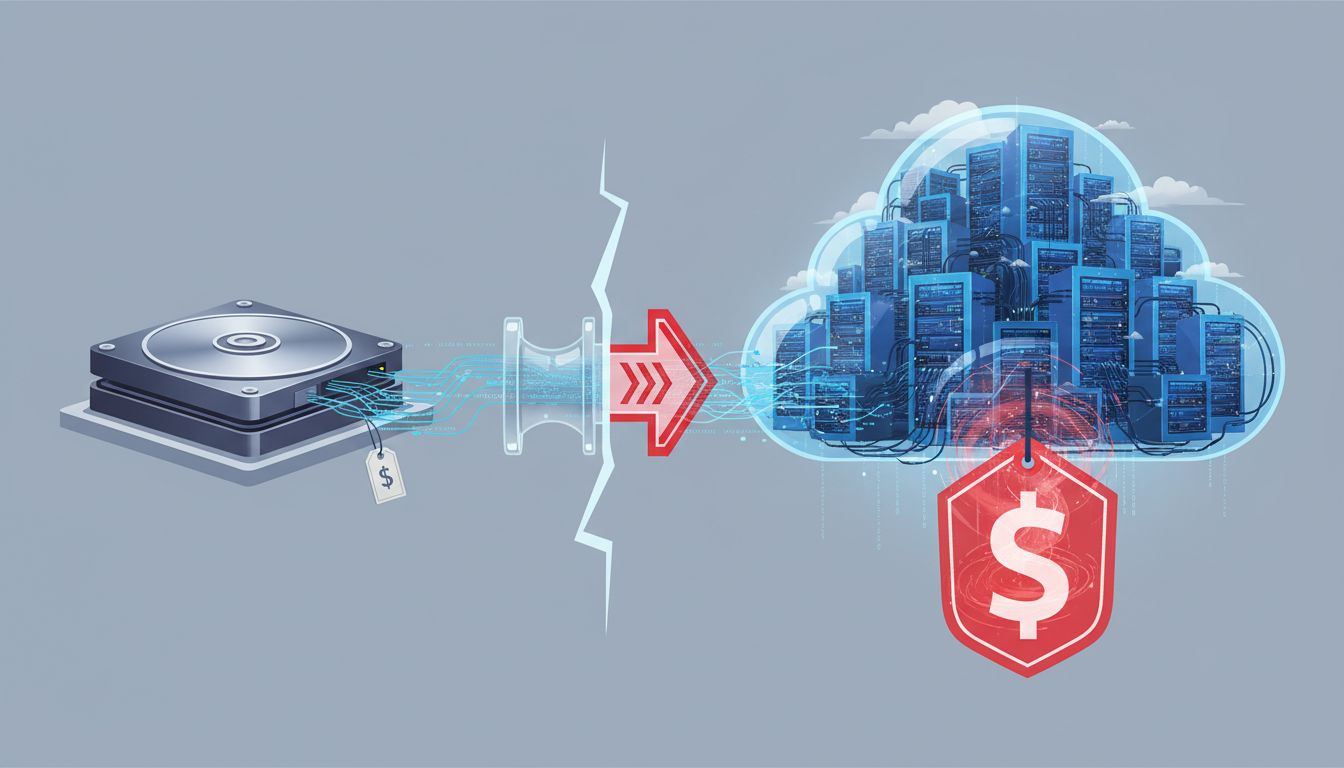
A terabyte of physical hard drive storage costs about $20 at retail. A terabyte stored on Amazon S3 costs roughly $276 per year, and that number climbs once you factor in data transfer fees, API request charges, and the quiet tax of egress pricing. The infrastructure gap between those two numbers is real but modest. The economic gap is almost entirely manufactured. Cloud storage is expensive not because it costs more to provide, but because providers have engineered a situation where leaving costs more than staying.
Free trials aren’t about letting you try a product, they’re about making sure you never leave, and the same logic governs cloud storage pricing at industrial scale. The mechanism is different but the architecture of entrapment is identical.
The Real Cost Is Not the Storage, It Is the Exit
Amazon, Google, and Microsoft have each built what economists call switching cost moats, and cloud storage is one of the deepest. The monthly fee you pay for storage is almost beside the point. The real pricing leverage comes from egress fees, the charges you incur when moving data out of a cloud provider’s infrastructure.
Amazon charges up to $0.09 per gigabyte for outbound data transfer. Move a petabyte of data out of AWS, and you owe $90,000 before a single engineer lifts a finger. Google and Azure run similar structures. This isn’t an accident of cost accounting. It’s deliberate architectural pricing. The storage fee is the door. The egress fee is the lock.
The practical consequence is that enterprises don’t evaluate cloud storage on cost per terabyte. They evaluate it on the cost of being wrong about which provider they chose. And that number is almost always high enough to make switching feel irrational, regardless of what competitors are offering.
Why Physical Drives Are Cheap and Getting Cheaper
Hard drive prices have followed a trajectory that mirrors Moore’s Law in its relentlessness. The cost per terabyte of mechanical storage has dropped from thousands of dollars in the early 2000s to single digits today. SSDs are following the same curve, just a decade behind.
Cloud providers benefit from this trajectory at scale. When you’re buying hundreds of thousands of drives and deploying them in purpose-built data centers with negotiated power rates and automated management systems, your per-terabyte cost drops well below retail. Backblaze, the cloud backup company that publishes its storage costs publicly, has reported all-in costs of roughly $5 to $7 per terabyte per year, including hardware, power, and staff. That’s the number the major providers don’t want you doing math around.
The gap between $5 and $276 is not filled with engineering. It’s filled with lock-in.
The Complexity Layer That Makes Comparison Impossible
Cloud pricing pages are not designed to help you understand what you’ll pay. They’re designed to make comparison so cognitively expensive that most buyers give up and choose based on brand familiarity or existing relationships. This is not a conspiracy theory. It’s a documented pricing strategy.
AWS alone has over a dozen storage product tiers, each with distinct pricing models for storage, retrieval, requests, and transfer. S3 Standard, S3 Intelligent-Tiering, S3 Standard-IA, S3 One Zone-IA, S3 Glacier, S3 Glacier Deep Archive. Each tier has different retrieval latencies, different minimum storage durations, and different penalty structures for early deletion. Understanding the true cost of a given architecture requires modeling usage patterns that most buyers can’t accurately predict.
This complexity isn’t accidental. As we’ve explored in our analysis of how tech companies deliberately make their APIs difficult to use and profit from the confusion, opacity in technical interfaces tends to benefit whoever built the interface. When you can’t accurately price-compare, you can’t credibly threaten to leave, and your negotiating leverage collapses.
The Bundling Trap
The subtler mechanism of cloud storage pricing is bundling. AWS doesn’t just sell you storage. It sells you a development environment, a deployment platform, an analytics stack, a machine learning infrastructure, and a global network. Once your application is built on Lambda, talks to RDS, and pipes data through Kinesis, the storage bill stops being a line item you evaluate independently. It becomes collateral.
This is the real genius of the hyperscaler model. Storage looks cheap when you’re signing up, because you’re comparing it to a drive you might buy at Best Buy. It looks cheap in year one, because your data footprint is small. By year three, your data is interwoven with a dozen other services, your engineering team has built assumptions about AWS-specific APIs into the application layer, and the actual cost of migration has become a multi-quarter engineering project.
The storage price was never the point. The storage was the anchor.
This mirrors the broader pattern we see in how software licenses end up costing more than the hardware they run on. The economics make no sense until you account for the switching costs that the license holder has quietly built into the relationship.
What Would Actually Change This
The European Union has made the most serious regulatory attempt to address cloud egress fees, with the Data Act requiring that providers make switching technically and economically feasible. The law took effect in 2024 and includes provisions specifically targeting the egress pricing structures that make migration expensive. It’s the right diagnosis. Whether enforcement proves meaningful is a separate question.
Some competition has emerged at the margins. Cloudflare R2 offers S3-compatible storage with zero egress fees, a direct attack on the structural lock-in model. Backblaze B2 operates on similar principles. Neither has the ecosystem depth of AWS or Azure, which is precisely why the hyperscalers aren’t panicking. Storage pricing isn’t defended by storage. It’s defended by everything else.
For most enterprise buyers, the pragmatic answer isn’t to avoid cloud storage but to architect deliberately. Keep your data portable from day one. Avoid proprietary formats where open standards exist. Model your egress costs before you’re locked in rather than after. The price you’re really paying for cloud storage is an option on flexibility, and that option gets more expensive the longer you wait to exercise it.
The terabyte you’re paying for is the cheap part. What you’re really buying is the right to leave, and the providers know exactly what that’s worth.