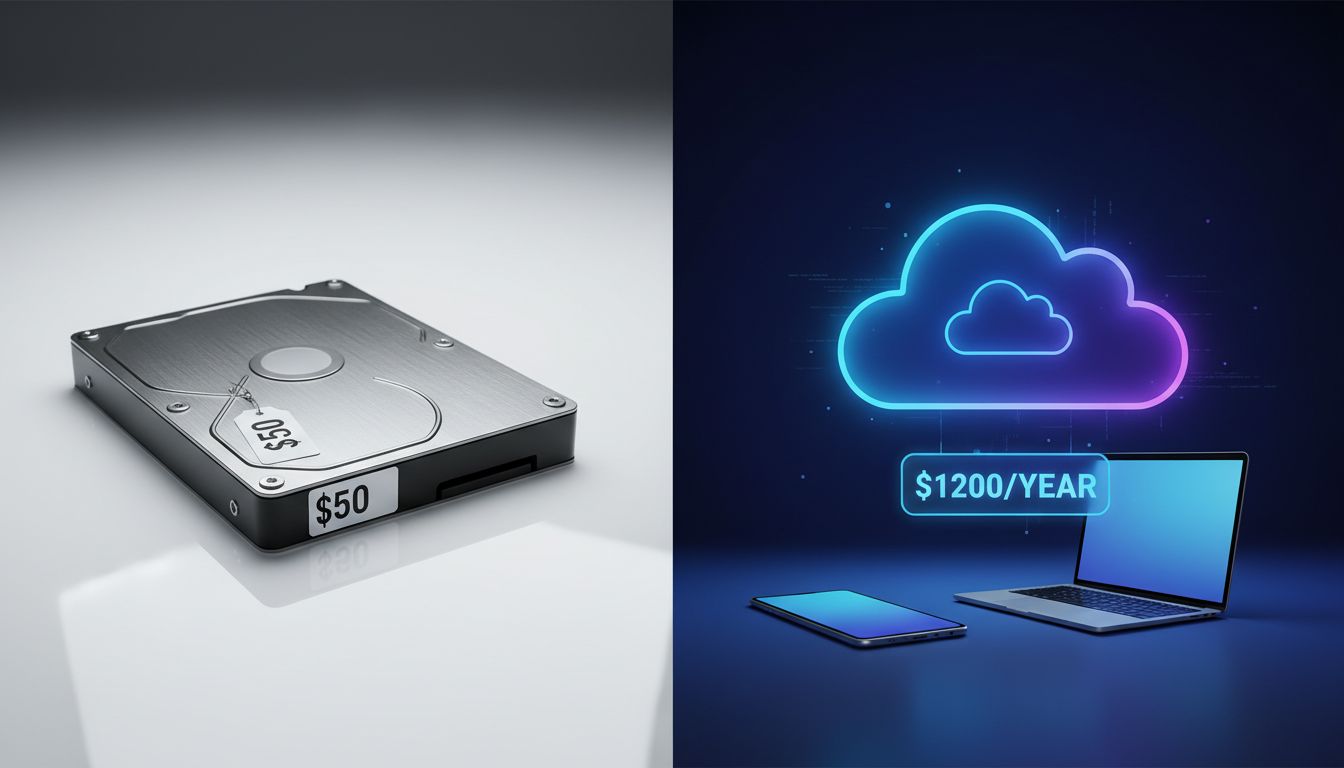
A one-terabyte external hard drive costs around $50. A terabyte of cloud storage from Google, Microsoft, or Apple costs anywhere from $100 to $240 per year, every year, forever. That gap is not a coincidence, not an oversight, and not simply the premium for convenience. It is the entire business model, dressed up as a utility bill.
This pattern shows up across the tech industry with remarkable consistency. As we explored in our analysis of why SaaS companies lose money on their cheapest tier on purpose, the pricing structure you see on any tech company’s subscription page is almost never about recovering costs. It is about engineering behavior.
The Hardware Math That Doesn’t Add Up
Start with the raw economics. A hard drive depreciates, sure, but its cost per gigabyte has fallen so dramatically over the past two decades that even accounting for electricity and occasional replacements, physical storage remains orders of magnitude cheaper than cloud subscriptions over any meaningful time horizon.
Cloud providers are not oblivious to this math. Amazon Web Services publishes its infrastructure costs obsessively. Google has entire teams dedicated to driving down the price of storage at scale. The cost to store your vacation photos on a Google server is, in absolute terms, negligible. Yet the price you pay has remained stubbornly elevated, even as the underlying hardware costs have collapsed.
The reason: the storage itself is not the product being sold.
What You Are Actually Paying For
Cloud storage is, at its core, a data collection and retention mechanism. When your photos, documents, and files live in Google Drive or iCloud, those companies gain something worth far more than the storage fee: persistent access to your behavioral data, your file metadata, your usage patterns, and crucially, your dependence.
This is where the model gets interesting. The storage fee is not primarily revenue. It is a switching cost, engineered and priced to be just low enough that you keep paying without thinking too hard, and just high enough to generate a meaningful recurring revenue stream at scale. Apple reported over $85 billion in services revenue in a recent fiscal year. A substantial slice of that comes from iCloud subscriptions, which exist in part because Apple’s devices are designed to generate more data than its free storage tier can hold.
That design choice is not accidental. It connects directly to a broader pattern in how tech companies deliberately design software to become obsolete every 3 to 5 years, nudging users toward new hardware that generates new storage needs, which renew the subscription cycle.
The Lock-In Architecture
The more insidious layer is what happens after you commit. Moving data out of a cloud ecosystem is technically possible but practically painful. Google Photos applies its own compression algorithms. iCloud integrates so deeply into macOS and iOS that extraction requires deliberate effort and technical comfort that most users simply do not have.
This friction is architectural, not incidental. Cloud providers invest heavily in what the industry calls “data gravity,” the phenomenon where the more data you accumulate in one ecosystem, the more expensive (in time, effort, and sometimes money) it becomes to leave. Egress fees, the charges some providers levy just to download your own data, are the most naked expression of this dynamic. AWS, for instance, long charged for outbound data transfers at rates that made switching providers a genuinely costly exercise for enterprise customers.
The strategy mirrors what we’ve documented in how tech companies deliberately make their APIs hard to use, where technical friction is not a bug but a retention mechanism dressed in the language of engineering tradeoffs.
The Real Competition Is Not Other Clouds
Here is the counterintuitive part. Amazon, Google, and Microsoft are not primarily competing with each other for your personal storage dollars. They are competing with the idea that you might stop needing them at all.
This is why all three have moved aggressively to make cloud storage feel indispensable rather than merely useful. Automatic photo backup, cross-device sync, collaborative document editing, version history, sharing links, these are not features designed to justify the price. They are features designed to make the price feel beside the point. The goal is to make the thought of returning to a physical hard drive feel primitive, risky, and socially inconvenient.
The psychological engineering here is deliberate and sophisticated. Once your files exist in the cloud and other people can access shared folders, comment on documents, and collaborate in real time, the storage has become infrastructure. You are no longer paying to store files. You are paying to maintain a web of dependencies.
What This Means for Consumers and Enterprises
For individual consumers, the practical implication is simple: the price you pay for cloud storage reflects your switching costs more than it reflects the cost of storage. Providers will lower prices only when competitive pressure forces them to, not because their margins compress.
For enterprises, the stakes are considerably higher. Organizations that migrate entire data workflows to a single cloud provider often discover, years later, that their negotiating leverage has evaporated entirely. The data is too large to move practically, too integrated to extract cleanly, and too operationally critical to risk disrupting. This is precisely the failure mode that explains why digital transformation projects fail 84 percent of the time: organizations focus on adopting the technology rather than interrogating the long-term commercial architecture they are accepting along with it.
The hard drive sitting on your desk is just storage. The cloud subscription is a relationship, priced accordingly, and structured to be very difficult to end. Understanding that distinction does not necessarily change what you should buy. But it should change what you think you are buying.