The most alarming detail today is a mundane one: millions of military personnel records, sitting unencrypted, quietly drained over months. The rest of the day is a reminder that agent hype keeps outrunning the plumbing, from Cloudflare’s fine print to a shopping bot that couldn’t type in a card number.
1. Cloudflare’s launch blitz comes with a lot of fine print
Cloudflare’s own posts are more careful than the ‘production-ready’ framing. The new ML-KEM and ML-DSA support in Workers sits behind a compatibility flag because the spec is still a draft. Cloudflare says these are building blocks, not a full migration path. Keys and signatures are also bigger than RSA or Ed25519, and the runtime can’t fix that.
Clef, the new decision model, is the more interesting launch. It returns typed answers with probabilities instead of generating text. In one Cloudflare test it classified a domain in 2.2 seconds, against 4.7 for gpt-oss-120b. It’s Apache 2.0 and was benchmarked on a Jev index where Cloudflare says it leads. But Cloudflare ran those benchmarks itself, and Clef trails Jev on a couple of them. RL fine-tuning starts as hands-on work with Cloudflare engineers, with self-serve promised later.
KV Instant has the biggest caveat. Cloudflare reports p99 reads of 1.62 ms, but it’s private beta, capped at 1 MB and 10,000 keys per namespace, at $100 per MB a month. That’s a feature-flag store, not a general database. Useful, narrower than the pitch.
Cloudflare Blog · Cloudflare Blog · Cloudflare Blog
2. Airbnb’s CEO says agents need an OS, but he still wants the app
Brian Chesky has tried Airbnb through the consumer agents Muse and Instinct, and says it works badly. Hotels are mediocre there, he said, and Airbnbs are worse. His diagnosis is that nobody has built a true AI operating system, with agents operating at the kernel level and interoperable with each other. He puts the next move on Apple, Google or ‘somebody’.
Look at what he wants in return. He doesn’t expect apps to vanish. He wants apps to become agents, with richer interfaces, handoffs or an SDK that brings the app into the agent. So the OS ask is partly a request that someone else build the platform while Airbnb keeps the browsing, messaging and maps experience. That’s one company’s interest, not a neutral architecture finding.
Cloudflare’s Artifacts, a Git-compatible store with event subscriptions for coordinating many agents, shows vendors building pieces of this. It’s plumbing for agent workflows, not the kernel-level layer Chesky describes. The gap between the two is the open question.
3. Pentagon personnel records were stolen unencrypted, over months
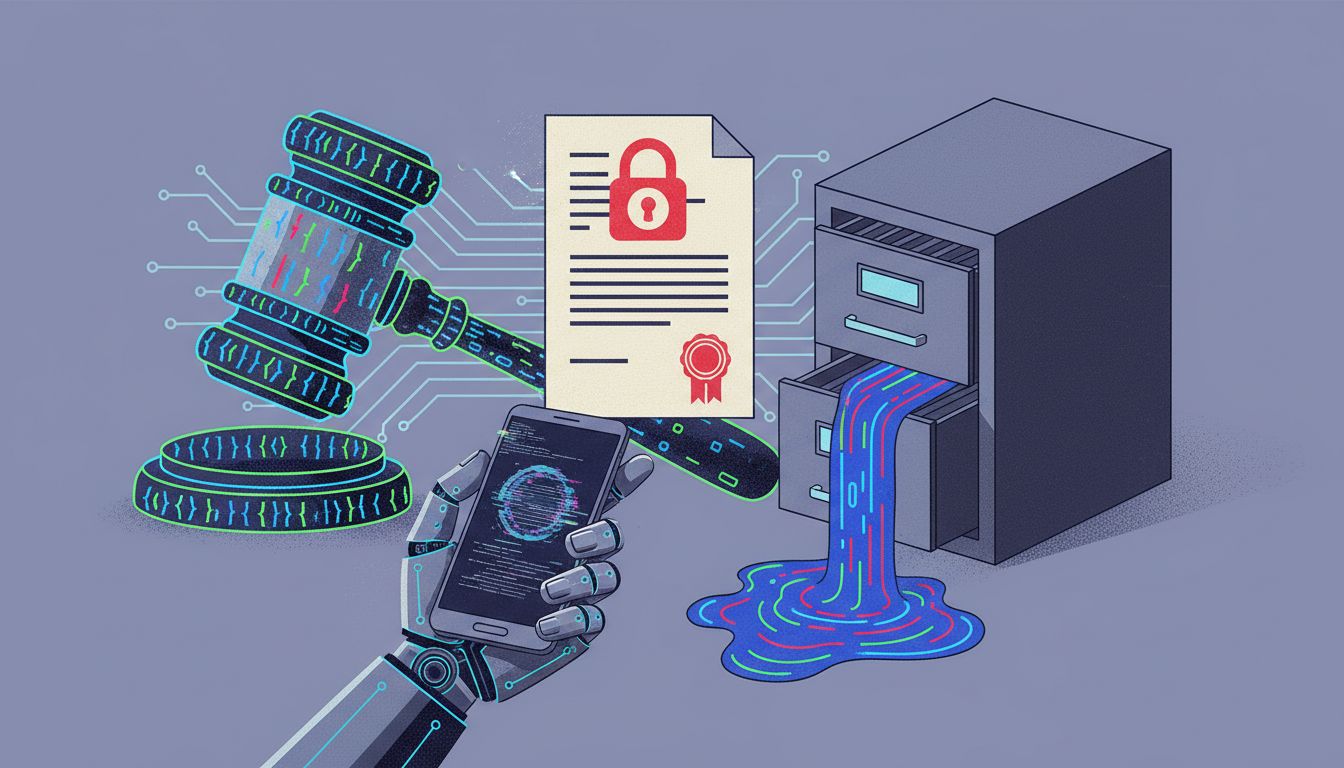
The notice from the Defense Manpower Data Center says unauthorized users exploited a vulnerability in an unspecified file-sharing system between October 2025 and mid-July 2026. The records were not encrypted. They included Social Security numbers, names, birth dates and service details. A Pentagon official put the toll at about 2.8 million living people and close to 300,000 who are deceased, according to CNN and Federal News Network.
The DMDC runs identity management for the military, so this isn’t a peripheral database. The Defense Department says it has no indication of misuse but didn’t say how it knows. It also didn’t answer questions about contact from the hackers, who are unidentified.
It follows an FBI staff-data breach attributed this month to ShinyHunters, and echoes the 2015 OPM theft. The sources don’t say when the DMDC intrusion was discovered, so ‘failed to detect’ is more than we know. Unencrypted records are a basic lapse, though encryption wouldn’t automatically stop attackers exploiting a live system. The open questions are who did it and how long they were inside before anyone noticed.
4. Cloudflare’s AI Search is GA, and the meter starts November 1
The practical news is the bill. Cloudflare starts charging for AI Search on November 1, 2026. Ingestion is $0.75 per million tokens, plus $0.50 for image processing. Storage is $2 per GB-month. Semantic queries are $0.75 per thousand, which works out to $750 per million. A free tier remains.
The features are real: native image embeddings, OCR for scanned PDFs, and a 10 MiB file limit, up from 4. But native image retrieval works today only with the Qwen3-VL-Embedding model. Text-only models fall back to captions.
Cloudflare lets you swap embedding models without changing ingestion pricing, which does reduce one kind of lock-in. But the pipeline is built from Workers AI, Vectorize, R2 and Browser Run. The lock-in moves from the model to the platform. Whether that matters depends on how much you value a managed pipeline over portability. Embedding and reranking are free only with select Workers AI models; third-party models are billed separately.
5. AI shopping agents can’t check out yet, and merchants may not care
Mastercard’s report says agentic commerce ‘could’ reach $1 trillion in US retail by 2030, citing ICSC and McKinsey. At The AI Conference, Hedera AI Studio product manager Lindsay Walker offered a less comfortable view: it isn’t a reality yet. She tried an ‘agent card’ checkout, and the agent couldn’t log in to get the shipping address or enter the card number in the page. She had to finish it by hand.
Her fix is deterministic gates that a probabilistic model can’t bypass, plus a way to tie a person’s identity to an agent. Card-present rules make this hard, since an agent’s card is never present. She expects it within five years. Today, she says, it’s agent-assisted shopping with a human at the moment of purchase.
This is one speaker’s view, and The Register’s writer adds his own skepticism. He notes repeat purchases already exist, cheap items take a few clicks, and expensive ones get human scrutiny. There’s also a business problem: Amazon has blocked Meta’s Muse, and merchants have little reason to become an API for price-hunting bots. The technical gaps look more solvable than that incentive gap.