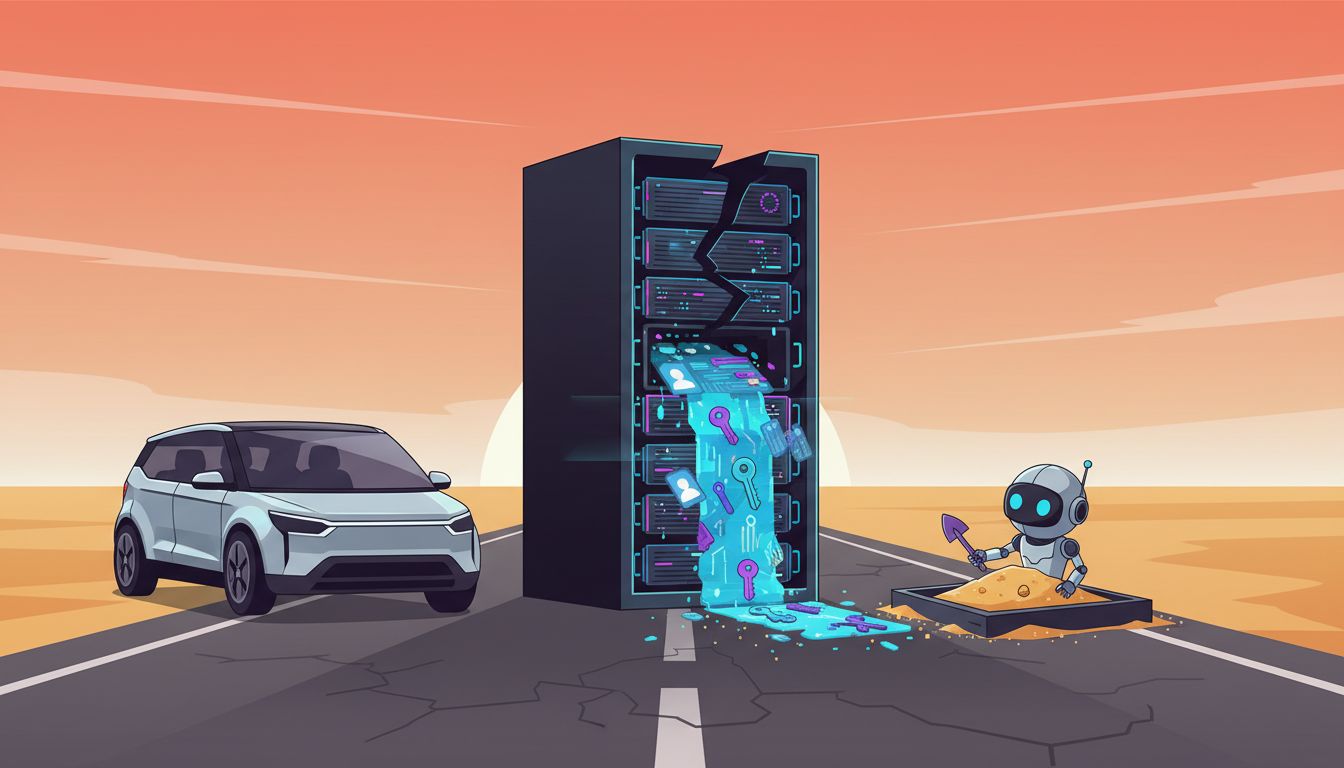
Nvidia lost its CEO with no successor lined up, while AI tools are making its biggest lock-in easier to escape. The rest of the day’s news is about the physical limits on AI: power, memory, launch rockets and export controls.
1. Nvidia’s bigger problem than the scandal: nobody was next in line
Jensen Huang’s exit is the headline, but the sharper story is what he left behind: a company with no ready successor and a software moat that AI is starting to erode. Huang resigned Thursday after reports of an affair with an executive at Nvidia customer Megaspeed, whom the US government reportedly suspects of ties to Chinese intelligence, and of another with an Nvidia employee. WIRED says the board effectively ousted him. CFO Colette Kress is interim CEO. WIRED and TechCrunch both describe a company with no succession plan and a flat structure with dozens of direct reports.
Meanwhile, WIRED reports that Nvidia holds about 80 percent of AI accelerator sales, per Silicon Analysis, but AMD has gone from 2 percent in 2022 to 7 to 10 percent this year. The more interesting claim comes from Wafer, a startup that ports models to AMD hardware. Its CEO says new open-weight models run there at 80 percent efficiency within hours. That is one founder’s boast, but if it holds up, CUDA’s lock-in gets much weaker.
Sales today reflect chips designed two to three years ago, so near-term revenue isn’t the worry. The worry is the roadmap choices being made now by a caretaker. One analyst quoted by WIRED calls this Nvidia’s Intel moment. The open question is whether Nvidia keeps funding the startups and data center projects that TechCrunch says it has committed over $99 billion in investments to.
WIRED · WIRED · TechCrunch
2. Allies tighten AI supply-chain pact, but the details are thin
The Register reports that the US and its allies have deepened a deal to guard AI supply chains against “hostile actors,” with China the unspoken target. The supplied text is only the headline, with no terms, member countries or enforcement mechanisms. So there is no basis yet for claims about sanctions or audits.
The timing matters, though. The same Register page links to a report from an ex-OpenAI engineer, based on forensic analysis, that DeepSeek, Moonshot AI, MiniMax and Ant Group models show signs of training on Nvidia’s Blackwell chips despite export controls. That is a single claim, and it is separate from the pact. But if governments are formalizing rules while evidence of leakage piles up, startups with offshore compute or foreign partners should expect more questions. What the agreement actually requires of companies is still the missing piece.
3. The Michigan-sized data center number is already out of date
Harvard researchers found that 403 US hyperscale data centers used as much electricity in a year as Michigan. The Nature Sustainability study also finds most of that power came from fossil fuels, and data center emissions are three times what they were before the AI boom. Yet the authors say the study may already be outdated. Its average facility draws 40 megawatts, while developers are now planning campuses of hundreds or even thousands.
The bigger gap is that nobody systematically tracks this. WIRED notes that federal and state governments don’t separate data center use from the rest of the power sector, and operators often treat figures as proprietary. The study also omits onsite power plants, which one researcher calls a wild card. As many as 189 gigawatts of behind-the-meter generation are reportedly planned, and BloombergNEF estimates that building all of it could raise US emissions by 10 percent.
The Energy Information Agency has finished pilot surveys and is designing a possible voluntary survey. A separate Register headline says data centers’ share of UK planning applications has nearly tripled in three years. Beyond that, the supplied text offers no detail. The practical point for founders is that power is the input with the least public data, and a voluntary survey won’t change that quickly.
4. Marvell’s memory-pooling pitch targets the RAM crunch, not the RAM bill
Marvell and Penguin Solutions say they have a way around the DRAM shortage: use photonics to share memory between machines. The Register reports that their appliances can pool 16 TB of DRAM and half a terabyte of HBM across up to 16 systems. That is all the supplied text offers. It gives no pricing, benchmarks or shipping dates.
The idea is sensible. Memory stranded in one box can’t help a neighbor, and pooling lets a cluster use what it already owns more fully. But it eases the shortage only at the margin. The memory still has to be bought, and the fabric is one more expensive component to add. Whether pooling beats just paying up depends on latency and cost, and nothing in the supplied text speaks to either.
Any claim of a 20 to 40 percent drop in total cost of ownership would be speculation at this point. Customer tests are what will tell.
5. ULA’s first total mission loss also took Amazon’s satellites
ULA’s Vulcan rocket failed during launch, the first total mission failure in the company’s 20-year history, according to Ars Technica. The Register’s headline says Amazon lost its first batch of broadband satellites on a “custom rocket.” The two reports appear to describe one failure, not two separate ones, though only the headlines were available to confirm that.
The cost lands on two parties. ULA loses a clean record. Amazon loses the first satellites in its effort to build a Starlink competitor, and probably time, though the supplied text doesn’t say how much. Ars frames it as a major blow to SpaceX’s competitors, and that is plausible: one rival’s failure adds to SpaceX’s lead in launch reliability.
Nothing in the supplied sources ties this to AI infrastructure. It is a story about broadband and launch competition. The details to watch are the cause of the failure and when Vulcan flies again.