
Deletion sounds like the simplest operation in computing. You have a thing. You remove it. Done. But anyone who has spent real time in production systems knows that deletion is where complexity hides. It touches distributed architecture, legal compliance, user trust, referential integrity, and the fundamental question of what it even means for data to be “gone.” Here are the reasons deletion deserves far more engineering respect than it gets.
1. Data Is Almost Never Stored in One Place
When a user deletes their account, the obvious target is the users table. But that same user’s ID is probably sitting in an orders table, an audit log, a recommendation model’s training set, a third-party analytics pipeline, a data warehouse that syncs nightly, and a backup that runs weekly. The relational database you designed carefully has foreign key constraints that will throw errors if you try to delete the parent row. The other systems have no constraints at all, which is worse.
This is the fan-out problem. A single logical delete can require coordinated writes across a dozen systems, some of which you own, some of which are vendor products, and some of which belong to other teams who may not even know you’re asking. The more microservices a company has adopted, the more pronounced this gets. Distributed systems make writes fast and cheap by deferring consistency. Deletion forces you to collect that debt all at once.
2. GDPR and CCPA Turned “We Should Delete This” Into a Legal Deadline
Before 2018, data deletion was mostly a hygiene concern. After GDPR came into force in the EU, it became a compliance obligation with fines attached. The regulation grants users a “right to erasure,” and the California Consumer Privacy Act extended similar rights in the US. Companies have to honor deletion requests within defined time windows, and they have to be able to prove they did it.
This is where many systems hit a wall. Audit logs exist specifically to be immutable. Backups exist specifically to be complete. A GDPR deletion request is, in technical terms, a demand to retroactively rewrite history across systems that were architecturally designed to resist exactly that. Some companies handle this by storing personally identifiable information in a separate layer that can be nulled out while keeping event records intact. Most companies, when the regulation hit, discovered they had no such layer and had to build it under time pressure.
3. Soft Deletes Create Their Own Mess
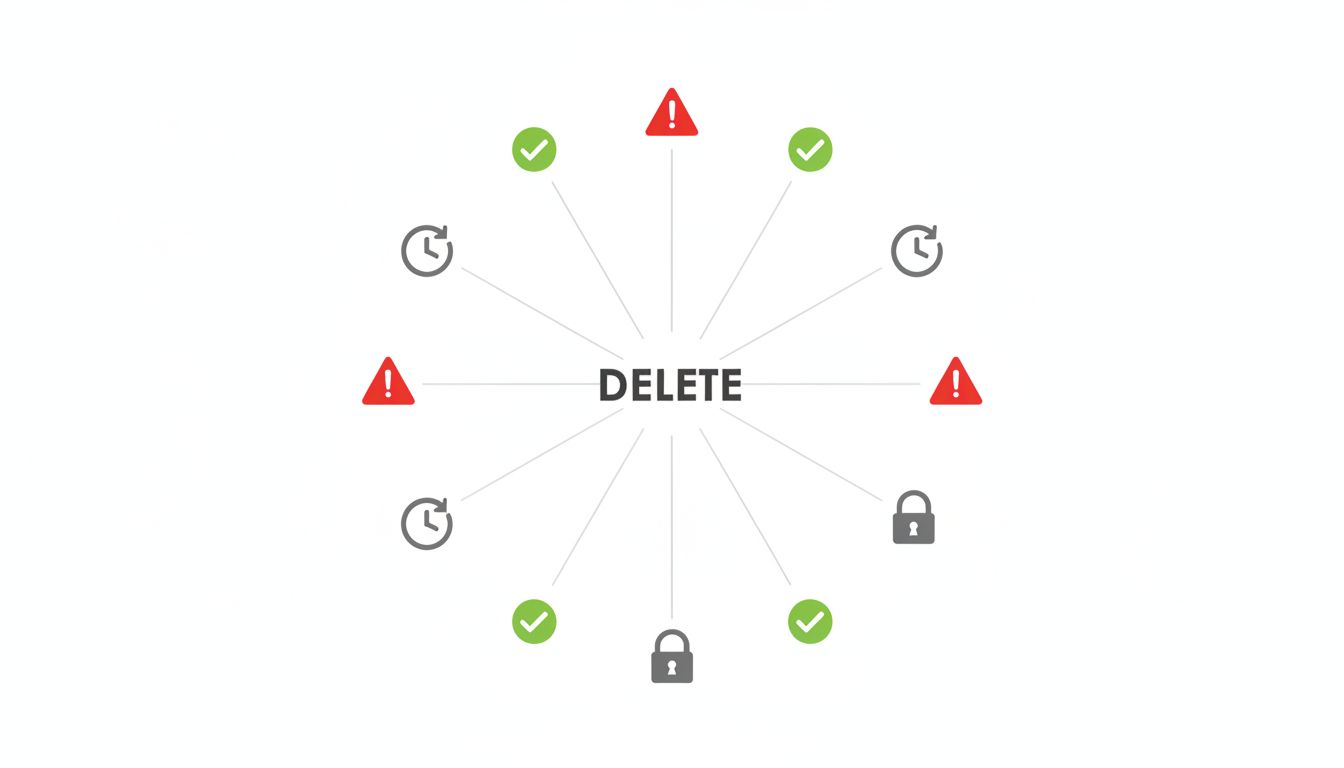
The standard engineering response to deletion anxiety is the soft delete: add an is_deleted flag or a deleted_at timestamp, and just filter it out in queries. This feels safe. You can recover the data if something goes wrong. But soft deletes are a form of debt that compounds quietly.
Every query that touches that table now needs to include the filter. If one query forgets it, you have a data leak. Your indexes grow because they still include the “deleted” rows. Your row counts stop meaning what they appear to mean. And critically, soft deletes do not satisfy GDPR’s right to erasure, because the data is still there. Soft deletes solve the “oops” problem while making the compliance problem and the performance problem worse. They are often the right tradeoff, but only if you treat them as a deliberate architectural choice with known costs, not as a way to avoid making a decision.
4. Deletion in Distributed Systems Is a Consistency Problem
In a distributed database, there is a class of problem called the tombstone. When you delete a record in a system like Apache Cassandra, the deletion is not an absence of data. It is a presence of a marker that says this data was deleted. That marker has to outlive any replicas that might still hold the original value, otherwise a read-repair operation can resurrect the deleted data. Cassandra calls the time window for this the gc_grace_seconds, and if you do not configure it carefully relative to your repair schedule, deleted data comes back.
This is not a niche problem. It is a fundamental property of eventual consistency. You cannot have both “deletion is instantaneous” and “the system tolerates network partitions.” Tony Hoare’s null pointer is the famous example of a convenient shorthand creating decades of downstream pain. Tombstones in distributed systems are a quieter version of the same bargain.
5. Machine Learning Models Remember What You Feed Them
This is the newest and least-solved version of the problem. When a user’s data is used to train a machine learning model, deleting the raw data does not delete its influence. The model’s weights have encoded something about every example it was trained on. There is an active research area called machine unlearning that is trying to figure out how to remove a data point’s influence from a trained model without retraining from scratch, which is often computationally prohibitive.
The practical reality for most companies today is that they cannot honor a deletion request with respect to trained models. They can delete the raw data. They can exclude the user from future training runs. But the model that is currently serving predictions still contains a ghost of that user’s behavior. Regulators have not fully caught up to this yet, but they are moving in that direction. The companies that will be ready are the ones building deletion into their ML pipelines now, not after the rule arrives.
6. “Deleted” Means Different Things to Different Stakeholders
A user deleting their account wants to feel like they never existed in your system. A finance team needs to retain transaction records for seven years for tax purposes. A security team needs audit logs to investigate incidents. A product team wants to preserve anonymized behavioral data for analytics. These are all legitimate requirements, and they are in direct tension.
The engineering work of deletion is partly technical and partly about forcing an organization to make explicit choices it would rather defer. What counts as personal data? What counts as anonymized? Who has authority to override a deletion request, and under what circumstances? Systems that handle deletion well have usually had those conversations. Systems that handle it badly usually have not, and they have built infrastructure that reflects the ambiguity rather than resolving it. Getting deletion right is, in the end, mostly a product and organizational problem that happens to require precise technical execution.