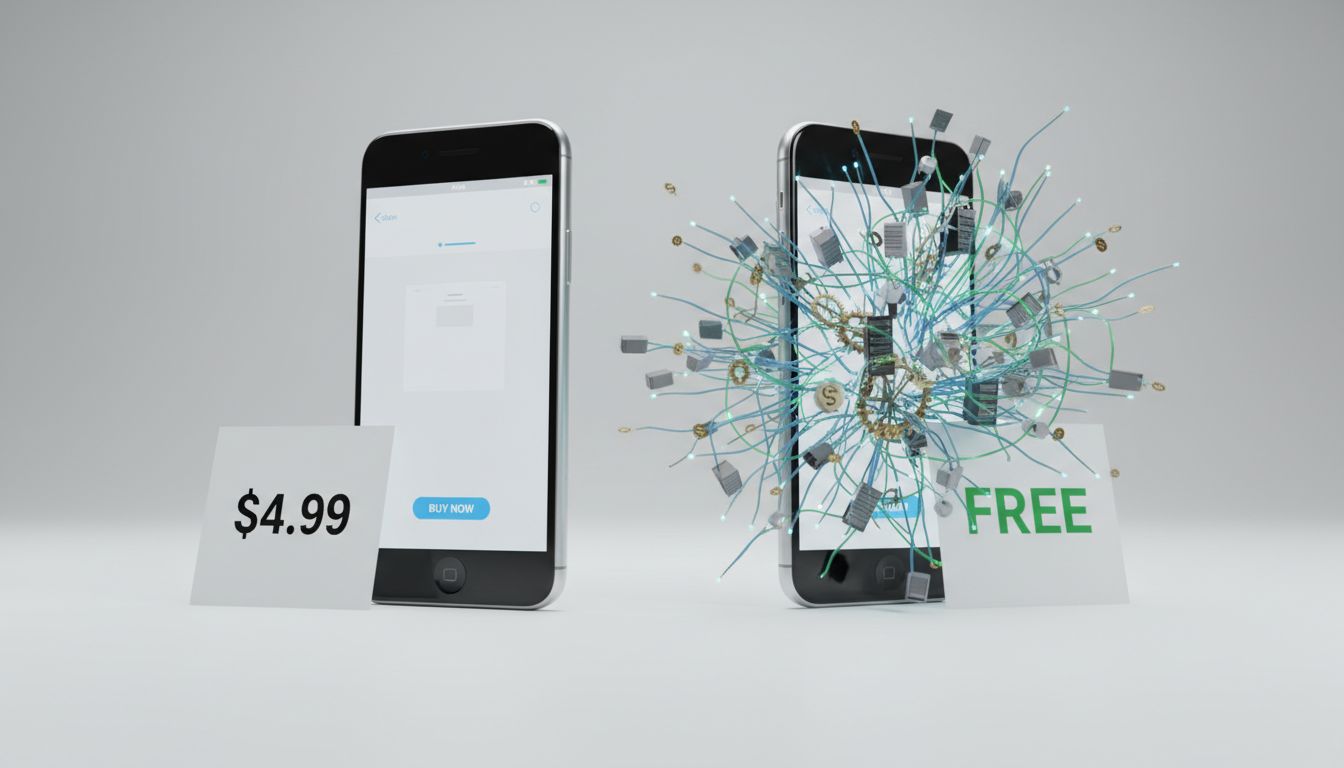
Building a paid app is relatively simple. You make something, you charge for it, and the transaction is honest. Building a free app is something else entirely, a financial architecture so complex and expensive that most founders don’t fully understand what they’ve signed up for until they’re already underwater.
The Trojan Horse Economy explains the strategic logic of free software beautifully, but the tactical, day-to-day cost reality deserves its own reckoning.
The Infrastructure Tax Nobody Talks About
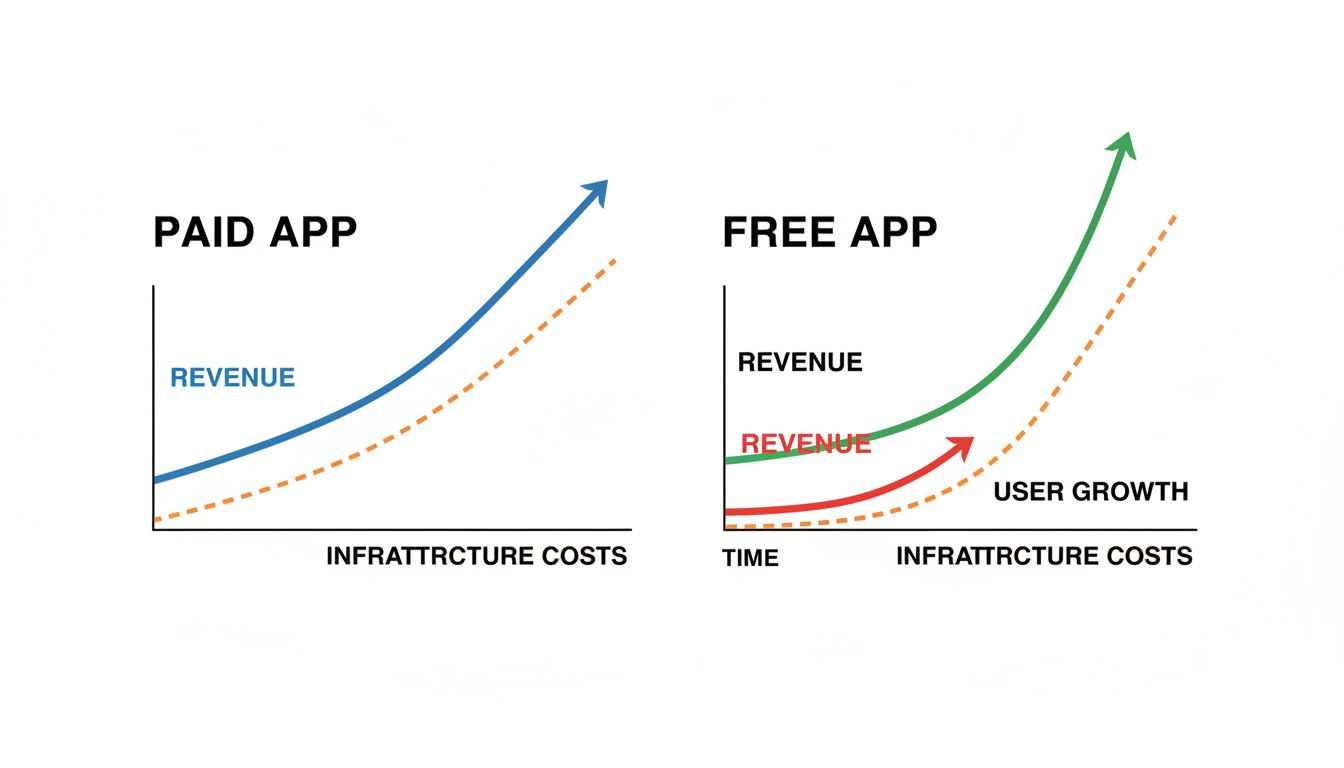
When you charge users money, your infrastructure scales with revenue. When you give your product away, infrastructure scales with users, and those two curves rarely move together. Free apps must be engineered to handle millions of users before a single dollar arrives. Paid apps can grow infrastructure incrementally, funded by the customers already paying.
Spotify spent years hemorrhaging cash on server costs before its advertising and premium conversion math started working. Dropbox famously offered so much free storage that its customer acquisition cost ballooned to levels that made most paid-app founders wince. The company spent more acquiring free users than many subscription competitors spent acquiring paying ones.
This is the infrastructure tax: every free user is a liability on the balance sheet, a bet that their future value (through ads, upgrades, or data) will eventually exceed the cost of serving them. Most of the time, that bet loses.
Monetization Engineering Is a Product in Itself
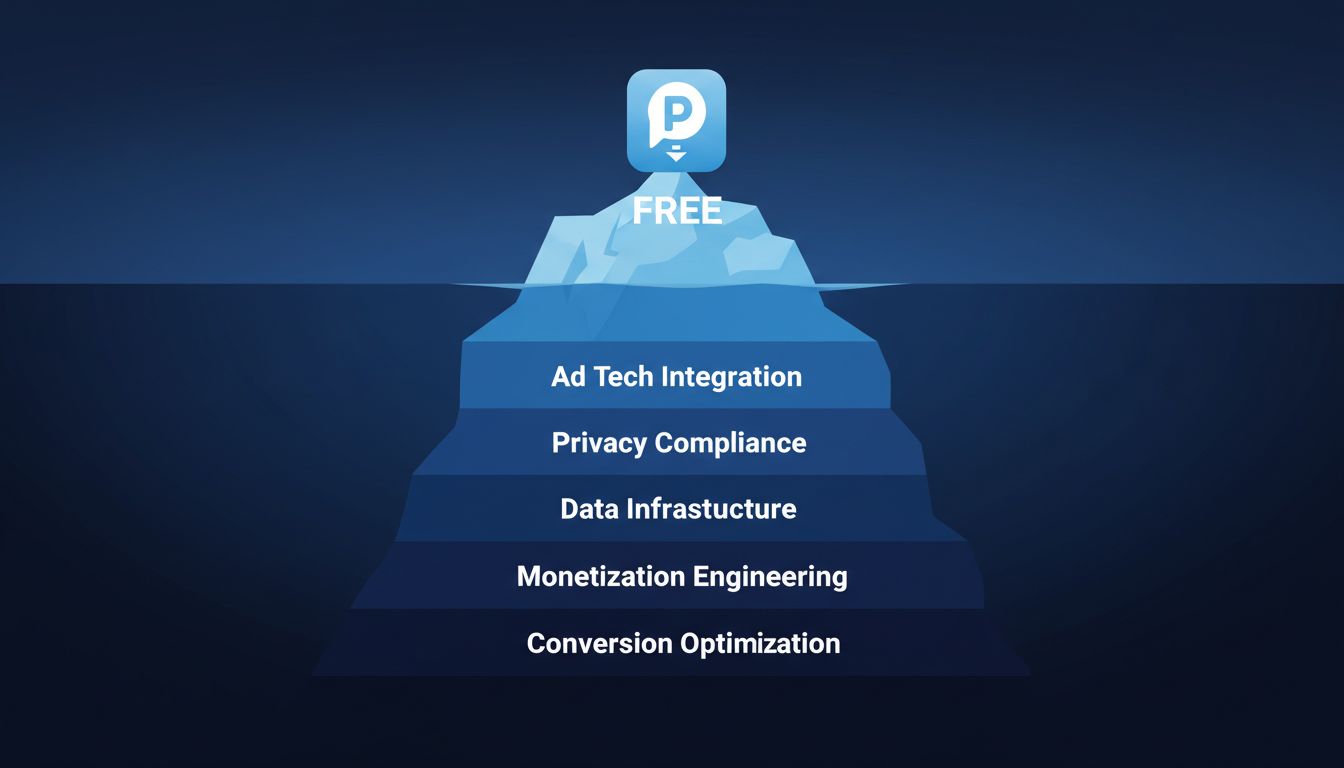
Here’s what founders building “free” products rarely budget for: the monetization layer is a second product, as complex and expensive as the core app itself.
Ad-supported apps require ad tech integrations, privacy compliance frameworks, brand safety tooling, and auction optimization systems. They need teams who understand fill rates, CPMs, and the Byzantine relationships between publishers and demand-side platforms. They require constant A/B testing to find the precise density of ads that maximizes revenue without triggering user churn, a balance so delicate that entire companies exist just to help other companies find it.
Freemium apps are no simpler. The paywall has to be engineered to feel fair rather than coercive. The free tier has to be genuinely useful (otherwise users don’t stick around) but not so useful that nobody upgrades. Research into how productivity apps are designed reveals just how much psychological architecture goes into keeping users engaged and nudging them toward paid tiers, an architecture that paid-only apps simply don’t need to build.
Data-monetization models are the most expensive of all. Collecting data at scale, cleaning it, structuring it, and packaging it for advertisers or partners requires infrastructure that dwarfs what most apps need to simply function. The machine learning systems that power social media recommendation engines exist largely to make user data more valuable to advertisers. That engineering doesn’t come cheap.
The Support Paradox
Paid users are fewer but more forgiving in one specific way: they accept that premium support costs money. Free users expect Rolls-Royce service at no charge, and they have the social media platforms to demand it loudly.
This creates a brutal staffing calculus. Scale a free app to ten million users and you’ve inherited ten million potential support tickets, ten million potential one-star reviews, ten million people who paid nothing and feel entitled to everything. The cost of managing that relationship, even with automation, is staggering. Tech companies have tried to solve this with AI-driven support, but the economics only improve marginally. The volume problem doesn’t go away just because a robot is answering the tickets.
Paid apps, by contrast, serve a smaller, self-selected user base. Customers who paid money are more likely to read documentation before complaining, more likely to engage constructively, and far less likely to brigade an app store page because a free feature was removed.
Why Founders Keep Making This Mistake
If free apps are so expensive, why does every other startup default to the model? A few reasons.
First, venture capital has historically rewarded user growth over revenue, which made “free to grow fast” a rational strategy for VC-backed founders even when it was economically irrational for the business. That era is ending, but its assumptions persist in pitch decks everywhere.
Second, founders often underestimate how different the iteration cycle is. Paid apps can listen carefully to their first customers and adjust pricing or features based on real willingness-to-pay signals. Free apps accumulate millions of users whose preferences are genuinely diverse and often contradictory, making product decisions exponentially harder and more expensive to validate.
Third, free feels safer because it lowers the barrier to adoption. But lowering the adoption barrier means every person on earth is a potential user, which means the product has to be engineered for far more diverse use cases, devices, connectivity conditions, and accessibility needs than a focused paid product serving a specific customer.
The pattern of founders learning this the hard way across multiple companies is well documented. The founders who crack it the second or third time usually do so by choosing a monetization model before writing a line of code, not after.
The Honest Math
None of this means free apps are always the wrong choice. Advertising-supported models work at scale. Freemium works when conversion economics are understood deeply. Data monetization works when executed legally and ethically (and increasingly, those constraints are making it far more expensive to execute at all, as privacy regulations tighten globally).
But the honest math, the math that most pitch decks skip, is this: a free app requires you to build not one product but three. The core product, the monetization system, and the trust infrastructure that keeps users engaged long enough for either to work. Each of those is a real engineering investment. Each has real operational costs. And unlike a paid app, where the customer’s credit card is your clearest signal that you’ve built something worth building, a free app can accumulate millions of users and still be economically worthless.
The next time someone describes their app as “free,” ask them to describe their monetization architecture. If they can’t answer in two minutes or less, they probably haven’t done the math. And the market, eventually, will do it for them.