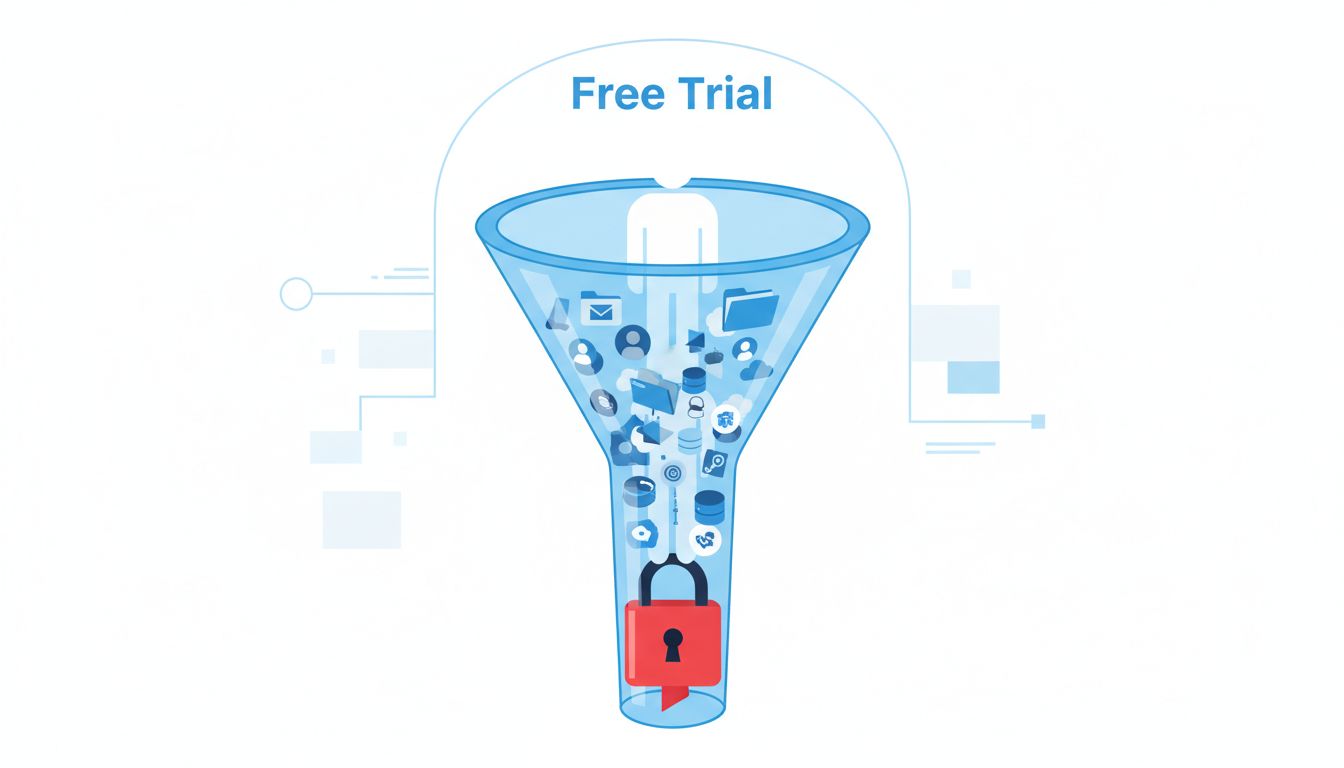
The average free trial converts at somewhere between 15 and 25 percent, depending on the product category. That number sounds modest until you realize it was never the point. The companies running these trials are not measuring success by how many users upgrade at the end of 14 days. They are measuring something far more durable: how deeply a user has embedded the product into their daily workflow before the billing question ever appears.
This is the quiet economics of platform lock-in, and it operates almost entirely in plain sight. Tech companies use dark patterns and psychological design to guide behavior at every step of the product experience, but the free trial is perhaps the most structurally elegant tool in that playbook. It does not trick you. It simply makes leaving feel like too much work.
The Trial Is a Data Collection Event, Not a Sales Pitch
When Salesforce onboards a new trial user, the first thing it asks you to do is import your contacts. When Notion starts a new workspace, it prompts you to create pages, link databases, and invite teammates. When Slack welcomes a new organization, it immediately pushes integrations with every tool the company already uses.
None of this is accidental. Each of these actions deposits something irreplaceable into the platform: your data, your structure, your colleagues’ habits. By day three of a 14-day trial, a reasonably active user has already performed what behavioral economists call “endowment” behavior. You begin to feel ownership over the thing you have built inside the platform, even though you built it during a period of ostensible evaluation.
Adobe understood this years before most of the SaaS industry caught up. When Adobe moved from perpetual licenses to Creative Cloud subscriptions in 2013, it faced enormous backlash. Subscription revenue dipped initially. But within 18 months, churn had dropped to historically low levels. The reason was not that the product had improved dramatically. It was that the trial-to-subscription pipeline had been redesigned so that users arrived at the billing screen with months of project files, custom brushes, saved settings, and collaborative workflows already living inside Adobe’s ecosystem. Leaving meant losing all of it.
Switching Costs Are Built Deliberately, Not Accidentally
The economics of software switching costs are worth understanding precisely because they are so rarely discussed honestly. A user who leaves a platform after a 14-day trial costs that company almost nothing. A user who leaves after two years of active use is a different calculation entirely.
Research from the technology consulting firm Blissfully (now part of Vendr) found that the average mid-size company uses over 130 distinct SaaS applications. Yet churn rates for established platforms remain remarkably low, typically between 3 and 8 percent annually for products with strong workflow integration. The gap between those two facts, a crowded market and low churn, is explained almost entirely by switching costs that were engineered into the product from the beginning.
This connects directly to a broader pattern in how software is actually priced and positioned. Software licenses frequently cost more than the hardware they run on, which looks irrational until you account for the fact that switching a software vendor is categorically more expensive than buying a new machine. The switching cost is not charged on the invoice. It is paid in time, retraining, data migration, and disrupted workflows.
Platforms design their free trials to front-load as much of that cost as possible. Every integration you connect, every template you customize, every team member you add, is an invisible line item that appears only when you try to leave.
The Onboarding Checklist Is an Anchor, Not a Tutorial
Most users experience onboarding checklists as helpful guidance. “Connect your calendar. Import your data. Invite your first colleague.” These feel like product tutorials. Functionally, they are anchoring mechanisms.
Behavioral research consistently shows that completion instincts are powerful motivators. When a platform shows you a checklist at 70 percent complete, the psychological pull toward finishing it is strong enough to override cost-benefit reasoning about whether the product is actually worth subscribing to. Duolingo built an entire retention strategy around this principle. HubSpot’s onboarding sequence is specifically designed to reach a “moment of value” that coincides with the user completing enough setup steps that migration would feel burdensome.
The sophistication here is worth acknowledging. Tech companies deliberately cripple their best features at certain tiers precisely to make the trial feel incomplete until you upgrade, which means the checklist and the feature gates work in tandem. You are nudged toward building more inside the platform while simultaneously being shown a ceiling just above your current reach.
Why Teams Are the Ultimate Lock-In Vector
Individual lock-in is manageable. Organizational lock-in is nearly permanent.
This is why almost every major platform with a free trial aggressively pushes team invitations during the trial period. Slack’s viral growth model, which the company documented openly in its early investor materials, was built on the premise that each additional user added to a workspace multiplied switching costs exponentially. Leaving Slack is not just a personal decision once your whole organization is on it. It is a coordination problem requiring buy-in from every stakeholder who has built habits, integrations, and institutional memory inside the product.
Microsoft understood this when it bundled Teams into Office 365 and offered it free to existing enterprise customers. The product did not need to win on merit in early markets. It needed to become embedded in organizational workflows before anyone ran a formal evaluation. SaaS companies routinely lose money on their cheapest tier on purpose because the economics only work if you account for what that cheap entry point eventually becomes once switching costs have accumulated.
Once a team has stored its documentation, communication history, and project structure in a single platform, the question is no longer “Is this the best tool?” The question becomes “Is moving worth the disruption?” Almost always, the answer is no.
What This Means for Anyone Evaluating Platforms
Understanding this dynamic does not make free trials less useful. It makes evaluation more honest. The right question to ask at the start of any trial is not “Does this product work well enough to pay for?” It is “What would it cost us, in time and disruption, to leave this platform in three years?”
That question changes the evaluation criteria entirely. Data portability matters more than feature polish. Export functionality is more important than import convenience. API openness, ironically often made deliberately difficult by the same companies running the trials, becomes a critical due-diligence factor rather than a developer footnote.
The free trial is a genuinely useful product discovery tool. It is also a carefully constructed on-ramp to a road that becomes progressively harder to exit. The companies building these trials are not hiding that fact. They are simply counting on the fact that most users will not think to ask about it until they are already committed.