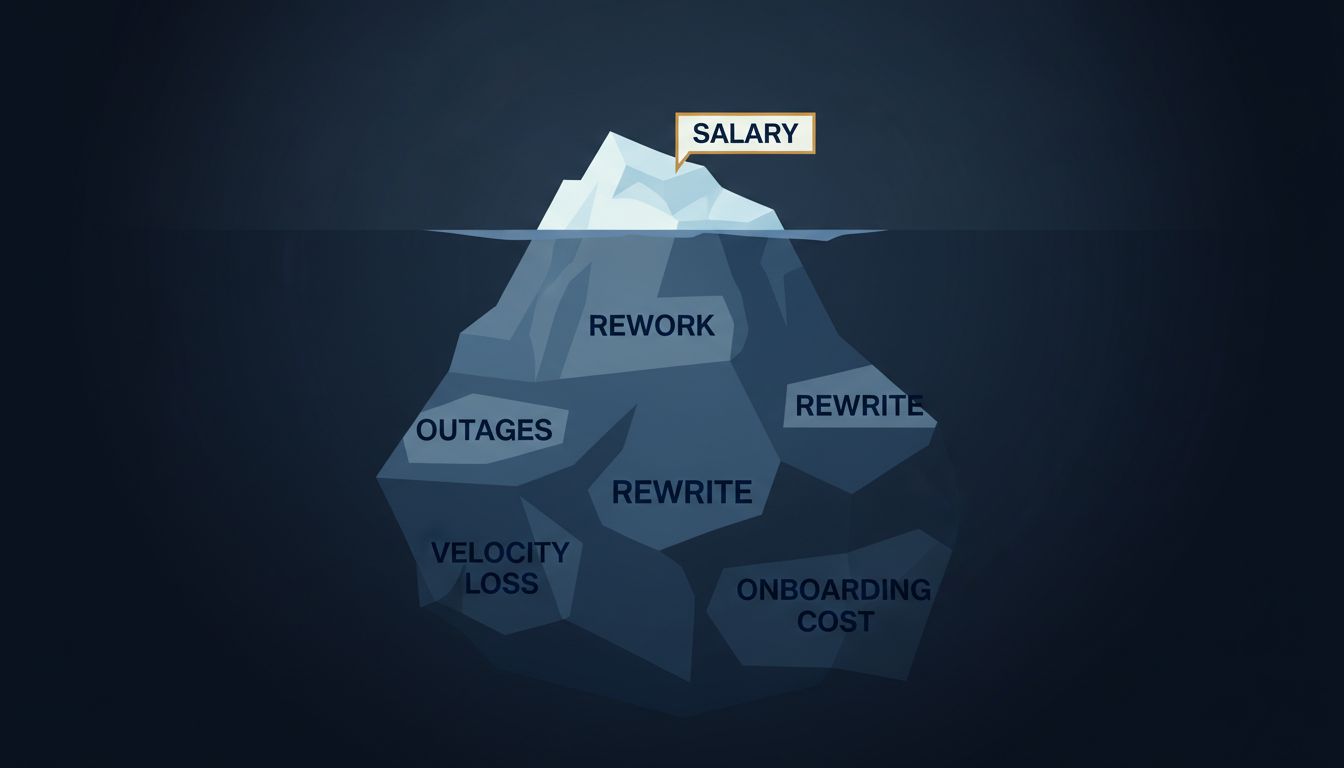

In early 2023, Mark Zuckerberg declared the ‘Year of Efficiency.’ Meta had already cut roughly 11,000 employees in November 2022, and it was about to cut 10,000 more. The stock, which had lost nearly two-thirds of its value across 2022, began one of the most dramatic recoveries in the history of large-cap tech. By the end of 2023, Meta reported net income of $39.1 billion, up 163 percent from the prior year.
The press covered this as a story about discipline, about a chastened Zuckerberg finally listening to investors who had grown tired of metaverse spending. That framing is not wrong, but it is incomplete. The efficiency story obscures something more structurally important: Meta did not become more profitable because it cut costs. It became more profitable because it finally stopped hiding them.
The Setup: The Overhiring Was the Product
Between 2020 and late 2022, Meta’s headcount grew from roughly 58,000 employees to over 87,000. This was not anomalous. Across the industry, companies that had been printing money through the pandemic added engineers at a pace that bore no relationship to the actual complexity of their products or the growth of their revenue. Google’s headcount grew by roughly 30,000 people in 2021 alone. Amazon added hundreds of thousands across its workforce.
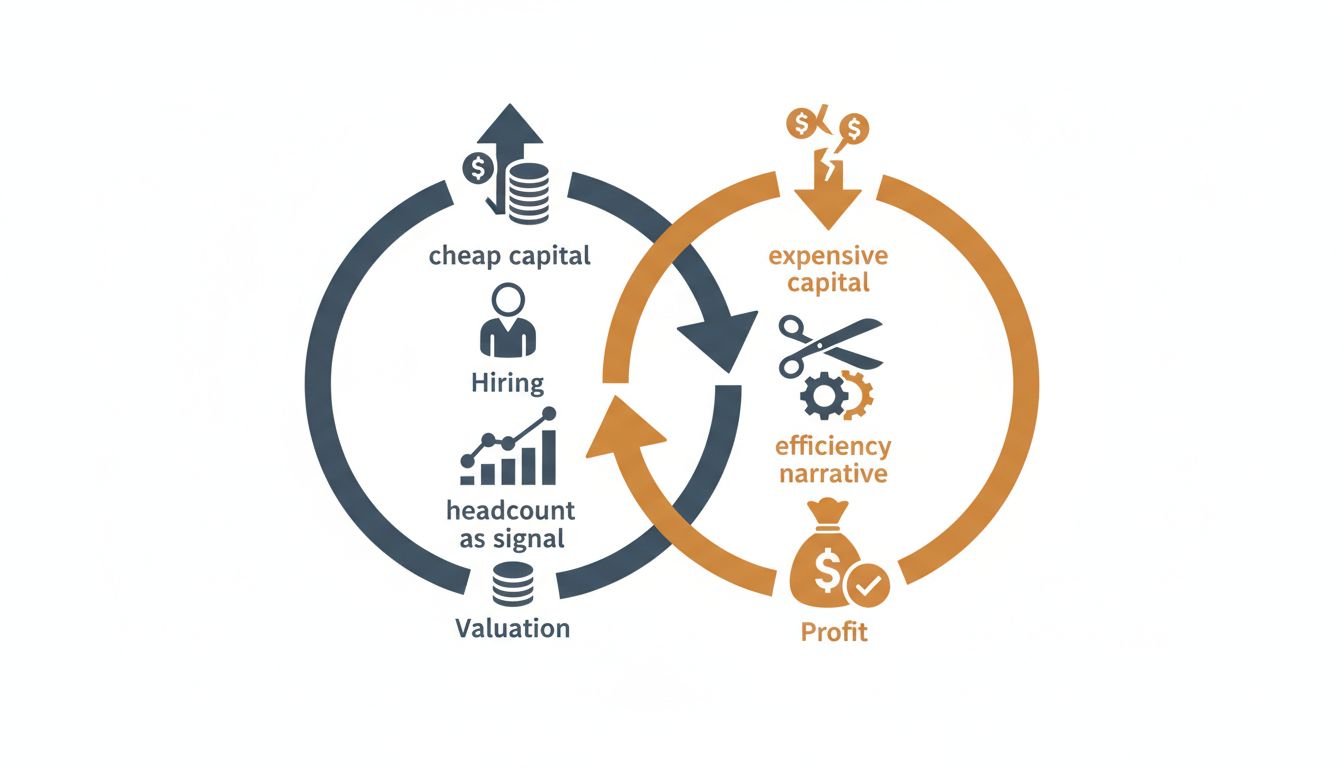
The standard explanation is that the companies were competing for talent, that hiring was a defensive move to prevent rivals from acquiring the engineers who would build the next thing. There is truth in this. But the fuller explanation is that free capital made overhiring costless in the short term, and possibly profitable. When your valuation is a multiple of revenue growth, adding headcount signals ambition. Engineers on payroll become a story about future capability even if their current output is marginal. The workforce itself was a financial instrument.
This is the hidden mechanism. The layoffs did not reveal newfound discipline. They revealed that the discipline was never necessary when money was free, and became immediately necessary when it wasn’t.
What Happened: Efficiency as Accounting, Not Operations
When Meta conducted its cuts, the company did not meaningfully shrink its product surface. WhatsApp, Instagram, and Facebook continued to operate with the same feature sets. The advertising infrastructure, which generates nearly all of Meta’s revenue, was not rebuilt with a smaller team. What changed was the ratio of revenue to compensation expense.
In 2021, Meta’s total costs and expenses were $56.7 billion against revenue of $117.9 billion. In 2023, with a leaner headcount, total costs and expenses dropped to $88.2 billion against revenue of $134.9 billion. The margin expansion was not primarily a product story. It was a labor cost story.
This matters because it means the work that was eliminated was, by revealed preference, not necessary work. Or it was work that had been packaged as necessary, presented to management as essential infrastructure, and approved because the cost of approval was low. Large engineering organizations develop their own gravity. Teams justify their existence through roadmaps. Roadmaps justify headcount. Headcount justifies more roadmaps. When the money runs out, it turns out that a meaningful fraction of those roadmaps were optional.
Zuckerberg acknowledged this indirectly when he described a management structure that had become too layered, too slow. What he was describing is what happens when hiring outpaces purpose. You don’t just add engineers. You add the coordination costs around them, the managers, the meetings, the tools, the processes. Your digital calendar fills with exactly the kind of work that looks like productivity but produces nothing.
Why It Matters: This Is Structural, Not Cyclical
The tech industry tends to present these layoff cycles as a response to macroeconomic conditions, a correction to pandemic-era distortions, a recalibration. This framing is convenient because it implies the next expansion will be different, more measured, more rational.
It won’t be, for a straightforward reason: the incentives that produced the overhiring have not changed. When interest rates fall and growth multiples expand again, hiring will accelerate. The workforce will again function partly as a signal of ambition rather than purely as a driver of output. The cycle is not a bug in how these companies are managed. It is a feature of how they are valued.
What changed in 2022 and 2023 was the cost of capital, not the character of the companies. Investors who had rewarded growth at any cost began penalizing it. Companies that had been optimizing for one set of signals immediately began optimizing for another. The engineers who lost their jobs were not victims of poor individual performance reviews. They were the residue of a compensation structure that no longer made sense once the valuation math changed.
This is also why the profit numbers look so dramatic. The gains are real, but they are partly an accounting artifact of how much was being spent on optional work during the expansion. A company that was burning capital on low-priority projects for three years and then stops is not becoming more efficient. It is reverting to a sustainable baseline while recording the distance between the two as profit improvement.
What We Can Learn
The lesson is not that tech companies are cynical or that engineers are expendable. The lesson is about what growth capital actually purchases when it flows into mature software businesses.
For a genuinely early-stage company building novel infrastructure, headcount and output scale together reasonably well. The engineering problems are hard, the solutions don’t exist yet, and more skilled people genuinely accelerate the work. But for a company with a functioning product and a known distribution channel, adding engineers past a certain threshold produces coordination overhead faster than it produces useful software. The productivity research on this has been consistent for decades, from Fred Brooks’ observations in the 1970s forward.
What the 2020-2022 hiring boom demonstrated is that the companies themselves knew this, at least implicitly. The fact that they could cut thousands of engineers and maintain or improve their products is not evidence that they hired carelessly by accident. It is evidence that the hiring served a purpose other than building software.
For anyone trying to understand where tech profits actually come from, the Year of Efficiency is a useful case study. The profits were always there. They were being deferred, converted into headcount, and reported as investment. When the investment case collapsed, the profits reappeared. The underlying business had not changed at all.