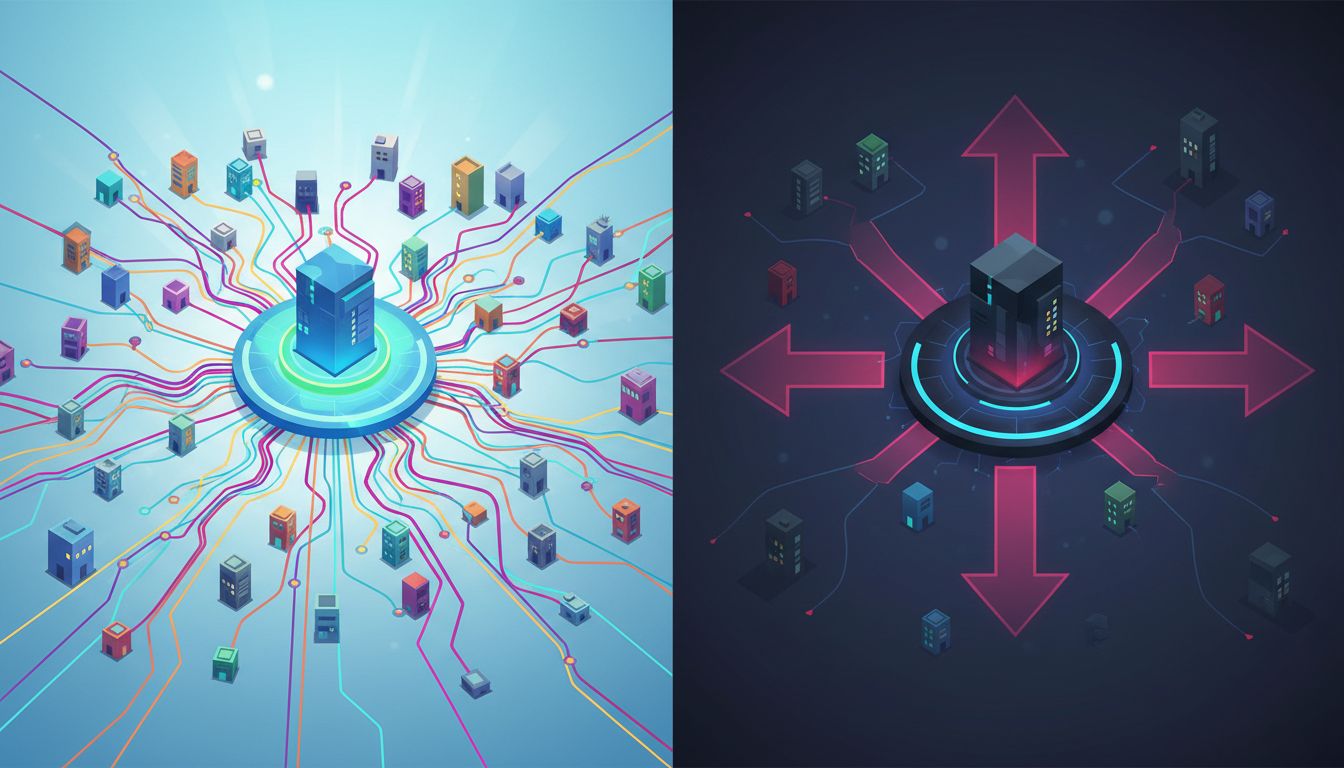

The conventional story about Big Tech dominance goes something like this: a brilliant company builds a superior product, wins customers, and grows so large that competitors can’t catch up. That story is almost entirely wrong. The most durable advantages held by platform companies, from Uber to Meta to Apple’s App Store, were not earned through product quality alone. They were engineered through a specific economic mechanism that turns user growth itself into a competitive weapon, one that quietly makes the market uninhabitable for anyone who arrives second.
That mechanism is the network effect, and most people who cite the term dramatically underestimate what it actually does. It doesn’t just help platforms grow faster. At sufficient scale, it structurally prevents viable competition from forming in the first place. The economics behind this are closely tied to how free software became one of tech’s most profitable strategies.
The Math That Builds Walls
Metcalfe’s Law, formulated by Ethernet inventor Robert Metcalfe, states that the value of a network scales with the square of its number of users. A network with 10 users has a potential value of 100. A network with 1,000 users has a potential value of 1,000,000. The ratio is not linear, it is exponential, and that gap is what makes late entry so punishing.
Consider WhatsApp when Facebook acquired it in 2014 for $19 billion. At the time, the app had roughly 450 million monthly active users. A competitor building an objectively better messaging app at that moment faced a problem that had nothing to do with engineering. Their superior product would be worth nothing to a user whose contacts were all on WhatsApp. The value was not in the software. It was in the address book.
This is why platform companies spend so aggressively on growth during their earliest phases, often at significant losses. The goal is not immediate profitability. The goal is to reach a threshold of users beyond which the network itself becomes the product, and the switching cost for any individual user becomes functionally prohibitive.
Predatory Compatibility and the Open-Door Trap
One underappreciated tactic platforms use to cement early dominance is what economists call “open-door” interoperability. In their growth phase, platforms make it extremely easy to import contacts, share to other networks, or integrate with outside tools. Facebook famously allowed users to find friends by importing email contacts. Twitter made its API freely available for years, allowing third-party apps to build audiences on top of it.
The logic is counterintuitive. By making themselves compatible with everything else, platforms accelerate user acquisition. Then, once network density reaches a critical point, the door quietly closes. Twitter began restricting its API in 2012, then more aggressively after 2023. Facebook deprecated contact-import features that had helped it grow. The open door was always a growth mechanism, not a philosophy.
This pattern explains why early startup strategy sometimes involves leaving features deliberately incomplete, seeding adoption rather than optimizing product, because the goal at that stage is network density, not product perfection. Some startups have formalized this approach, winning precisely by leaving things deliberately broken.
Data Asymmetry as a Barrier to Entry
Network effects are compounded by a second and less visible moat: proprietary data. The longer a platform runs, the more it understands about user behavior, and that understanding cannot be replicated by a new entrant regardless of their engineering talent or funding.
Google processes roughly 8.5 billion searches per day. Each search, each click, each result that gets ignored feeds back into ranking algorithms that have been trained on decades of behavioral data. A new search engine with a technically superior algorithm still starts with no behavioral data. It cannot know which results users actually found useful, which queries were ambiguous, or how intent varies by time of day and geography. The gap in training data is not a temporary disadvantage. It compounds every day Google operates.
The same dynamic applies to recommendation systems. The machine learning models that decide what users see on platforms like YouTube or TikTok are only as good as the behavioral data they are trained on. How those algorithms shape what billions of people see every day is one of the least understood power structures in modern media. A competitor can hire the same engineers. They cannot replicate five years of engagement data.
The Kill Zone
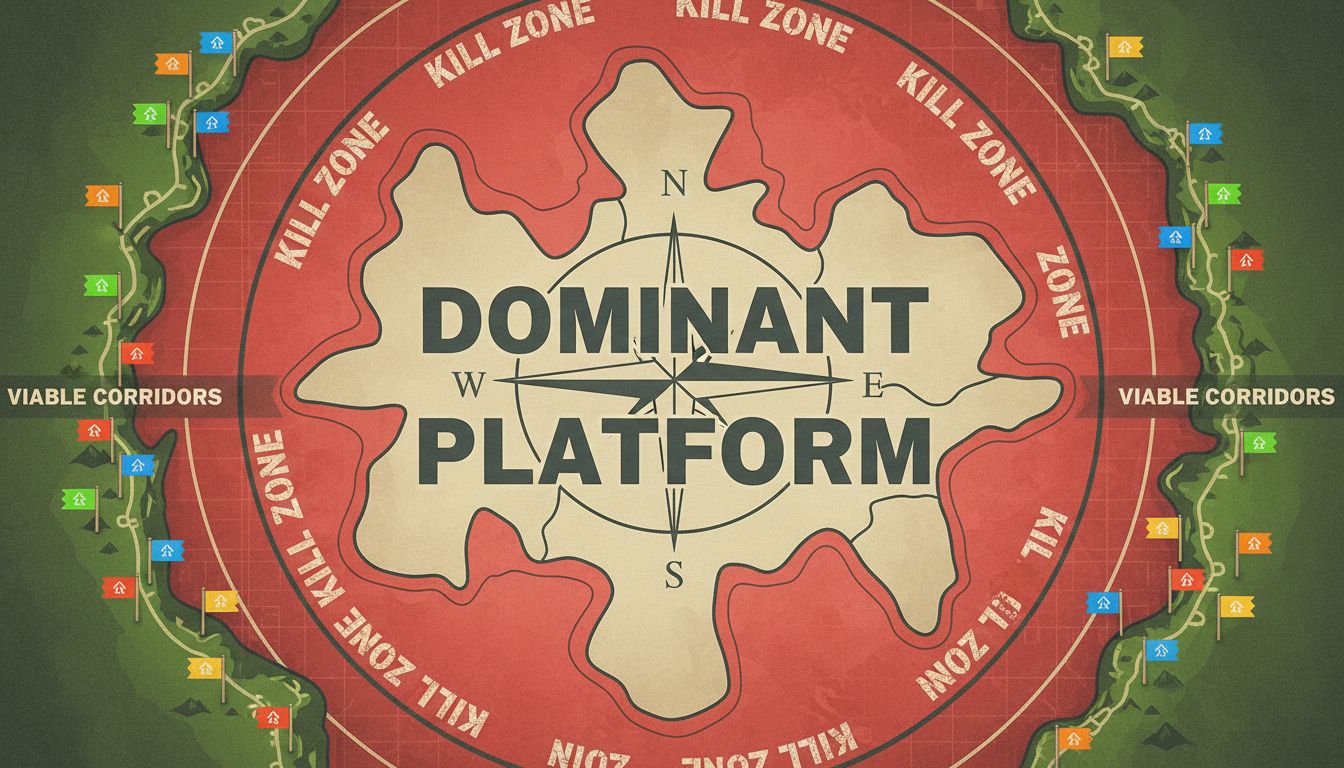
Venture capitalists have begun using the term “kill zone” to describe the product categories immediately adjacent to large platforms, spaces where startups are rational not to compete because the platform can copy, acquire, or starve any emerging threat before it reaches meaningful scale.
A 2019 paper by economists Sai Krishna Kamepalli, Raghuram Rajan, and Luigi Zingales found that startup investment in categories overlapping with major platforms declined measurably after those platforms achieved dominance. The chilling effect was not primarily about acquisition, it was about anticipation. Founders and investors simply stopped funding companies in spaces where a platform could neutralize the threat with a feature update.
Apple’s addition of native screen-time controls to iOS in 2018 effectively commoditized an entire category of third-party apps overnight. Google’s integration of travel search decimated companies like Kayak and Hipmunk. These were not accidents. They were the network effect functioning as designed, absorbing adjacent value before competitors could capture it.
This is also why many investors consistently miss the companies that do break through. The ones that succeed often do so in spaces that look too small, too boring, or too peripheral to attract platform attention until it is too late. The history of overlooked unicorns reveals a consistent pattern in how incumbents and investors alike misjudge where durable value actually forms.
What Survives the Moat
The companies that successfully compete against entrenched platforms tend to share one characteristic: they do not compete on the same network. They find a dimension of value that the incumbent’s user base actively works against.
Slack did not beat email by being a better email. It created a different kind of network, one organized around teams rather than individuals, where the incumbent’s scale in the consumer market was irrelevant. Zoom did not compete with Skype by acquiring more users. It competed on reliability and simplicity in a specific use case where Skype’s sprawling feature set was a liability rather than an asset.
The lesson for founders is structural, not tactical. You cannot outgrow a network effect by adding features or cutting prices. You can only circumvent it by defining a network geometry where the incumbent’s connections do not transfer. That requires clarity about which users you are not trying to serve, and the discipline to resist expanding into the incumbent’s territory before your own network has density.
Platforms do not win by being best. They win by becoming the infrastructure through which value flows, and then collecting a toll on everything that passes through. Understanding that dynamic is the first step toward building something that can survive outside its walls.