Every SaaS company with a pricing page has a dirty secret sitting in plain sight. That nine-dollar-a-month starter plan, the one with the friendly green checkmark and the words “perfect for individuals,” is almost certainly a money-losing product. Not accidentally. Not temporarily. Structurally, permanently, and by design.
This is not a story about startup naivety or bad unit economics. It is a story about one of the most sophisticated psychological and strategic instruments in modern software business, one that borrows more from behavioral economics than from accounting. To understand it fully, you have to stop thinking about the cheap tier as a product and start thinking about it as infrastructure. Tech giants lose money on purpose to win markets all the time, and the entry-tier playbook is the same logic applied at the individual customer level.
The Real Cost of a Free (or Near-Free) User
Let’s get concrete. A typical SaaS company serving a starter-tier customer at ten dollars per month faces a cost structure that most investors would find uncomfortable. Customer acquisition costs (CAC) for even the cheapest inbound lead average between forty and two hundred dollars depending on the category. Onboarding, which includes welcome emails, in-app tutorials, support tickets, and the engineering overhead of provisioning accounts, adds another fifteen to sixty dollars per user in amortized cost. Cloud infrastructure, payment processing fees (Stripe alone takes about 2.9% plus thirty cents per transaction), compliance overhead, and customer success tooling layer on further.
The math rarely works at ten dollars a month, especially in year one. Some companies absorb twelve to eighteen months of losses on every starter-tier customer before reaching break-even, assuming they retain the customer that long.
And yet the pricing page stays. The cheap tier does not disappear. Why?
Anchoring, Aspiration, and the Middle Option
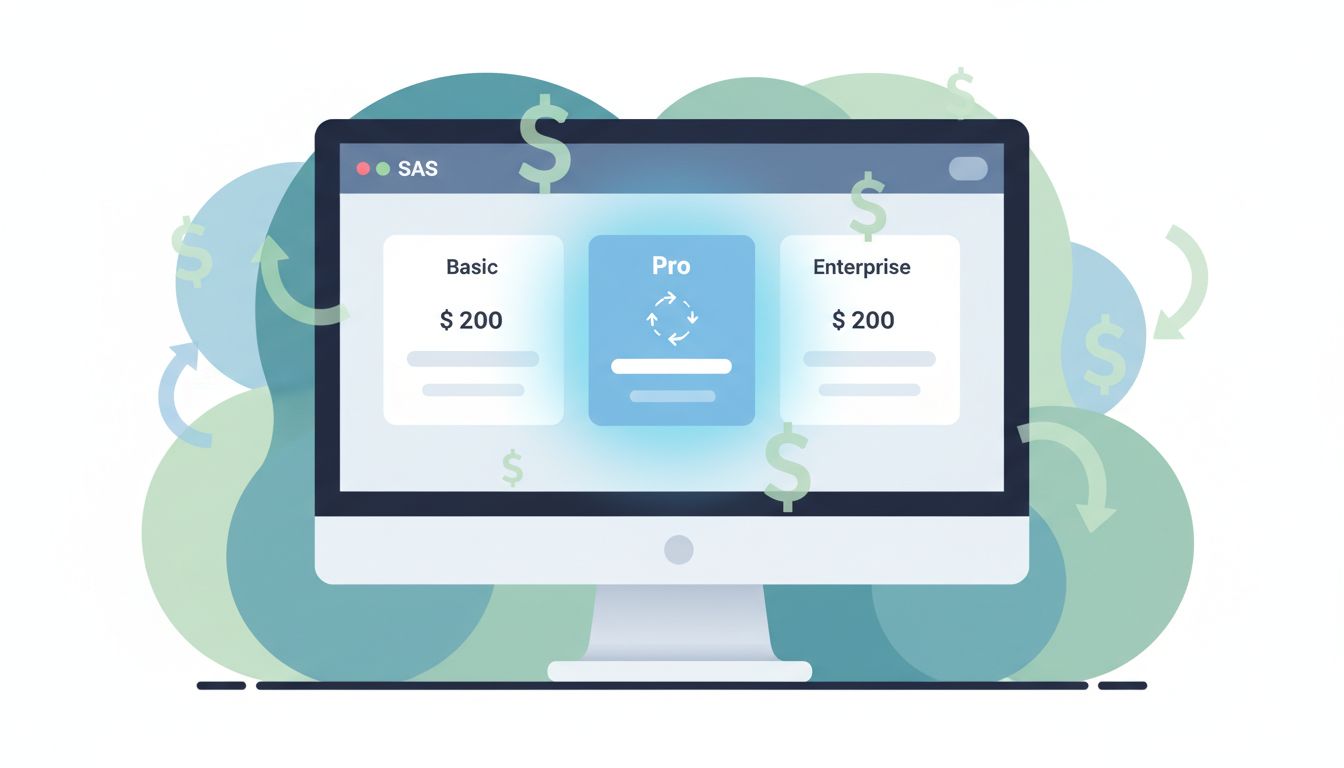
The answer begins with how human beings make decisions under uncertainty, and it is worth pausing here because the psychology is genuinely elegant. When a potential customer lands on a pricing page showing three tiers at ten, forty-nine, and one-hundred-and-twenty-nine dollars per month, the ten-dollar option is not there to sell itself. It is there to make forty-nine dollars feel reasonable.
This is anchoring, and SaaS companies have refined it to an art form. The cheap tier calibrates perception. It signals “we are accessible” while simultaneously making the mid-tier plan feel like a bargain rather than a commitment. The expensive enterprise tier performs the same function from the other direction, making the middle option feel safe rather than extravagant. Most conversions land in the middle, which is exactly where the margin lives.
Tech companies use a 100-year-old psychology theory to make apps feel effortless, and the same cognitive machinery governs pricing page design. The layout is not neutral. The highlighted plan, the “most popular” badge, the slight visual weight given to the middle column: all of it is deliberate architecture.
The Funnel Is the Product
Here is the insight that changes everything: the cheap tier is not a product. It is a funnel stage that has been assigned a price to filter for intent.
Free trials attract everyone, including people who will never pay for anything. Charging ten dollars per month creates a small but meaningful commitment signal. The customer has entered a billing relationship. They have configured payment details. They are, in the language of conversion optimization, “activated.” From that activated state, the upgrade path is dramatically shorter than starting from zero.
The internal metric that matters is not revenue per starter-tier customer. It is the conversion rate from starter to mid-tier, and the time it takes. Companies with well-designed cheap tiers see conversion rates to paid higher plans ranging from eight to twenty-two percent, depending on product category and onboarding quality. That math, applied across tens of thousands of starter accounts, produces mid-tier and enterprise revenue that dwarfs whatever the starter tier costs to run.
This is also why the feature limitations on cheap tiers are not arbitrary. They are engineered friction. You get three projects but need five. You get one seat but just hired a second person. You get basic analytics but your boss wants the dashboard. The ceiling is set at exactly the point where real business use begins to strain against it. This connects to a broader pattern in how software companies release intentionally constrained products as a strategic choice rather than a resource limitation.
The Long Game Nobody Talks About
There is a second, less-discussed function of the loss-leader tier that becomes visible only at scale: market defense.
A SaaS company with a ten-dollar starter plan makes it economically painful for competitors to undercut them on entry price. Dropping to five dollars would require either a structural cost advantage or an even longer subsidy runway. Most competitors cannot afford either. The cheap tier, paradoxically, is a moat. It trains the market to associate your brand with accessibility while making the competitive floor expensive to replicate.
Slack understood this early. Notion has refined it. Linear, despite positioning as a premium tool, keeps its individual tier accessible enough to seed adoption inside engineering teams before procurement conversations begin. The starter tier is a Trojan horse inside organizations, where one individual user becomes a department-wide champion becomes an enterprise contract.
This kind of strategic misdirection, where what looks like a simple pricing decision is actually a competitive positioning move, appears throughout the tech industry. The same companies launch features they know will fail because the real goal is not the feature itself. The cheap plan follows the same logic: it is not designed to succeed on its own terms.
What This Means If You Are Building
If you are designing a pricing strategy, the lesson is not “offer a cheap tier.” It is more precise than that. The cheap tier only works as loss-leader infrastructure if three conditions are met: the upgrade trigger is built into the product’s core workflow, the conversion path from cheap to mid requires minimal friction, and the mid-tier margin is healthy enough to absorb the subsidy.
Get the feature ceiling wrong and users stall permanently on the cheap plan, neither churning nor upgrading, the worst possible outcome. Price the mid-tier incorrectly and the math never recovers. Neglect onboarding and the activation rate collapses, turning your cheap tier from a funnel into an expensive hobby.
The companies that have cracked this, Figma, Notion, Airtable, Linear, share one visible characteristic: their starter tiers feel genuinely useful rather than crippled. That generosity is calculated. The goal is not to frustrate users into upgrading. It is to deliver enough value that users want to upgrade, and to structure the product so that wanting to upgrade is inevitable for anyone using it seriously.
The cheapest plan on the pricing page is the most expensive thing a SaaS company builds. The ones that understand that are the ones worth watching.