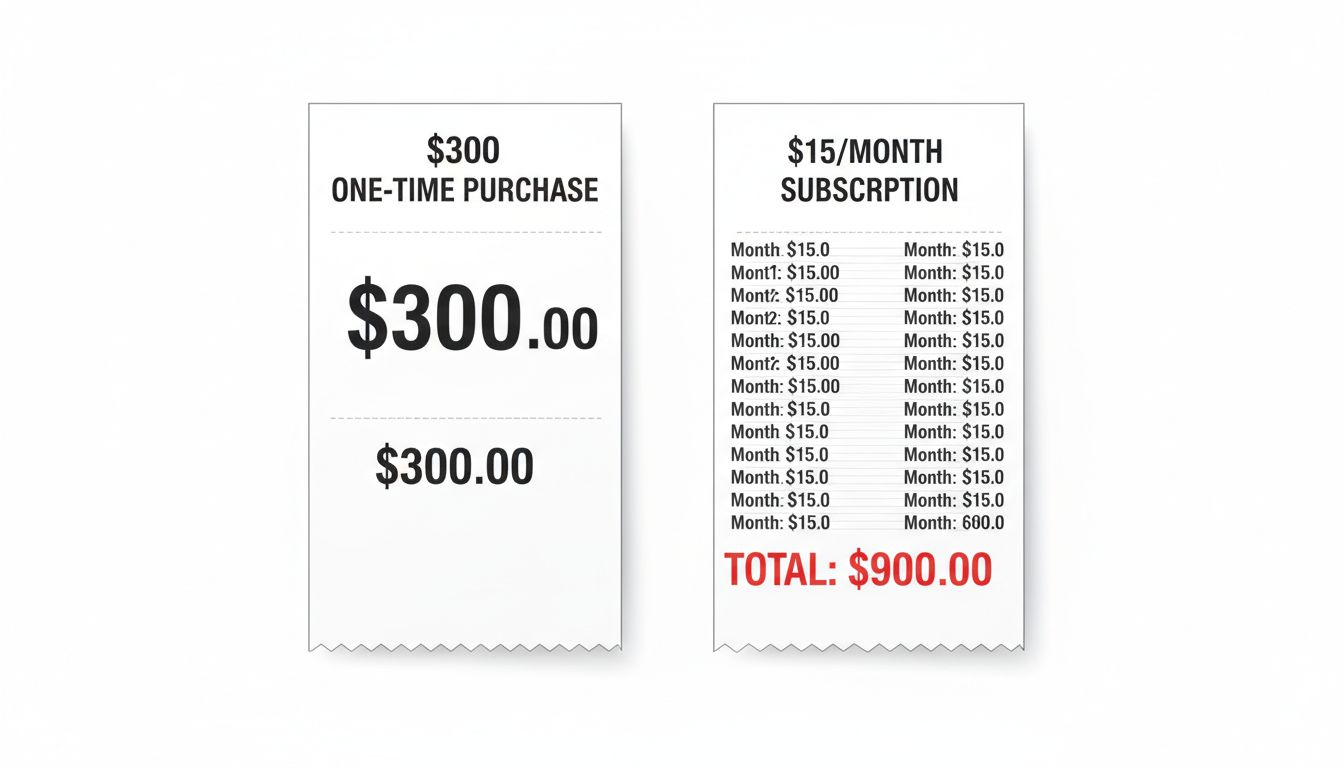
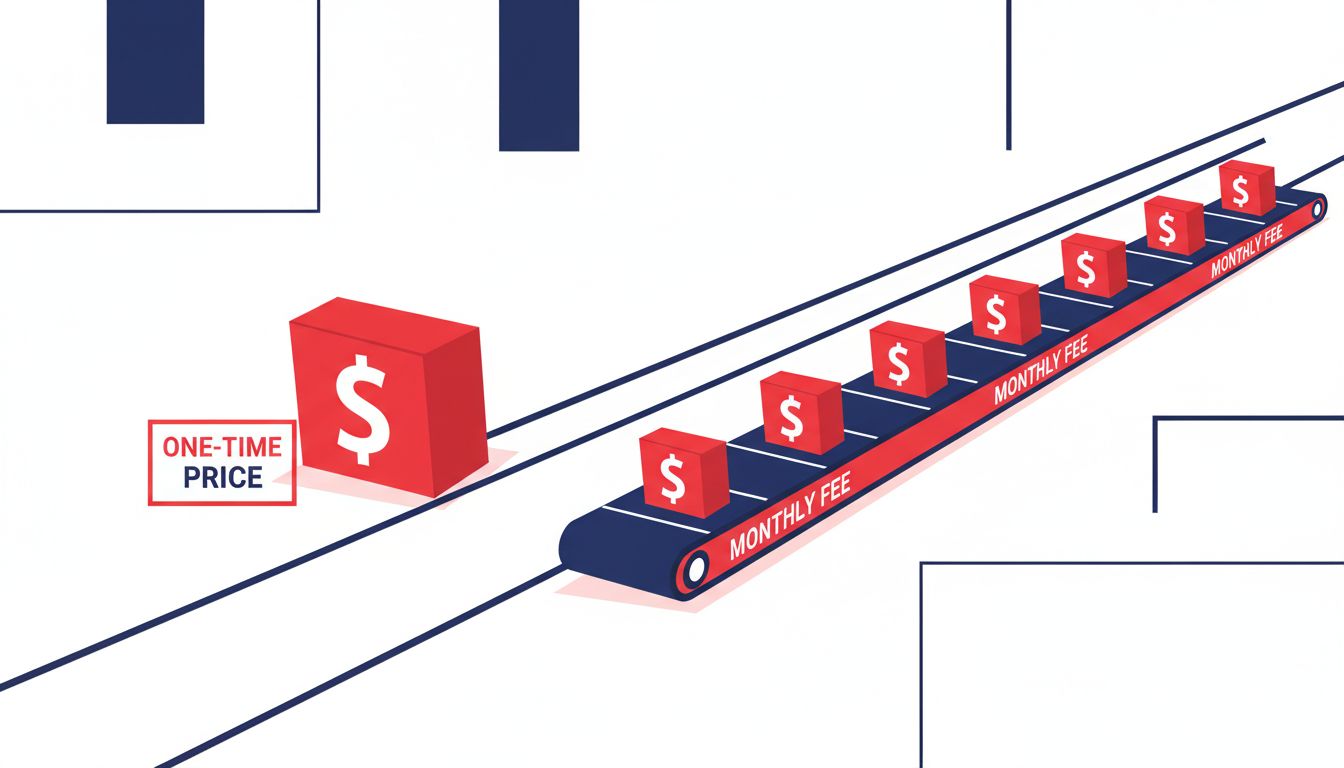
Here is the uncomfortable truth the software industry would prefer you not calculate: if you subscribe to a typical productivity app for five years, you will spend three to eight times what a perpetual license once cost. This is not an accident, a market inefficiency, or a side effect of rising development costs. It is the entire point.
The shift from boxed software to subscriptions is one of the most consequential economic restructurings in tech history, and it happened so gradually that most users simply adapted without performing the arithmetic. Understanding why requires looking past the surface-level justifications, which companies offer freely, and into the underlying mechanics that actually drive the model. As we’ve explored in The Trojan Horse Economy: How Free Software Became Tech’s Most Profitable Weapon, pricing architecture in software is almost never what it appears to be at first glance.
The Lifetime Value Swap
In the perpetual license era, a software company sold you a product and hoped you’d buy the next version. The incentive structure was straightforward: build something good enough that customers upgrade willingly. The problem, from the vendor’s perspective, was that customers could simply refuse. Adobe’s Creative Suite users famously held onto CS6 for years after Creative Cloud launched, because CS6 worked fine for their purposes.
Subscriptions eliminate that customer leverage entirely. The moment you stop paying, the software stops working. This is not a technical necessity. It is a contractual choice designed to convert a one-time transaction into a permanent dependency.
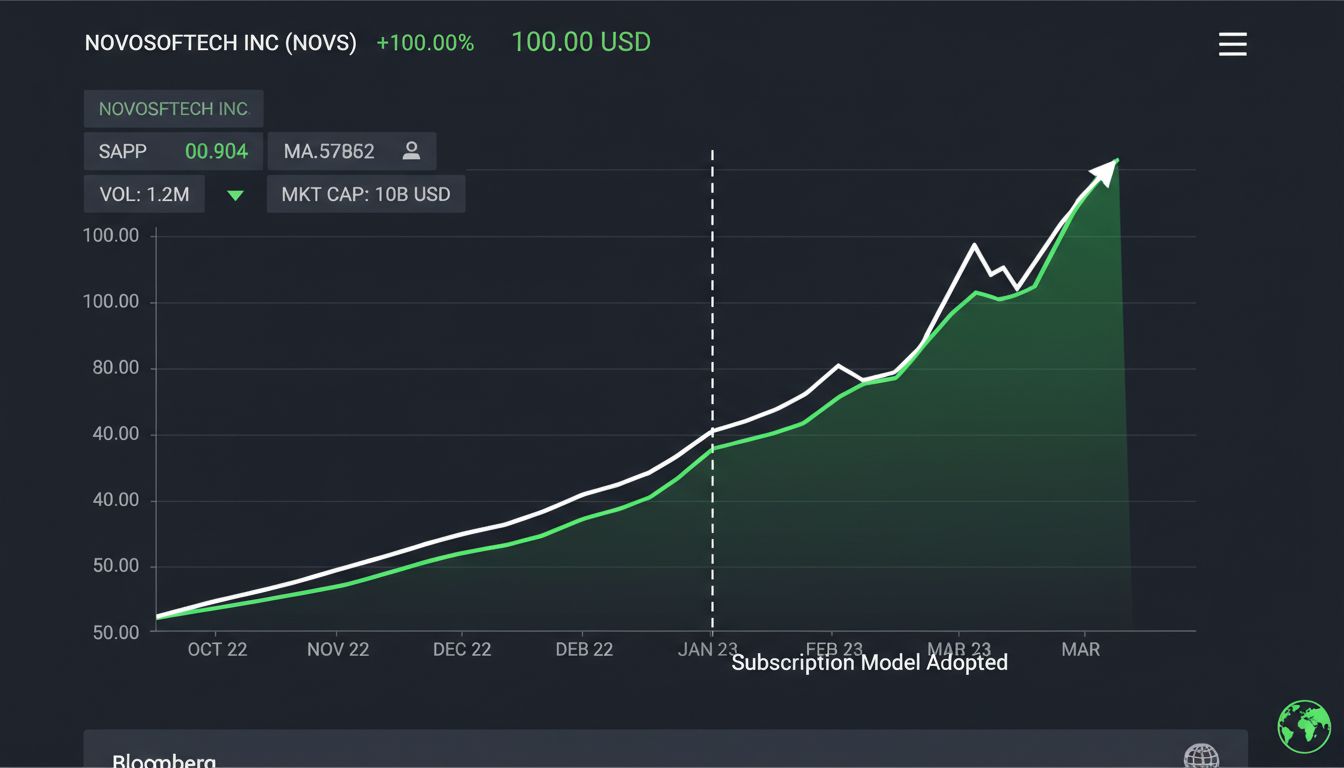
The financial logic is staggering once you model it out. A company that sells 100,000 perpetual licenses at $300 each books $30 million in revenue, then spends the next year hoping those customers want an upgrade. A company that converts those same customers to $15 per month subscriptions books $18 million in the first year, which looks worse until you run the numbers forward: year two adds another $18 million from existing customers before a single new sale. By year three, the subscription model has generated more cumulative revenue than the perpetual model would have even with a healthy upgrade cycle. Wall Street noticed. Software company valuations roughly doubled as a category when the industry shifted to recurring revenue, because predictable cash flows are worth more than lumpy ones.
The Infrastructure Argument (and Its Limits)
Companies defend subscription pricing with a consistent set of arguments: continuous updates, cloud infrastructure costs, ongoing security patches, and the labor required to maintain software across constantly evolving operating systems. These costs are real. But they do not fully explain the pricing delta.
Consider that free apps cost more to build than paid ones in many cases, because the infrastructure requirements for supporting millions of concurrent users at scale dwarf what a simple productivity tool requires. The marginal cost of delivering a software update to a subscriber is not meaningfully higher than delivering it to a perpetual license holder. The update mechanism itself is not the cost driver. The recurring revenue model is.
What genuinely does cost more in the subscription era is customer retention infrastructure: the analytics pipelines, churn prediction models, re-engagement campaigns, and engagement-optimizing features that exist not to make the software better but to prevent cancellations. A portion of your subscription fee funds the machinery designed to keep you subscribed. This connects to a broader pattern documented in how software updates keep breaking things that worked fine, where product decisions are made with retention metrics, not user outcomes, as the primary variable.
Switching Costs as Moat
The deepest economic logic of subscriptions is not the monthly fee itself. It is what the subscription model enables over time: the accumulation of switching costs so steep that cancellation becomes practically unthinkable.
Every file format you store in a proprietary cloud, every workflow you build around a specific tool’s interface, every integration you configure between a subscribed service and your other tools, these are investments that become liabilities the moment you consider leaving. Enterprise software has operated on this principle for decades, which partly explains why enterprise software looks so terrible: when switching costs are high enough, aesthetic quality becomes optional. Consumer subscriptions are simply applying the same logic at scale.
This is why the most sophisticated software companies bundle aggressively once they have a subscriber base. Each added feature, even a mediocre one, is another thread in the web of dependency. Microsoft 365 does not include Teams because Teams is indispensable. It includes Teams because every user who adopts Teams is one more reason not to cancel the subscription.
What You’re Actually Buying
The honest reframe of subscription pricing is this: you are not buying software. You are renting access to a relationship, and the terms of that relationship are set entirely by the vendor.
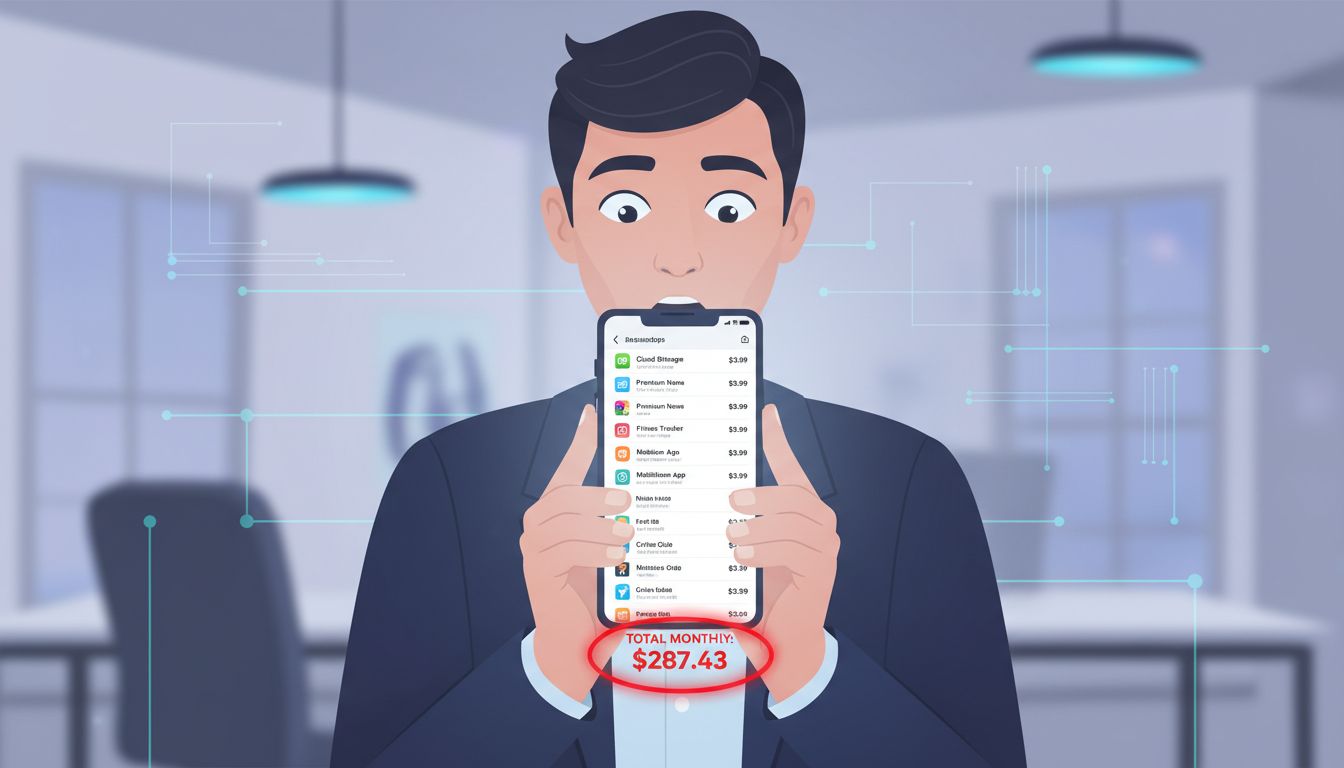
This is why the most thoughtful observers of digital tool usage have noted that the most productive people often delete apps instead of downloading them. The subscription model creates a gravitational pull toward accumulation, toward maintaining tools you use infrequently because canceling feels like losing something you already paid for. That psychological friction is not accidental. It is engineered.
For consumers, the practical implication is simple: calculate the five-year cost before subscribing, not the monthly rate. The monthly figure is designed to feel negligible. The five-year figure is designed not to be discussed. For businesses evaluating software, the calculation includes not just cost but exit risk: what does it cost to leave in two years if the vendor raises prices, gets acquired, or simply degrades the product? That exit cost, rarely zero, is the hidden premium embedded in every subscription contract.
The Endgame
The subscription economy has now matured enough to show its second-order effects. Subscription fatigue is real. Consumers are reaching natural limits on how many recurring charges they will tolerate, which is creating pressure on vendors to justify their monthly fees with genuine, visible value rather than switching-cost inertia.
The vendors who will thrive in this environment are not those with the stickiest lock-in but those with the strongest genuine utility. The irony is that the subscription model, designed partly to insulate companies from competitive pressure, may ultimately force a return to the oldest principle in software: build something people actually want to keep paying for, because they want it, not because leaving is too expensive.
The math was always deliberate. But eventually, so is the customer’s response.