
The most valuable person in any product meeting is not the engineer who built the feature or the executive who approved the budget. It is the employee sitting in the back of the room who used the competitor’s product for three years and still has opinions about why it was better. Silicon Valley has known this for a long time. What it is only now articulating clearly is that hiring your own users is not a recruitment coincidence. It is a deliberate strategy, and the companies doing it most systematically are pulling ahead in ways that are difficult to replicate.
This connects to a broader truth about how the best products get built: winning startups treat customer complaints as a product roadmap, but the companies that go furthest hire those complaining customers directly.
The Problem With Building Products You Don’t Use
The standard model for product development goes something like this: gather user research, run focus groups, analyze telemetry data, build features, ship. It is a process designed to simulate understanding. The problem is that simulation is expensive, slow, and almost always incomplete.
When Figma was scaling its design tool, it recruited heavily from the design community it was already serving. Many early employees were freelancers and agency designers who had strong opinions about where Adobe and Sketch were failing them. They did not need to be taught what mattered to users. They showed up knowing it. The result was a product that felt eerily well-calibrated from the start, because it was built by people who could feel the misalignments themselves.
Slack followed a similar arc. The team behind it had spent years building tools they were frustrated by. When they shipped something for themselves, it resonated with others who shared those frustrations. It is not a coincidence that most successful apps started as internal tools nobody meant to sell. The internal use case and the user hire are two expressions of the same underlying idea: proximity to the problem produces better solutions.

What User-Employees Actually Do Differently
The advantage is not just cultural. It is operational. An employee who was a genuine user of the product brings something no amount of research can manufacture: an embodied sense of friction. They know the workarounds users develop. They know which help documentation is useless. They know the moment in the onboarding flow where they almost quit.
This is qualitatively different from reading a user interview transcript. A transcript tells you what someone said. A user-employee tells you what it felt like, and then they tell you again six months later when a new feature threatens to recreate the same problem.
This dynamic matters because the most dangerous product decisions are not the obviously bad ones. They are the ones that look fine on paper and feel wrong only to someone who has spent real time on the other side of the interface. The companies that hire users are installing that early-warning system directly into their teams.
It also changes how complaints get processed internally. When a support ticket escalates into a product discussion, the user-employee in the room does not need the situation explained. They often predicted it. That kind of institutional foresight is hard to put on a balance sheet, but it shows up in retention numbers and NPS scores eventually.

The Hiring Signal Most Recruiters Miss
Here is where the strategy gets counterintuitive. Most technical recruiters screen for credentials: degrees, previous employers, GitHub contributions. The user-hire strategy inverts that priority. It looks first at authentic engagement with the problem space, and treats credentials as secondary confirmation.
Duolingo has hired language learners who were vocal critics of the app. Notion has brought on people who were deeply embedded in the productivity tool community, sometimes as bloggers or template creators, before they ever applied for a job. These hires arrive with context that would take a credential-first hire two years to accumulate.
The pattern extends beyond consumer apps. Developer tools companies like Linear and Vercel have recruited from the communities of developers who were loudest about what was broken in legacy workflows. Those developers became employees and then shipped the things they had been asking for publicly. The feedback loop collapsed from months to days.
There is a related principle at work here that applies to founders as much as hiring managers. Most successful startups solve problems their founders never experienced is a true and useful observation, but it requires the founders to compensate by getting closer to the problem through the people they hire. Bringing users onto the team is one of the most direct ways to close that gap.
The Limits of the Strategy
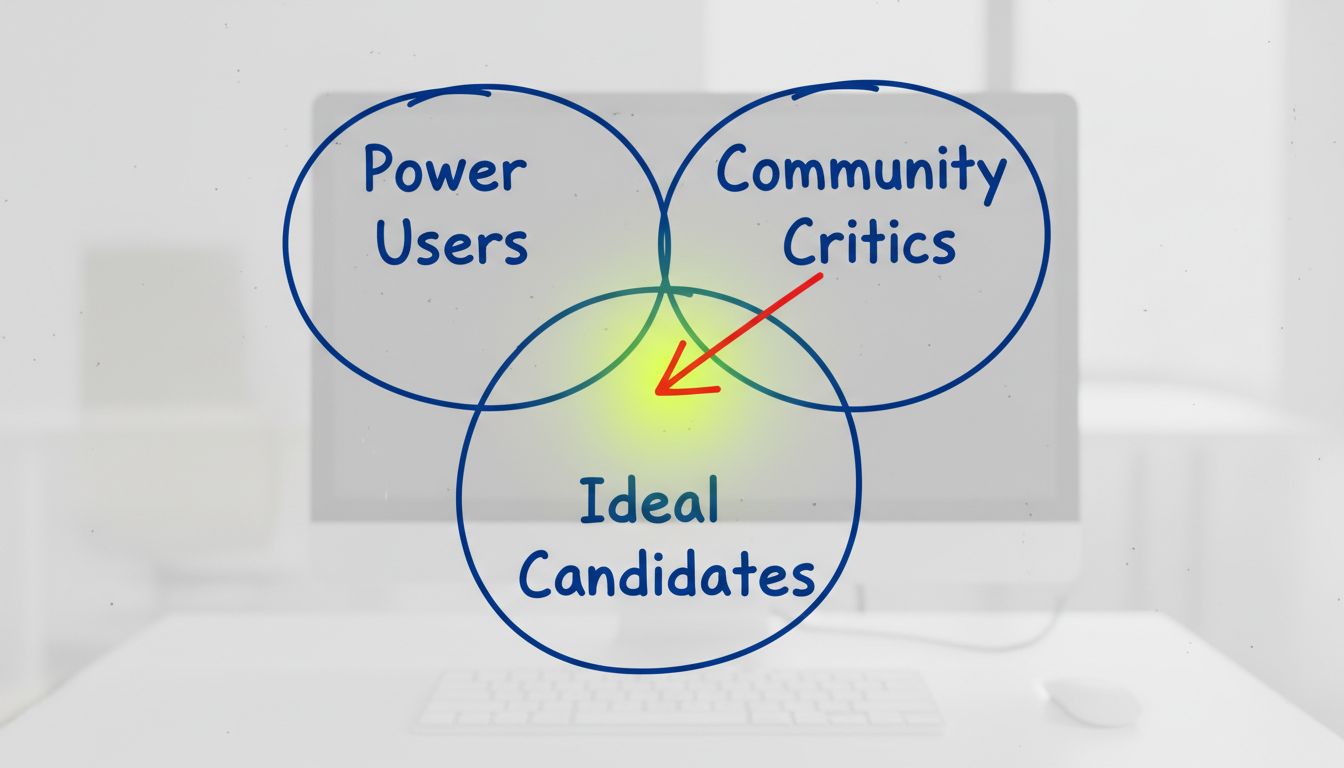
User-hiring is not without its failure modes. The most common one is mistaking power-user enthusiasm for broad user insight. A person who loved a product so much they built a following around it may represent the top two percent of engagement, not the median user who needs more hand-holding and clearer defaults.
This is the same trap that catches teams who over-index on their most vocal feedback. Early-stage startups that weaponize customer rejection outlast the ones that avoid it, precisely because rejection comes from users who did not self-select into loyalty. The user-hire strategy works best when companies recruit across the engagement spectrum, not just from their most enthusiastic advocates.
There is also the question of adaptability. A user hired for their familiarity with a product’s current state can become a liability when that product needs to change fundamentally. Their investment in how things are can make them resistant to what they need to become. Companies that manage this well treat the user-employee’s instincts as a signal, not a veto.
Why This Is Accelerating Now
The strategy is not new, but it is spreading faster than it used to. A few forces are converging to make it more attractive.
The rise of creator communities and public build-in-public culture means that users now demonstrate their expertise openly. A product manager who spent two years writing detailed teardowns of a competitor’s UX has a public portfolio of insight that no interview process could fully surface otherwise. Recruiters who know where to look can find people pre-qualified by their own output.
AI is adding pressure in the same direction. As more routine product analysis gets automated, the premium on human judgment rooted in genuine experience goes up, not down. A model can analyze feature usage patterns. It cannot tell you that the pattern exists because users found a workaround and the workaround became habit. That knowledge lives in people.
The companies that understand this are not waiting for users to apply. They are watching communities, reading forums, and recruiting the people who care most loudly about the problems they are trying to solve. They are turning their best critics into their most valuable colleagues. And in doing so, they are building something no research budget can buy: a team that understands, from the inside, what it actually feels like to need what they are building.