

Picture this: A senior engineer leaves Google after six years. She joins a well-funded startup, spends eighteen months building her skills in a completely different stack, and then gets a call from her old manager. The offer is forty percent above her exit salary, with a signing bonus, and accelerated vesting. She takes it. Her former colleagues, who never left, quietly seethe. But here is the thing: Google made the right call, and so did she.
The economics of tech hiring are stranger than most people realize. The boomerang hire, the deliberate practice of recruiting former employees back at meaningfully higher compensation, is one of the most misunderstood strategies in the industry. It looks like sentimentality or desperation from the outside. It is neither.
The Real Cost of Hiring a Stranger
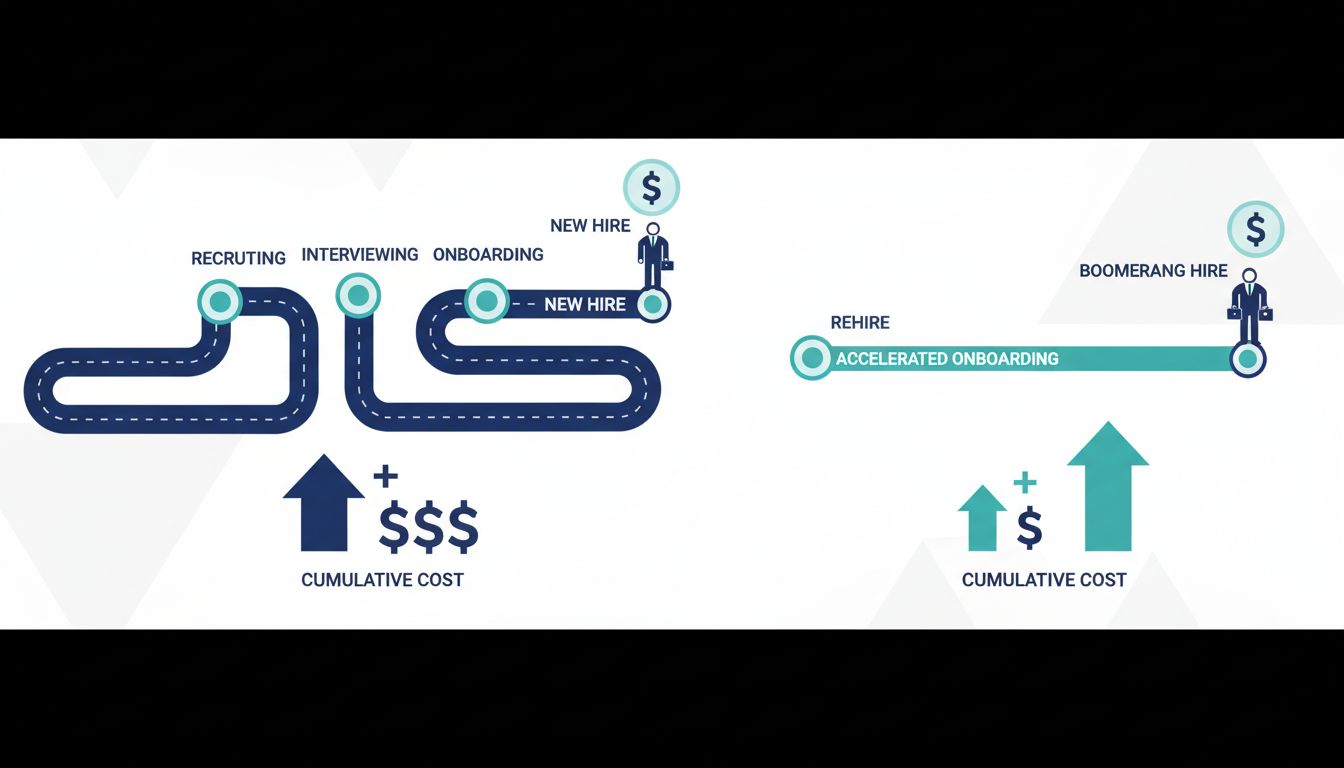
Let us start with some numbers that HR departments often bury in their reporting. Replacing a senior engineer costs somewhere between fifty and two hundred percent of that person’s annual salary when you factor in recruiting fees, interviewer time, onboarding, and the productivity cliff that lasts six to twelve months. A $200,000 engineer who quits can cost the company $300,000 to replace with someone new.
Now consider the boomerang scenario. You bring back someone who already knows the codebase, the internal politics, the unwritten rules about how decisions actually get made. Their ramp time is measured in weeks, not quarters. Yes, you are paying them forty percent more. But you are also avoiding the hidden tax of institutional ignorance that every new hire carries for their first year.
The math is not even close. Paying a known quantity more is almost always cheaper than paying a stranger less.
What Happens to People Who Leave
Here is the part that makes boomerang hiring genuinely strategic rather than just economically convenient. When a strong employee leaves a major tech company for a startup or competitor, they do not just leave. They go get educated on your behalf.
They see how another company structures engineering teams. They learn a different product philosophy. They experience what it looks like when a scrappy ten-person team ships features that a thousand-person org could not. Then they bring all of that back when they return.
This is not accidental. Some companies have started treating departing employees less like defectors and more like scouts. Alumni networks at companies like Microsoft, Amazon, and Salesforce are maintained carefully, not just for recruitment pipeline reasons but because a well-placed former employee who returns eighteen months later is carrying competitive intelligence that no consultant could replicate.
The practice mirrors something we see in product strategy, where the most valuable information often comes from outside the building. Unicorn startups have long understood that deliberately ignoring certain internal assumptions is how you find the real opportunity. Boomerang hiring is the talent equivalent: stepping outside the building, getting a different view, and coming back with something you could not have found by staying.
Why the Salary Jump Feels Insulting (and Why That Is the Point)
If you have ever been the person who stayed, watched a colleague leave, and then watched that same colleague return at a significantly higher salary, you know exactly how this feels. It feels like the company is rewarding disloyalty. It feels like the lesson is: leave to get paid.
And honestly? That lesson is not wrong. It is just incomplete.
The reason boomerang hires command higher salaries is the same reason any negotiation works: information asymmetry closes and leverage shifts. When an employee leaves, they discover their own market value by testing it. When they return, both sides have better information than they did before. The company knows what it lost. The employee knows what they are worth. The higher salary is just the equilibrium price.
This dynamic also has a secondary effect that smart companies are starting to use intentionally. The visibility of boomerang salaries sends a signal to all current employees: your skills have external value, and this company knows it. That signal, counterintuitively, can improve retention. When people feel they could leave and return at a premium, they feel respected rather than trapped. Tech companies use behavioral signals like this more deliberately than most employees realize.
The Institutional Knowledge Problem Is Worse Than Anyone Admits
There is a crisis hiding inside most large tech companies that rarely gets named directly: institutional knowledge is evaporating faster than it can be documented.
As team sizes grow, as Slack replaces hallway conversations, as remote work scatters context across time zones, the thing that makes a senior engineer irreplaceable is increasingly impossible to write down. It is not in the codebase comments. It is not in the Confluence pages nobody reads. It lives in their head: why that API was designed that way in 2019, which product manager you can actually trust with an honest estimate, where the bodies are buried in the legacy authentication system.
When that person leaves, the knowledge walks out with them. When they come back, it comes back too, often sharpened by contrast with how other companies handle the same problems. Digital transformation projects fail at extraordinary rates partly because companies consistently underestimate how much of what works is tacit rather than documented. Boomerang hiring is one of the few mechanisms that actually recovers tacit knowledge instead of pretending a document can substitute for it.
What This Means If You Are the One Considering Leaving
If you are a strong performer at a large tech company and you are thinking about leaving, the boomerang dynamic should factor into your calculus. Leaving, if you do it well, is not burning a bridge. Done right, it is making an investment in your own market value that your current employer might eventually pay you to recoup.
The practical implications: leave on good terms, stay connected to your alumni network, and be explicit when you return about what you learned while you were gone. The premium you command as a boomerang hire is directly proportional to how much new context you bring back.
For companies, the implication is equally clear. Offboarding deserves the same strategic attention as onboarding. How you treat people when they leave determines whether they come back, and whether they recommend your company to others in the window before they do. The cost of a graceful exit is minimal. The return on it can be enormous.
The boomerang hire is not a sentimental reunion. It is a deliberately structured arbitrage on information, institutional knowledge, and market-rate correction. Once you see it that way, the forty percent salary bump stops looking like a reward for leaving and starts looking like exactly what it is: a fair price for something genuinely hard to replace.