
Picture this: a senior engineer at a major cloud company spends her afternoon pushing a fix that shaves 40 milliseconds off API response times. Nobody outside the building will ever know her name. Meanwhile, across the country (or across the ocean), a support agent earning $14 an hour is apologizing to a furious enterprise customer whose entire deployment just went sideways. One of these people is considered mission-critical. The other is considered a cost to be minimized. Understanding why reveals something uncomfortable about how the tech industry actually values human beings.
This isn’t a story about corporate greed, exactly. It’s a story about leverage, and how Silicon Valley learned to chase it with almost religious intensity. The same psychological machinery that keeps you glued to your feed, which machine learning algorithms carefully optimize, is built by people whose compensation reflects how irreplaceable that skill set is. Everything else, the org chart will tell you, is overhead.
The Leverage Equation Nobody Talks About
Here’s the core idea. A software engineer writes code once. That code runs a million times. If she writes something brilliant, the leverage ratio is extraordinary: one person’s work compounds into value at a scale no other profession can match outside of perhaps finance. A $400K engineer who builds infrastructure used by 50 million users is, in pure unit-economics terms, absurdly cheap.
A support agent handles one ticket at a time. Maybe 50 tickets on a good day. There is no compounding. There is no leverage. The math is brutal and the industry stopped pretending otherwise around 2010.
This is why the outsourcing industry for customer support exploded not because executives woke up one morning feeling callous, but because the incentive structure made it almost irrational to do anything else. When your valuation depends on demonstrating scalable margins, every headcount decision becomes a slide in a deck.
Why Engineers Are Genuinely Scarce (And It’s Not Just Hype)
The cynical take is that tech companies manufacture scarcity to justify salaries. There’s a grain of truth there. But there’s also a harder reality: the pool of engineers who can build reliable distributed systems, or design machine learning pipelines, or wrangle the kind of legacy codebases that run much of the modern internet is genuinely small. These skills take years to develop and have compounding value.
Companies like Meta and Google are not paying $400K out of generosity. They’re paying it because the alternative is watching that engineer walk across the street. The bidding war is real, and it’s been going on long enough that the salaries have decoupled entirely from what most people consider normal compensation.
Customer service, by contrast, has a massive labor pool. The skills are learnable in weeks. The training pipeline is fast. When companies can hire thousands of support agents overseas for what they’d pay one mid-level engineer, the calculus becomes obvious. Nobody on the board is losing sleep over it.
The Hidden Cost Nobody Accounts For
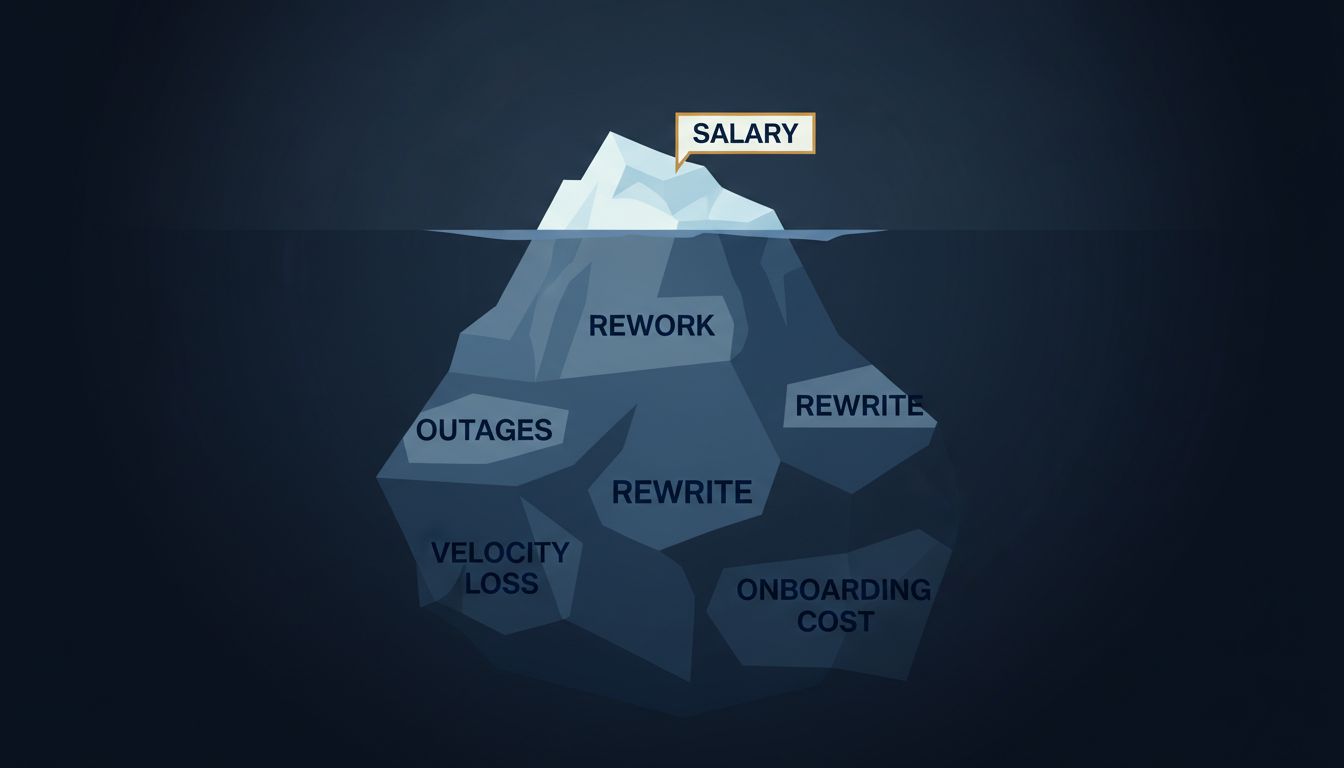
Here’s where it gets interesting. The conventional wisdom is airtight until it isn’t. Because the dirty secret of outsourced support is that bad customer experience has costs that don’t show up cleanly in the spreadsheet.
Churn is hard to attribute. When an enterprise customer quietly doesn’t renew, the support interaction from six months ago rarely gets a line item in the post-mortem. Sales gets blamed. Product gets blamed. The $14-an-hour agent who gave a confused answer to a frustrated CTO never enters the conversation.
This is the same blindspot that plagues a lot of tech decision-making. Companies get seduced by tools and systems that look productive on the surface but mask deeper dysfunction. Outsourcing support to the cheapest provider looks great on a cost-per-ticket metric and terrible on a lifetime-value metric. Most companies only figure this out after they’ve already burned the relationship.
The startups that get this right early tend to be the ones where a founder has personally spent time on support. There’s a reason many of the best product decisions come from founders who refused to hand off customer contact too soon. The signal in those conversations is irreplaceable. (The ones who skipped it often appear in the cautionary tales of serial founders who kept making the same category of mistake across multiple companies.)
The AI Layer Changes the Math, Until It Doesn’t
Every conversation about outsourcing now has an AI subplot. Why hire either an offshore agent or a local one when a large language model can handle 70% of tickets automatically? The pitch is compelling. The economics look even better. And for certain categories of support, it genuinely works.
But the 30% that AI can’t handle tends to be the 30% that matters most. The edge cases. The angry enterprise customer. The billing dispute with legal implications. The bug that a first-tier bot keeps misclassifying. This is where the model breaks, and companies are discovering that the humans left to handle escalations need to be more capable, not less, to navigate the mess that automation leaves behind.
The failure rate of AI-dependent products is partly a story about companies that automated the easy parts and forgot to staff for the hard parts. Customer service is a microcosm of the same trap.
What This Actually Means
The wage gap between engineers and support staff is not going to close. The leverage differential is structural. What will change is the floor of what good support looks like, as automation handles routine queries and humans specialize in the high-stakes interactions that machines still fumble.
The companies that treat support as a cost center will keep finding that their best customers eventually drift toward competitors whose support actually feels like the product is backed by humans who give a damn. The companies that treat it as an investment will occasionally look irrational on a quarterly earnings call and look smart over a five-year window.
The $400K engineer is easy to justify. The question worth asking is what the cost of a $14 agent actually is, once you account for everything the spreadsheet isn’t measuring.