
The conventional explanation for a dead acquisition goes something like this: the big company paid too much, failed to integrate the team, and eventually wrote it off. Clean narrative, wrong diagnosis. The graveyard of acquired-and-shelved products — Google’s Bump, Facebook’s Moves, Microsoft’s Sunrise — is not a record of failure. For the acquiring companies, most of these deals accomplished exactly what they were supposed to.
The Product Was Never the Asset
When Google acquired Applied Semantics in 2003 for roughly $102 million, it wasn’t buying a product to ship. It was buying the patent portfolio and team behind contextual text matching. The result was AdSense, which became one of Google’s most durable revenue streams. The original Applied Semantics brand disappeared almost immediately. That pattern, buying the underlying capability rather than the surface-level product, is the actual operating logic behind most acquisition activity.
This matters because it reframes what “failure to launch” really means. When a company acquires a startup and sunsets its product, the typical assumption is that integration fell apart. The less examined possibility is that shutting down the product was the plan, or at minimum, a perfectly acceptable outcome. The acquirer got what it came for: the team, the intellectual property, or the removal of a threat. The product was incidental.
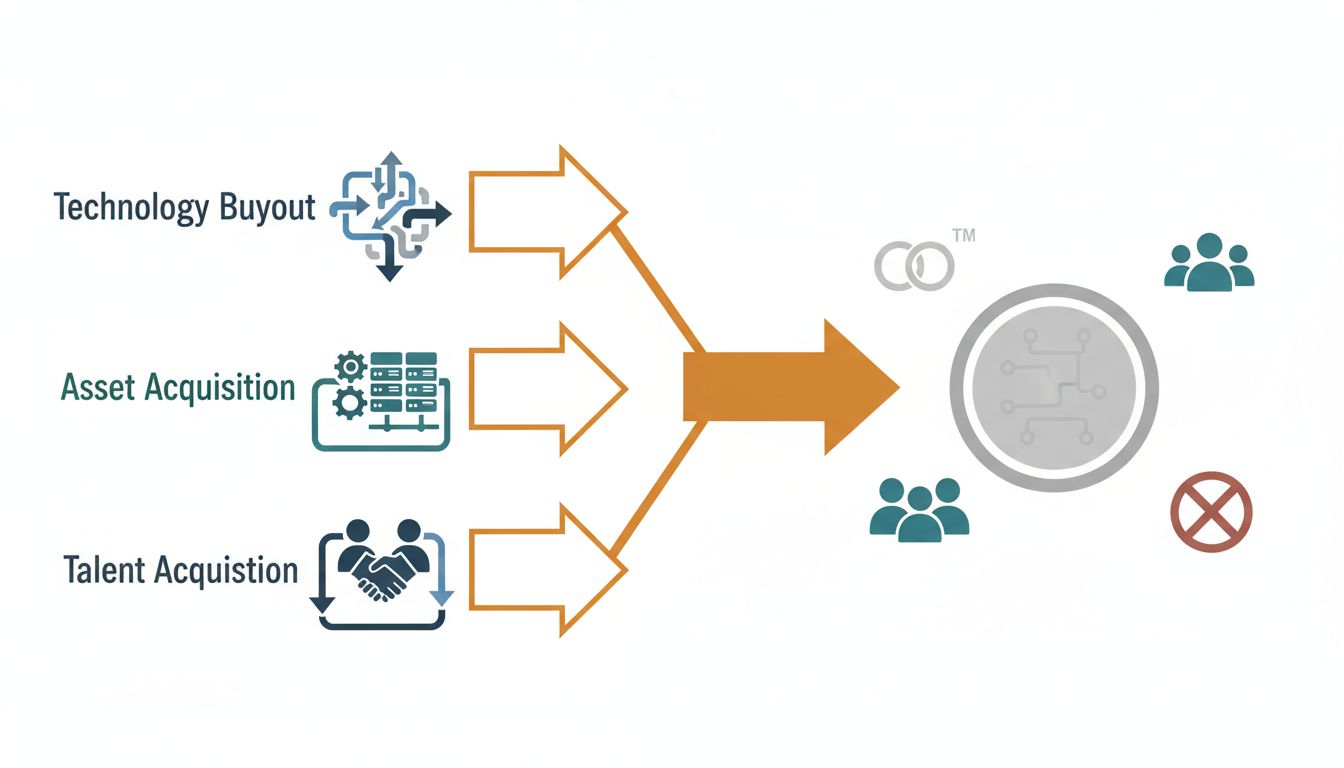
As a related piece on this site notes, tech companies lose billions on acquisitions because they are not actually buying technology. The same logic applies in reverse: when acquisitions look like losses from the outside, the company often wasn’t buying technology in the first place.
Acqui-Hires Are More Valuable Than They Look
Acquihiring, buying a startup primarily to get its people, is widely understood as a concept but routinely underestimated as a strategy. The economics are more defensible than they appear. Recruiting a strong senior engineer in a competitive market can cost over $100,000 in recruiter fees and months of interview cycles, with no guarantee of success. A small startup acquisition that lands five or six exceptional engineers, including founders with strong track records, can be justified on pure talent economics even if the product never ships.
Facebook’s acquisition of Parakey in 2007 is a clean example. The product was obscure. The founders, Blake Ross and Joe Hewitt, were not. Ross co-created Firefox. Hewitt built significant parts of the original iPhone app at Facebook. Neither continued working on Parakey after the acquisition. The deal made sense without the product ever mattering.
The subtler point is that at the senior levels where acquihires focus, talent is not just expensive to recruit, it is expensive to lose. A competitor landing a strong technical team can shift the balance on a specific problem for years. Paying to take that option off the table has real defensive value, even when you can’t put a clean number on it.
The Threat Removal Logic
Some acquisitions are primarily defensive: buy the threat before it matures. This is well-documented enough that regulators have started scrutinizing it under the label “killer acquisitions,” but the practice predates the terminology by decades. The logic is direct. A startup growing into an adjacent market is cheap to buy early and expensive to fight later. If the product subsequently disappears, that is not an accident of poor integration. It is the outcome that justified the purchase price.
Facebook’s acquisition of Instagram in 2012 for $1 billion looked audacious at the time. Instagram had 13 employees. It is now worth, by most estimates, somewhere between $100 billion and $200 billion as a business unit. That deal clearly wasn’t a killer acquisition. But many smaller deals in the same category are. A company that acquires five potential threats, launches two of them successfully and quietly buries the other three, comes out substantially ahead even if outside observers score it as three failures against two wins.
The asymmetry matters here. The cost of acquiring and shelving a startup is bounded. The cost of letting a startup grow into a credible competitor is not.
Why the “Failure” Narrative Persists
If these acquisitions often succeed on their own terms, why does the failure narrative dominate coverage? Part of the answer is that the actual goals of most acquisitions are never publicly stated. A company cannot announce that it is buying a startup to prevent a future competitor from accessing its talent pool, or to remove a product that was gaining traction with a demographic it wants to own. It announces integration plans and product roadmaps that it has no intention of executing.
When those roadmaps go nowhere, journalists write failure postmortems. The acquiring company does not correct the record, because the real explanation would invite regulatory attention and damage relationships with the startup community it needs to keep deal flow coming. The incentive structure pushes everyone toward accepting the failure narrative even when it is wrong.
This also means that acquisition track records are consistently misread by investors and analysts. A company that completes 20 acquisitions and “fails” to ship products from 15 of them is not an undisciplined acquirer. It may be a highly disciplined one, using acquisitions as a flexible tool for hiring, intellectual property consolidation, and competitive positioning that organic growth cannot accomplish as cleanly.
What This Means for Founders
For founders building in spaces adjacent to major platforms, the implication is uncomfortable but worth sitting with. An acquisition offer is not necessarily validation that a large company believes in the product. It may mean the opposite: that the large company has assessed the product as a manageable threat and prefers to control the outcome. The difference between those two scenarios has significant consequences for how a founder should think about terms, earnouts, and what happens to the team after close.
The founders who navigate this best tend to be the ones who understand, before signing, what specific asset the acquirer is actually trying to obtain. If the answer is the team, the IP, or the removal of market uncertainty rather than the product itself, that changes what a good deal looks like. It also changes what a founder owes to early users who built a relationship with the product under the assumption it would continue to exist.