
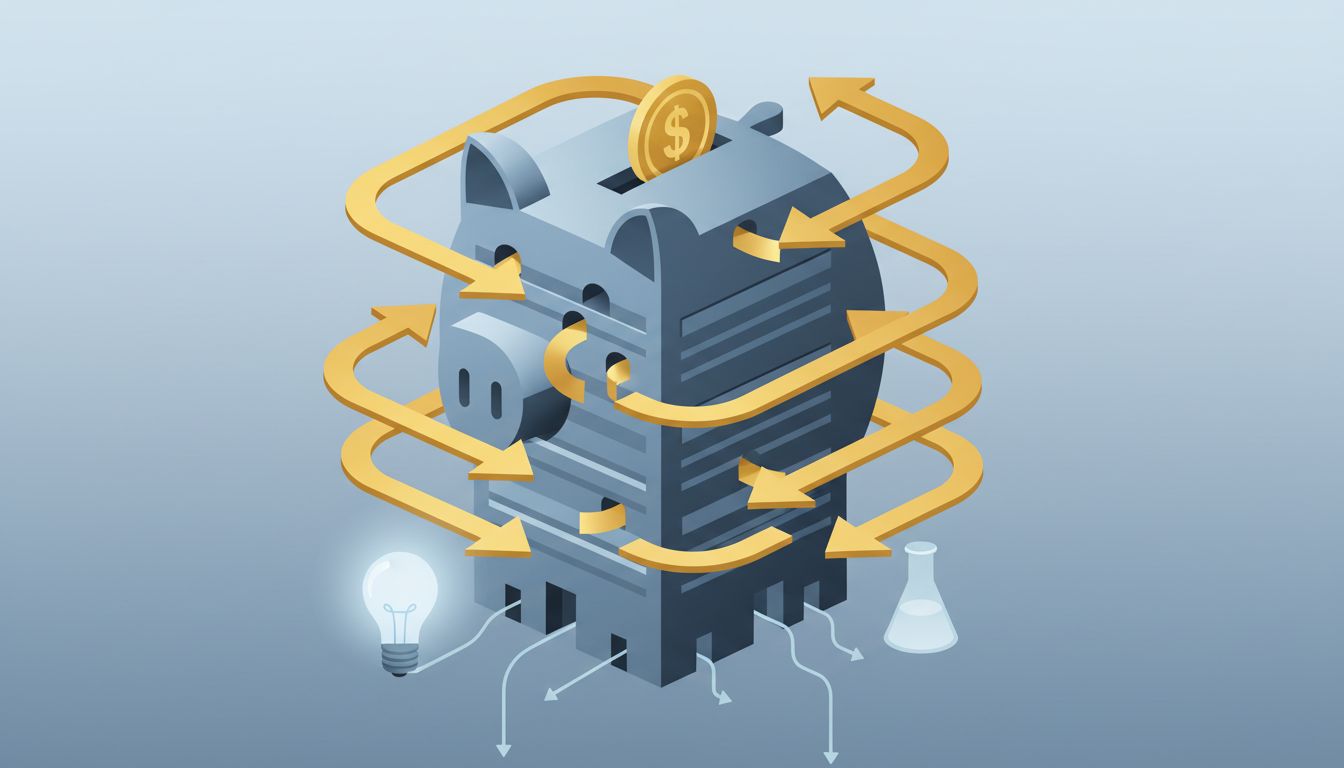
The most revealing thing a company can do with its money is give it back. Not to charity, not to employees through wages, but to shareholders through stock buybacks. When a company with $100 billion in cash decides the best investment available is its own equity, it is making a very specific claim about its future: that no internal project, no new product line, no research program offers a better return than buying shares on the open market.
For tech companies, which built their identities on the premise of perpetual innovation, this is a striking admission. Apple spent more on buybacks than on R&D in recent years, by a wide margin. Oracle has returned capital to shareholders at a rate that would embarrass most financial firms. Microsoft, before its aggressive AI pivot, ran a buyback program that routinely exceeded its research outlays. These are not anomalies. They are a structural pattern, and the reasons behind it cut much deeper than most coverage suggests.
The Maturity Problem Nobody Wants to Name
Tech companies are supposed to be different from industrial companies. The pitch, going back to the 1980s, was that software compounded in ways that factories never could. Code written once could scale infinitely. Each new product could seed the next. The economics were supposed to be self-perpetuating.
But software companies age. Their core markets saturate. Windows dominates the desktop, but the desktop stops growing. The iPhone captures the premium smartphone segment, but premium smartphone penetration plateaus. Oracle locks up enterprise database customers, but new databases proliferate and the growth math changes. What you’re left with is a business that generates enormous cash flows from an installed base it already owns, and faces genuinely diminishing returns on incremental R&D within that core.
The uncomfortable reality is that many of the largest tech companies are, by any rigorous definition, mature businesses. Not dying businesses. Mature ones. Mature businesses with excellent cash generation face a classic capital allocation problem: where do you put the money? Buybacks are not a trick. They are what rational capital allocation looks like when internal reinvestment opportunities have been exhausted.
Why R&D Returns Are Harder to Find Than They Look
The assumption embedded in buyback criticism is that the alternative, more R&D spending, would reliably produce better returns. The evidence is messier than that.
R&D productivity in large tech companies has been declining for a long time. This is not a controversial observation among people who study innovation economics. The low-hanging fruit of software gets picked early, and marginal research dollars buy progressively less novelty. Google has spent aggressively on moonshot projects through its various Alphabet subsidiaries, and the return on that spending, measured against the capital deployed, has been poor. The winners from those bets have been few and the failures numerous. Waymo has consumed resources for over a decade without generating meaningful revenue. Google Glass, Google+, Stadia, and a long list of other projects absorbed R&D budgets and returned nothing.
This is not to say innovation is impossible at scale. It clearly isn’t. But the idea that large tech companies are simply choosing financial engineering over genuine invention misreads how hard it is to generate high-returning research at scale. The companies that have done it, Microsoft with Azure, Amazon with AWS, Apple with the iPhone, tended to succeed by applying existing capabilities in adjacent markets rather than through pure laboratory research.

The Index Fund Effect and the New Shareholder
Something changed in shareholder composition over the past two decades that doesn’t get nearly enough attention in buyback discussions. The rise of passive index investing has made large institutional shareholders, Vanguard, BlackRock, State Street, structurally indifferent to whether a company grows or merely returns capital efficiently. They hold every stock in the index. They can’t sell Apple because they’re disappointed in its product roadmap. They can only push for efficient capital allocation across the portfolio.
This shift in ownership composition changes the incentives that flow down to corporate management. When your largest shareholders are index funds with no exit option and strong preferences for shareholder returns, the pressure to buy back stock and pay dividends intensifies. Activist investors, who typically own small stakes and campaign loudly for buybacks and cost discipline, operate in an environment where passive institutions often vote alongside them because the math is sound in isolation.
The result is a feedback loop. Management compensated in equity wants a higher stock price. The fastest path to a higher stock price, given uncertain R&D outcomes, is reducing the share count. Index fund shareholders don’t object. Activists cheer. The board approves the program. This is how you get Apple authorizing buyback programs measured in the hundreds of billions over successive years.
What EPS Mechanics Actually Do to Decision-Making
Stock-based compensation, which dominates executive pay at large tech firms, is denominated in shares, not dollars. A higher stock price directly enriches executives. Buybacks increase earnings per share mechanically, by reducing the denominator, without necessarily improving the underlying business. The incentive to choose buybacks over uncertain R&D projects is therefore not just about pleasing shareholders. It’s personal.
This is one of the points that the accounting realities underneath tech earnings make visible: the way companies structure their financials can obscure whether growth is coming from operational excellence or from financial mechanics. Buybacks are the most straightforward version of this. EPS goes up, the stock goes up, bonuses and options vest at favorable prices. The incentive structure does not require bad faith. It just requires following the money.
The Acquisition Alternative and Why It Has Limits
When internal R&D disappoints, large tech companies have historically used acquisitions as a substitute. Buy the innovation you can’t build. This worked well for a long time. Google acquired YouTube and Android. Facebook acquired Instagram and WhatsApp. Microsoft acquired LinkedIn and GitHub. These were bets that produced massive returns.
But the acquisition path has narrowed significantly. Antitrust scrutiny has intensified globally, making large acquisitions in adjacent markets legally perilous. The FTC blocked Adobe’s attempted acquisition of Figma. The DOJ scrutinized Microsoft’s Activision deal for well over a year. In this environment, the calculus shifts again toward buybacks, because the acquisition alternative is both more expensive in regulatory terms and less predictable in outcome.
Smaller acquisitions remain viable, but they rarely move the needle for companies operating at the scale of Apple or Oracle. Buying a promising startup for a few hundred million dollars does not change the capital allocation math when you’re sitting on cash reserves measured in the tens of billions.
The Companies That Break the Pattern and What They Reveal
The exceptions are instructive. Amazon historically plowed profits back into infrastructure, logistics, and AWS development rather than returning capital to shareholders. The result was a company that looked unprofitable for years while building structural advantages that eventually became enormous. Nvidia, before its AI moment, was considered a niche graphics company. Its sustained investment in CUDA and GPU compute infrastructure, made at a time when the returns were unclear, created the foundation for its current dominance.
What these companies share is a specific condition: a credible internal opportunity large enough to justify foregoing buybacks. Amazon saw that logistics and cloud computing were genuinely expandable markets where capital investment would compound. Nvidia’s researchers correctly identified that GPU architecture had applications far beyond gaming. The buyback-heavy companies, Apple, Oracle, IBM, have either failed to identify opportunities of equivalent credibility, or correctly identified that their best opportunities are behind them.
This is not a moral failing. It is a rational response to genuine strategic circumstances. Apple’s services business is growing, but it does not require the same scale of capital investment that building hardware platforms once did. Oracle’s cloud transition is real but incremental. The math actually works out in favor of returning capital, which is why smart investors don’t uniformly punish buyback programs. They reward them when the alternative is low-returning internal investment.
What This Means
The buyback-versus-R&D debate is usually framed as a question of corporate virtue: are tech companies being responsible stewards of the innovation economy, or are they hollowing out the future for short-term gain? That framing is too simple, and it obscures the more interesting structural forces at work.
Large tech companies buy back stock because they are often mature businesses with limited high-returning internal investment opportunities, because their shareholder base has shifted toward passive investors who prefer capital returns, because executive compensation creates personal incentives aligned with share price, and because antitrust scrutiny has constrained the acquisition alternative. None of these factors require villainy. They require only the normal functioning of incentive systems under specific market conditions.
The real question worth asking is not why mature tech companies return capital instead of investing it. That behavior is predictable and, in many cases, correct. The real question is why we continue to value and regulate these companies as if they were still in growth mode, when their capital allocation decisions are broadcasting something very different. The money tells the truth even when the earnings calls don’t.