
The fastest path to becoming an indispensable developer has nothing to do with learning another framework or grinding LeetCode problems at midnight. It is, counterintuitively, learning to write. Specifically, learning to document. The developers who consistently command the highest salaries, lead the most successful teams, and ship products that actually get adopted have internalized something that most of their peers treat as an afterthought: documentation is not a tax on building. It is the building.
This insight connects directly to a broader pattern in how tech companies structure information as a strategic asset. As we have explored before, tech companies deliberately make their APIs hard to use not out of carelessness, but because friction creates dependency. The inverse is equally true: developers who remove friction through excellent documentation create value that compounds in ways that are nearly impossible to replicate.

Documentation Is a Product, Not a Post-Product Task
The first conceptual shift successful developers make is treating documentation as a deliverable, not a footnote. This means writing it before the code is finished, sometimes before the code is started. It means maintaining it with the same discipline applied to test coverage. It means reading it from the perspective of someone who has never seen the codebase.
Stripe is the canonical example here. The company’s API documentation is so consistently praised that developers cite it as a primary reason they chose Stripe over competitors with objectively similar feature sets. Stripe did not get there by assigning documentation to junior engineers after the real work was done. Their engineering culture treats docs as a first-class artifact, reviewed with the same rigor as a pull request.
This approach maps onto something deeper about how the best software teams operate. Elite software teams use cognitive science principles to ship faster by reducing the mental load of context-switching. Good documentation is one of the most powerful tools for achieving exactly that. When someone can answer their own question by reading rather than asking, the entire team moves faster.
The Compounding Returns of Institutional Memory
Here is a dynamic that does not get discussed enough: documentation is the only form of knowledge that survives personnel changes at full fidelity.
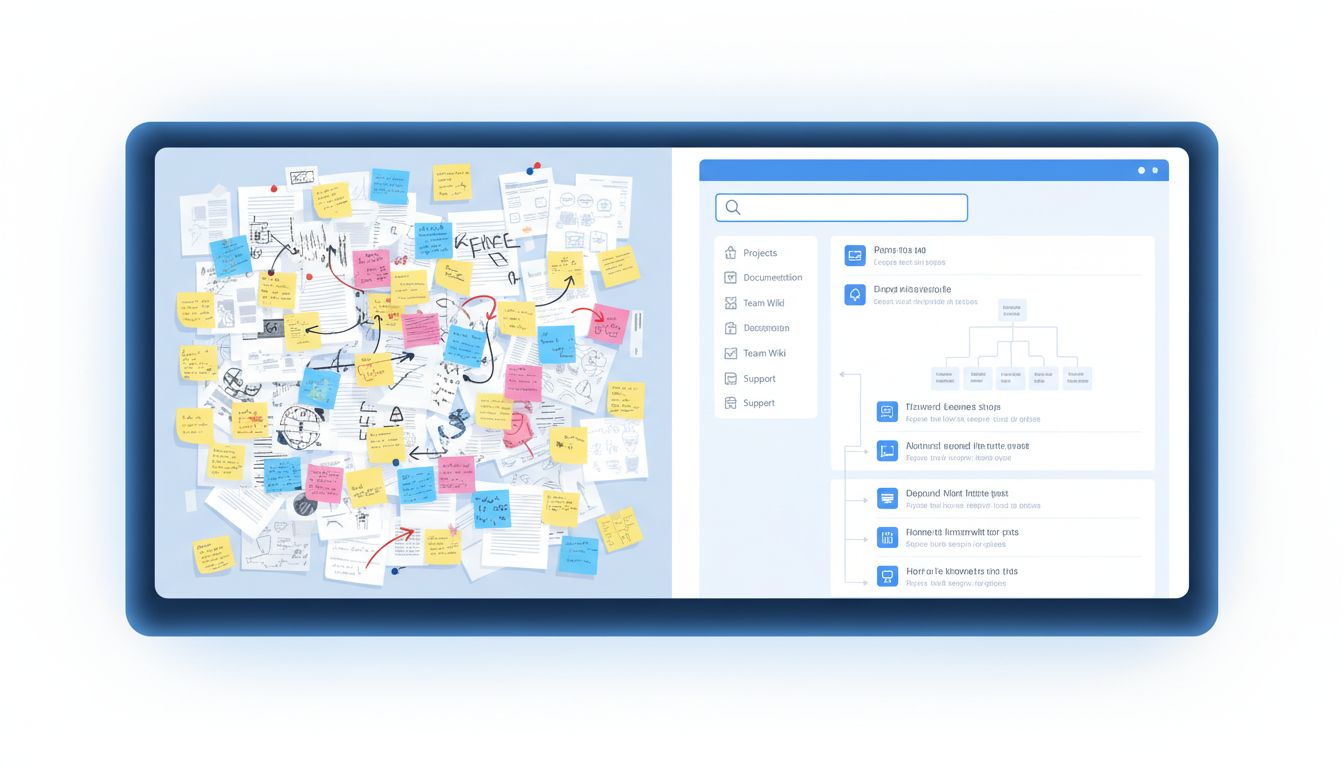
When a senior developer leaves a company, they take roughly 80 percent of their contextual knowledge with them. The code stays. The decisions behind the code, the failed approaches, the undocumented edge cases, the reasoning behind that inexplicable function name, that all walks out the door. Teams that document aggressively reduce this loss dramatically. Teams that do not document at all are essentially starting over every few years.
This is also why companies that invest in documentation tend to onboard engineers faster. The average onboarding time for a new developer at a well-documented codebase is measured in days. At a poorly documented one, it is measured in months. Multiply that across dozens of hires and the productivity gap becomes staggering.
It connects to a familiar pattern around how companies structure their investments in ways that look like overhead but function as infrastructure. In the same way that digital transformation projects fail at high rates because companies are solving the wrong problem, teams that treat documentation as optional are often solving the symptom (slow delivery) while ignoring the cause (knowledge trapped in individual heads).
How Documentation Changes Your Career Trajectory
The career implications of this habit are not subtle. Developers who document well tend to be promoted into technical leadership roles faster, and for a simple reason: they have already demonstrated the core skill of leadership, which is making other people more effective.
When you write a clear runbook, you have multiplied yourself. When you document an architectural decision with its full context and tradeoffs, you have given your future colleagues (and your future self) a gift that compounds over time. These are the behaviors that make someone genuinely irreplaceable, not because they hoard knowledge, but because they systematize it.
Consider also the external-facing dimension. Developers who write clearly about technical topics, whether in public documentation, blog posts, or open-source READMEs, build reputations that precede them. Hiring managers routinely report that a candidate’s public writing carries more signal than a portfolio of projects. A well-crafted technical explanation demonstrates systems thinking, communication ability, and intellectual rigor simultaneously. A GitHub repo full of undocumented code demonstrates only that the person can write code.
The productivity angle matters here too. Developers who document tend to think more clearly about what they are building before they build it. The act of explaining something in writing forces precision. Vague ideas that seem solid in your head become obviously flawed the moment you try to explain them to a hypothetical reader. This is why many experienced engineers insist on writing a design document before touching a keyboard. The document is not bureaucracy. It is the thinking.
The Strategic Asymmetry Nobody Talks About
Here is the competitive reality: most developers do not document well. This is not because they are lazy or incompetent. It is because documentation has no immediate feedback loop. Code that works ships. Documentation that is incomplete or confusing causes problems weeks or months later, long after the connection to the original decision is obvious.
This delay creates an enormous asymmetry. Developers who invest in documentation are playing a longer game in an environment where most people are optimizing for the short term. The benefits accumulate quietly and then arrive all at once, in the form of a team that trusts your work, stakeholders who can follow your reasoning, and a codebase that new engineers can actually navigate.
The parallel to other counterintuitive strategies in tech is striking. Just as successful startups deliberately make their first product worse than they could to preserve focus, the best developers deliberately invest time in documentation that does not directly ship features, because they understand that the constraint is not compute or code. The constraint is always coordination and clarity.
Where to Start
For developers who want to build this habit, the entry point is simpler than it sounds. Start with the decision log: a brief, plain-language record of every non-obvious decision made during a project, including the options considered and the reason for the final choice. This takes roughly ten minutes per decision and pays dividends for the entire lifespan of the codebase.
Next, audit your existing READMEs. If a new team member could not get your project running from scratch using only what is written there, the README is not finished. This is not a documentation problem. It is a product problem, because the product includes the experience of using it.
Finally, write for the person who will be frustrated at 2am trying to understand why something broke. That person is often you, six months from now. Treating your future self with that kind of consideration is not just good documentation practice. It is good engineering philosophy.
The developers who understand this are not working harder than their peers. They are working in a way that makes everything around them easier, and in a field that rewards leverage above almost everything else, that is an extraordinarily powerful position to hold.