
David Heinemeier Hansson wrote Ruby on Rails by extracting it from Basecamp, the project management tool he built for 37signals in 2003 and 2004. What most people remember about that story is the code: an elegant web framework that changed how web applications were built, extracted from a real product under real constraints. What most people miss is the ratio. Hansson was spending a shrinking fraction of his working hours writing code. The rest was spent on something harder to describe and much harder to measure.
This is not a story about work-life balance or burnout prevention. It is a story about where software value actually comes from, and why the popular image of a great developer as someone who codes furiously and constantly is almost exactly backwards.
The Setup
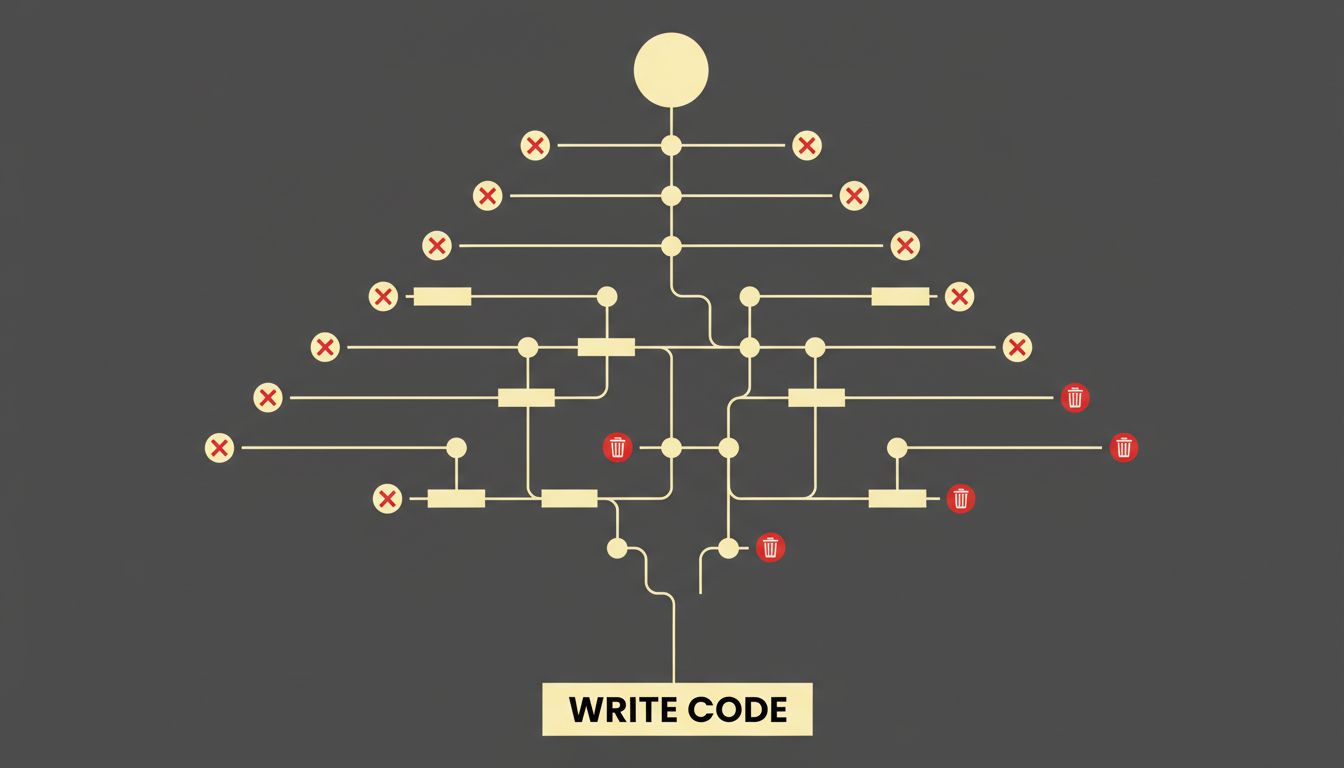
When 37signals (now Basecamp) was building its early products, the team was tiny. Hansson was the primary developer, Jason Fried was running product and business decisions, and there were no layers between a decision and its implementation. In that environment, something interesting happened. Hansson began spending significant time not coding: reading documentation carefully before writing anything, thinking about the design of the system before touching a text editor, and explicitly deleting code rather than accumulating it.
Basecamp as a company later documented this approach publicly in their book Rework and in the 37signals blog (now Signal v. Noise). The core claim was specific: the best code is often the code you do not write. This was not a productivity aphorism. It was a description of how the product actually got built.
What Happened
Hansson’s approach to Rails illustrates the pattern concretely. When he extracted Rails from Basecamp and released it as open source in 2004, it was notable for what it left out. Rails did not try to solve every problem in web development. It made strong, opinionated choices, which meant large categories of decisions were already made before a developer wrote a single line of application code. Convention over configuration, the framework’s central idea, was a direct product of Hansson spending time thinking about what not to build.
The result was a framework that spread faster than almost anything comparable at the time, not because it was more powerful than alternatives, but because it was more constrained. Developers using Rails wrote less code than developers using competing frameworks to accomplish the same thing. The framework’s author had done the cognitive work up front so that its users could move faster later.
This is a pattern that repeats at the individual developer level. Senior engineers at major technology companies consistently report that their most productive stretches involve the least keystrokes. The work is in the design, the diagnosis, and the deletion.
Why Beginners Miss This
The misconception has a clear source. When people learn to code, activity and progress are the same thing. Writing a for-loop is progress. Getting a function to return the right value is progress. Every keystroke is a step forward. The feedback loop is tight and visible.
This creates a mental model of developer productivity that maps directly to volume of code produced. More code, more work done. It seems obvious because for beginners, it is true.
The problem is that this relationship inverts as systems grow. A codebase with 10,000 lines is not ten times more functional than one with 1,000 lines. It is ten times harder to change, ten times more likely to contain interacting bugs, and ten times more expensive to understand for the next developer who has to work in it. The value of software is not correlated with its size. Often it runs opposite.
Ken Thompson, one of the creators of Unix, made this point in a form that is almost a provocation: one of his most productive days was when he deleted 1,000 lines of code. The value created that day was negative code. Basecamp has made a similar argument at the organizational level: smaller systems are faster to build, cheaper to run, and easier to improve.
The Economics of Not Coding
There is a business logic here that goes beyond individual developer preferences. When a developer writes code, the cost is not just the hours spent writing. It is also the hours future developers will spend reading, debugging, and eventually replacing that code. Every line added to a system has a long-term carrying cost.
This means the decision of whether to write something at all is often worth more time than the act of writing it. A senior developer who spends two hours deciding that a feature should not exist has saved, in many cases, weeks of downstream work. That two hours looks unproductive by any simple metric. It produces no commits, no tickets closed, no visible output. But the return on it can be enormous.
This is why the most experienced developers tend to ask different questions than beginners. A beginner asks how to build something. A senior developer asks whether it needs to be built, whether something already built can be reused, and what the system will look like in two years if this is added. The answers to those questions determine whether the keyboard ever gets involved at all.
What We Can Learn
The Basecamp story has a lesson that is easy to state and hard to apply: the measure of developer productivity is not code written. It is value delivered per unit of complexity added. These two things are often in tension, and the best developers know it.
For individual developers, this suggests a concrete reorientation. Before writing any significant piece of code, the question worth sitting with is: what is the simplest system that solves this problem? Not the most elegant, not the most general, not the most impressive. The simplest. Hansson built Rails by ruthlessly asking that question, and the answer was almost always to remove something.
For teams, the implication is more uncomfortable. If the people you consider your best developers are spending most of their time in a text editor, you may have the incentives backwards. The incentive structures that push developers toward more code rather than better decisions are real, and they do not disappear by accident.
The most important thing Hansson did in building Basecamp was not extracting a framework. It was deciding, repeatedly, what not to build. That decision-making does not look like work from the outside. It is, in fact, the hardest part of the job.