
The Rubber Duck Method Works Because Explaining Code Forces You to Think, Not Just Type
The rubber duck method sounds like a joke: when stuck on a bug, place a rubber duck on your desk, explain your code to it line by line, and watch the solution appear. Programmers have used this approach seriously for decades, popularized by Andrew Hunt and David Thomas in their 1999 book The Pragmatic Programmer. The technique is not whimsy. It is a reliable workaround for a specific cognitive failure that affects every developer who has ever written code.
Here is what is actually happening, and why the developers who use it well do more than just talk at a toy.
1. Explaining Forces You to Fill In the Gaps You Glossed Over
When you write code, your brain operates on assumptions. You know what a variable is supposed to do, so you don’t scrutinize it. You know where the data should come from, so you skip the check. This shortcut is efficient during normal work. It is catastrophic during debugging.
The act of explaining forces complete sentences. You cannot say “and then it just… processes the thing” to a rubber duck the way you might during a code review with a colleague who already shares your context. The explanation has to be coherent from first principles. That requirement is precisely where the bugs hide. Researchers studying “self-explanation” in educational psychology, including work by Michelene Chi at the University of Pittsburgh, found consistently that students who explained material aloud to themselves identified their own misconceptions far more reliably than those who re-read silently. The same mechanism applies to code.
2. Switching Audience Changes How Your Brain Processes the Problem
There is a measurable difference in how the brain encodes information when the goal is comprehension versus communication. When you write code, you are in production mode, optimizing for syntax and logic flow. When you explain it, even to an object, you shift into a different cognitive mode, one that prioritizes coherence and sequence.
This mode-switch is not trivial. Cognitive load research distinguishes between “intrinsic” load (the complexity of the task itself) and “germane” load (the processing that builds understanding). Debugging from inside the problem keeps you in high intrinsic load. Explaining forces germane processing. That is why the solution often surfaces mid-explanation rather than after it. You are not waiting for inspiration. You are changing the type of thinking you are doing.
3. The Duck Works Because It Cannot Interrupt You
Code reviews and pair programming are valuable, but they introduce a complication: the other person responds. They ask questions, make suggestions, or redirect you before you finish your own chain of reasoning. A human partner is often too helpful too early.
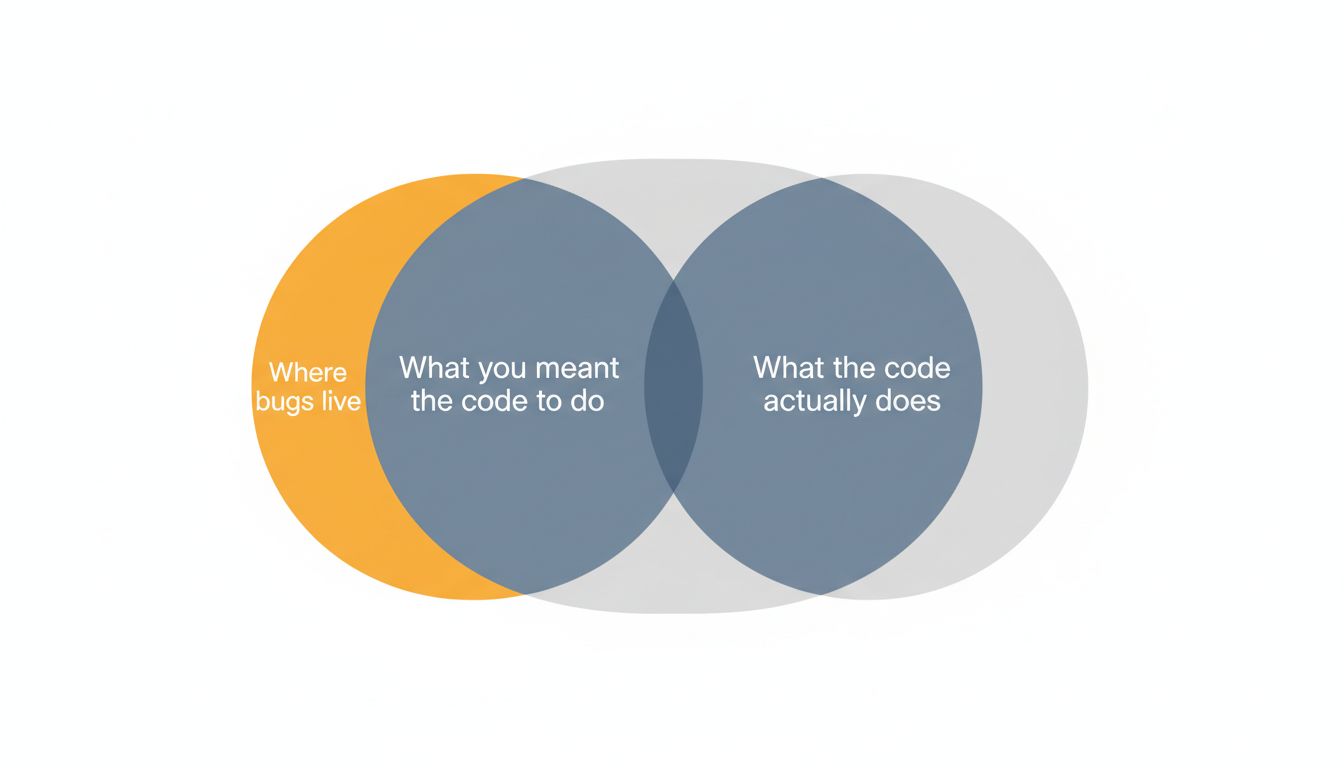
The duck’s silence is the feature. You have to reach the end of your own explanation without deflection. Senior developers who use this method report that the solution almost always appears before they finish describing the problem. That pattern makes sense. Most bugs are not exotic logic failures. They are gaps between what you think the code does and what it actually does, and full uninterrupted verbalization closes that gap.
4. It Works Best When You Explain Intent, Not Just Syntax
The developers who get the most out of this technique are not reading their code aloud like a text-to-speech engine. They are explaining why each line exists. “This function takes a user ID and should return their most recent transaction” is more useful than “this function has a parameter called userId.” The first version immediately exposes a testable assumption. The second version describes what is already visible on screen.
The distinction matters because bugs almost never live in the syntax. They live in the gap between intent and implementation. Explaining intent forces you to articulate what you expected, which makes it possible to compare expectation against reality. This is the same logic behind productive procrastination: the brain often needs to process a problem from a different angle before the solution becomes accessible.
5. The Physical Proxy Matters More Than You’d Expect
You can get some benefit from explaining a problem in your head. You get more from saying it out loud. You get the most from speaking to a physical object. This hierarchy has a practical explanation: each step raises the social stakes, even if the stakes are technically nonexistent.
Humans are wired to produce coherent communication for an audience. The more the interaction resembles a real audience, the more that wiring activates. A rubber duck, sitting on the desk making eye contact (so to speak), triggers just enough of that social circuit to sharpen the explanation. This is the same reason writing out a problem for Stack Overflow often produces the solution before you post it. The act of preparing a coherent question for a real audience forces the same articulation the duck forces.
6. Successful Developers Use It Proactively, Not as a Last Resort
The common framing of rubber duck debugging treats it as a rescue tool for when you are truly stuck. The developers who benefit most use it earlier, before the frustration sets in, as a first pass on any code they are about to write or review.
Explaining your approach before implementation is a different discipline than post-hoc debugging, and arguably more valuable. It surfaces architectural assumptions while they can still be changed. Teams that build this into their workflow, sometimes called “pre-mortems” or “rubber duck design reviews,” tend to catch category errors early rather than implementation errors late. The technique scales beyond individual bugs into system-level thinking.
7. The Duck Is a Stand-In for the Right Kind of Help
The lasting lesson of the rubber duck method is not about ducks. It is about the type of cognitive intervention that actually resolves hard problems. Asking a colleague for help often produces an answer. Explaining a problem to the right listener (or the right proxy) produces understanding. Those are not the same outcome.
Organizations that have built rubber duck logic into their culture, through documentation requirements, required problem statements before asking for help, or structured code walkthroughs, report fewer repeated bugs and faster onboarding for new engineers. The duck teaches you to solve the problem. The colleague just solves it for you. Over a long career, the difference compounds significantly.