A founder I know spent six months convinced his company’s growth problem was a top-of-funnel problem. He kept pouring money into acquisition. His free-to-paid conversion rate was fine. His enterprise deals were closing. What he couldn’t explain was why his unit economics looked so bad despite decent revenue. When we finally sat down with his pricing data, the answer was obvious: almost nobody was buying his middle tier. Everyone was either on the cheap plan or on the custom enterprise deal that required a dedicated account manager. He had accidentally designed the one pricing structure guaranteed to crush his margins.
The second-cheapest tier, the one sitting just above your entry-level plan, is where SaaS economics actually work. This isn’t a trick or a gimmick. It’s structural, and once you see it, you can’t unsee it.
1. It Captures Customers Who Have Already Decided to Pay
The free or entry-level tier does one job: it gets people in the door. But the customers on your cheapest paid plan are often still in evaluation mode. They’re hedging. The moment someone moves to the second tier, something has shifted. They’ve decided the product is worth real money and they want more of it. That psychological commitment changes everything about their relationship with your product and with churn risk.
Customers who self-select into the second tier tend to be more engaged, more likely to integrate deeply, and more likely to stay. You didn’t have to sell them up. They walked up. That means no sales commission, no negotiation, no hand-holding. They just converted.
2. The Margin Profile Is Structurally Better Than Every Other Tier
Free users cost you infrastructure and support with zero revenue. The cheapest paid tier usually covers costs but leaves little margin because the price is set low to minimize friction. Enterprise deals carry real revenue but also real cost: sales cycles, custom contracts, dedicated support, security reviews, and account managers who need salaries.
The second-cheapest tier sits in a pocket where the price has cleared the “this is a real purchase” threshold but the support burden is still close to zero. These customers generally don’t get dedicated support. They read the docs. They use the help center. They watch the onboarding videos. Many SaaS companies find that this tier generates their highest gross margin per customer when you account for fully-loaded costs. The revenue is real. The cost to serve is nearly the same as someone on the cheapest plan.
3. It Benefits From the Anchoring Effect of the Tier Above It
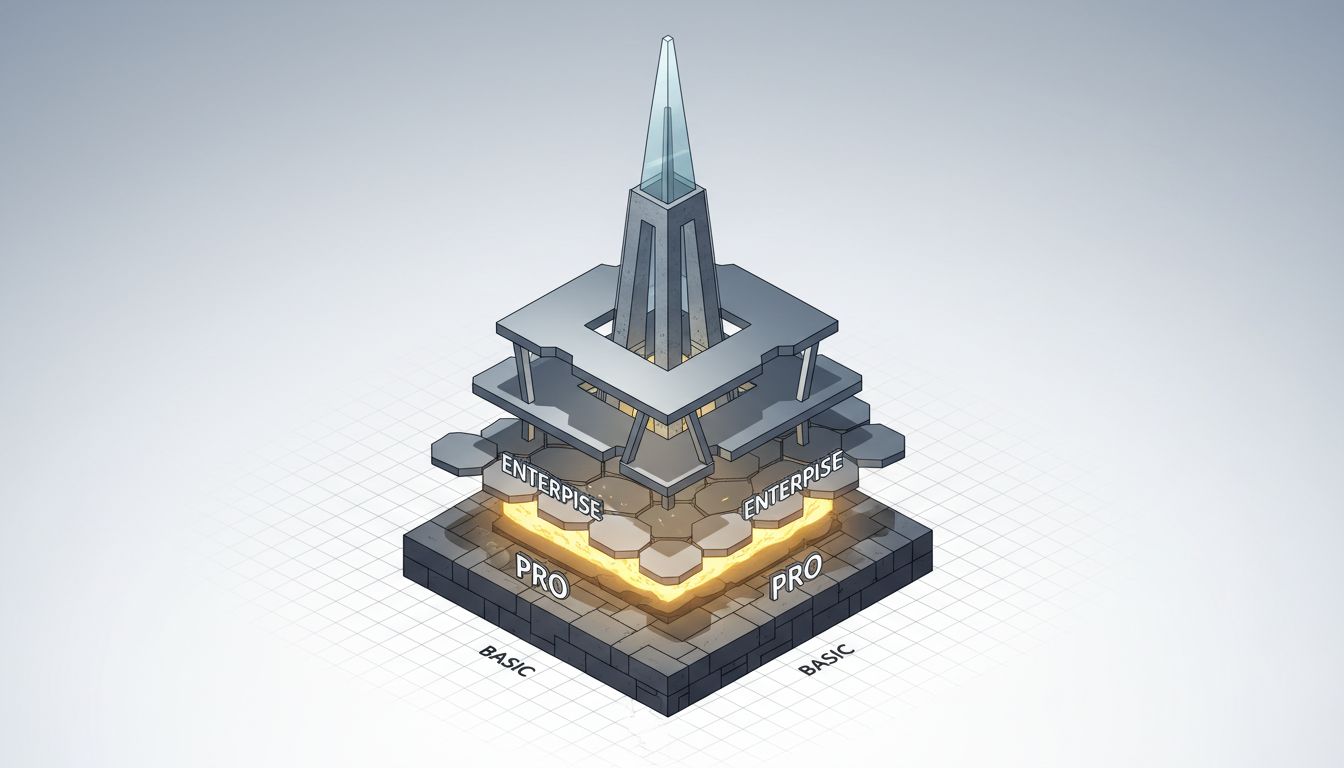
Pricing isn’t evaluated in isolation. It’s evaluated in context. When someone lands on your pricing page, they’re comparing tiers against each other, not against some abstract sense of value. The third tier (usually called “Pro” or “Business”) makes the second tier look like a bargain. The enterprise tier makes the third tier look reasonable, which further validates the second.
This is why the sequence matters. A well-designed pricing page doesn’t just list options. It creates a comparison environment where the second-cheapest tier reads as “smart choice” to a large portion of visitors. The customer feels like they’re getting most of the value without overpaying. They’re probably right. And you’re making excellent margins because the feature delta between tier two and tier three is often small but the price delta is significant.
4. It Scales Without You
Enterprise revenue is lumpy. It comes in big chunks, but those chunks require human effort at every stage. Pipeline management, demos, security questionnaires, procurement, onboarding calls. None of that scales automatically. When an enterprise deal falls through at the end of a quarter, it hurts.
Second-tier customers typically buy online, onboard themselves, and expand their usage without a conversation. The revenue compounds predictably. Many SaaS companies that look at their ARR cohorts find that second-tier customers, in aggregate, show better net revenue retention than enterprise customers because there’s no renegotiation cycle and no single-point-of-failure relationship with an account executive. As founders who’ve priced their products incorrectly often discover, the issue isn’t always the number on the tag. It’s the tier structure around that number.
5. Churn Looks Different Here
Customers who leave the free tier or the cheapest paid tier often leave because they never really committed. It costs you almost nothing to acquire them and relatively little to lose them, but when aggregate churn numbers are reported, these casual defections make everything look worse than it is.
Second-tier customers churn for real reasons: the product stopped working for them, a competitor won, their company hit budget trouble. These are churn events you can analyze, learn from, and in some cases prevent. The signal-to-noise ratio on churn data from this tier is far higher than from your lowest tier, which means your retention efforts actually work instead of just generating noise.
6. It’s Where Word-of-Mouth Comes From
Free users tell their friends about free things. Enterprise customers are often contractually quiet (NDAs, reference restrictions) and even when they’re not, they talk to other enterprise buyers in long cycles. Second-tier customers are the ones who actually evangelize. They paid real money, they’re getting real value, and they’re not embarrassed to say what they use. They post on Twitter. They answer questions on Reddit. They recommend tools in Slack communities.
The organic referral loop that keeps customer acquisition costs low for many successful SaaS companies is driven almost entirely by this cohort. They have skin in the game without the corporate restrictions that mute enterprise users.
7. It Tells You If Your Product Is Actually Working
If your second-cheapest tier is empty, something is wrong. Either your pricing gap between tiers is too large, your cheapest plan gives too much away, or the features that differentiate tier two aren’t compelling enough to justify the jump. An empty middle tier is a diagnostic signal, not just a revenue problem.
Companies like Basecamp and Linear have talked publicly about how they think about pricing as a reflection of product clarity. If customers can’t find the right tier, the product hasn’t communicated its value clearly enough. The second tier isn’t just a revenue mechanism. It’s a test of whether your value proposition is legible. When it fills up naturally, you know you’ve built something people understand and want more of, at a price that makes sense to them and to you.
The founders who figure this out early build businesses with much better unit economics than those who optimize for headline ARR. The second-cheapest tier won’t show up in your pitch deck as the star. But in your operating model, it usually is.