In 2021, a mid-market SaaS company in the sales intelligence space was growing annual recurring revenue at roughly 150% year-over-year. Every metric a venture investor wanted to see was pointing up and to the right. Slide decks were being built around it. Term sheets were arriving.
There was one problem. The company was spending somewhere between $1.80 and $2.20 to acquire every dollar of new ARR. Its best customers were churning inside eighteen months. And its gross margins, once you included the data licensing costs that somehow always ended up in “cost of goods sold” footnotes, were sitting in the low fifties. For context, a healthy SaaS business targets gross margins above 70%, ideally above 80%. The company wasn’t building a software business. It was building a very fast treadmill.
This story is not unusual. It is, in fact, the modal story of venture-backed SaaS between 2018 and 2022.
The Setup: How Growth Hides the Rot
Zoom out and look at what happened to Zendesk before its 2022 acquisition. Or look at what happened to companies like Sprinklr when they went public and investors finally got full visibility into their cost structures. Or consider the implosion of valuations across the entire SaaS sector when interest rates rose and the cost of capital suddenly mattered again.
The pattern is consistent. During low-rate environments, investors rewarded growth multiples so aggressively that the actual economics of the underlying business became secondary. A company doing $100M ARR at 100% growth could command a 40x revenue multiple. That same company doing $100M ARR at 30% growth with strong margins might command 10x. The math rewarded growth above everything else, so that’s what founders optimized for.
The problem is that growth purchased with bad unit economics is not growth. It is an obligation.
What Actually Happened at the Case Level
Let me walk through the mechanics using a composite that reflects what I watched happen across several real companies during this period.
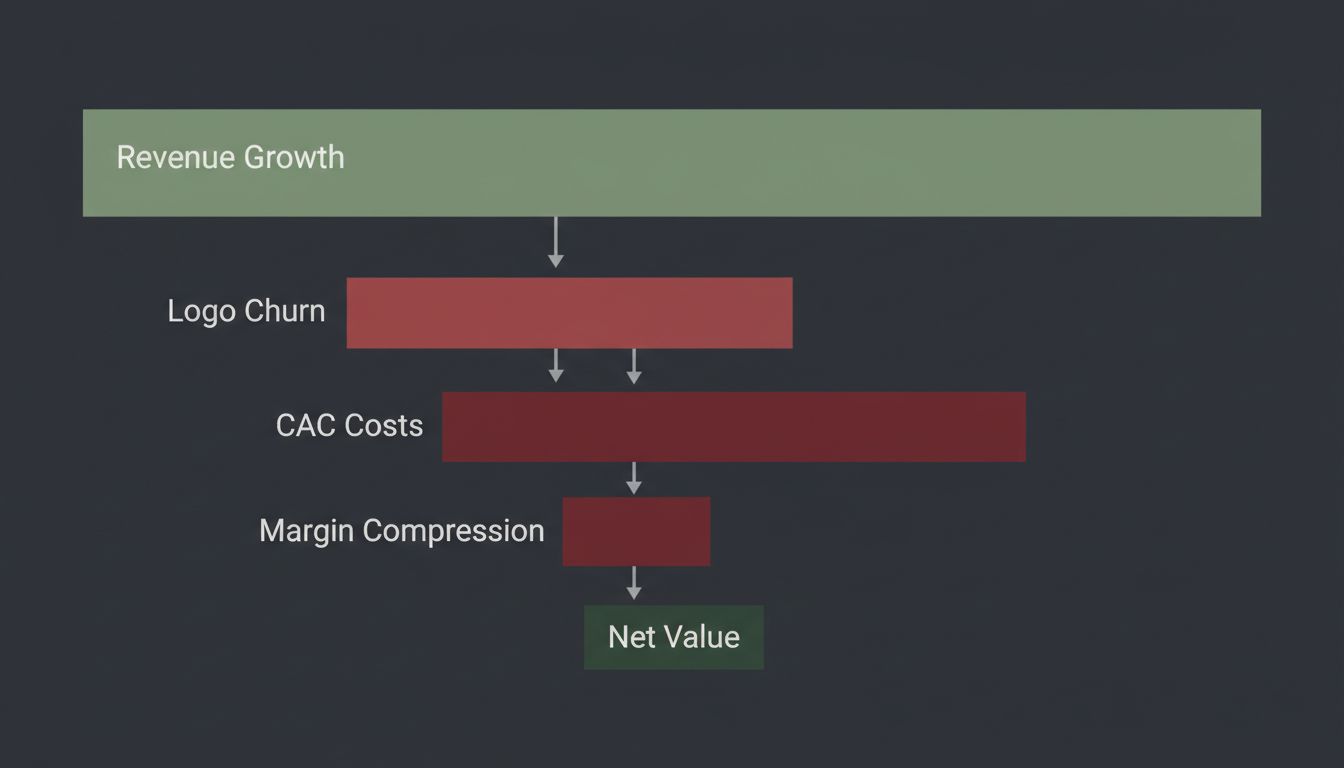
A SaaS company raises a Series B on the strength of its net revenue retention (NRR), which is sitting at 118%. That number is real. Customers who stay are expanding. But the word doing a lot of heavy lifting in that sentence is “who stay.” The company’s logo churn (the percentage of customer accounts that cancel) is running at 22% annually. So roughly one in five customers is leaving every year, and the growth in the remaining accounts is masking it.
The sales team is compensated on new ARR booked, not on retained revenue. So they’re selling aggressively into segments the product doesn’t quite fit yet, harvesting commissions on deals that will churn in year two. Customer success is understaffed because headcount is expensive and the growth numbers don’t require you to fix what you can’t yet see.
Customer acquisition cost (CAC) is climbing because the obvious buyers have already been sold, and now the team is working harder for every new logo. The CAC payback period (how many months of gross margin it takes to recover what you spent acquiring a customer) has drifted past 24 months. The company is essentially giving customers an interest-free loan for two years before it breaks even on them.
All of this is survivable if the customers then stay for five or six years. They are not staying for five or six years.
The company raises a Series C. The deck shows ARR growth, NRR, and pipeline. It does not prominently feature logo churn, CAC payback trends, or the gross margin compression caused by the professional services team they’ve had to build to keep enterprise customers from leaving. The investors who lead the round are sophisticated. They see the issues. But they’re also underwriting the possibility that the company reaches scale before the economics matter, or gets acquired by a strategic buyer who wants the customer base.
This is the bet that works until it doesn’t. When it doesn’t work, it works spectacularly badly.
Why This Keeps Happening
There’s a structural reason why the fastest-growing SaaS companies so often have the worst unit economics, and it goes beyond founder greed or investor naivety.
Growth itself is genuinely hard to fake in the short term. If a company is adding $30M of ARR in a year, that’s real revenue from real customers making real decisions. The bad economics are downstream consequences that take time to materialize. Logo churn shows up 12 months after the sale. CAC payback problems don’t register until the sales team has exhausted the easy market. Margin compression from operational complexity only becomes visible at scale.
By the time the problems are visible, the company has raised at a valuation that requires continued growth to justify. The founders can’t slow down even if they want to. Tech companies report massive losses because the losses are the strategy, and in SaaS, the version of this is that the losses are structured to look like investments in growth, which they are, right up until they aren’t.
The investors are also not wrong to fund this model in many cases. If the underlying product is genuinely good and the market is large, you can sometimes outrun the bad economics by fixing operations at scale. Salesforce did this. HubSpot did this. But survivorship bias is doing enormous work in that observation. For every Salesforce that grew into its economics, there are many companies that grew into a wall.
What You Can Learn From This
If you’re a founder, the lesson is not to stop growing. It’s to understand which of your unit economics are improving with scale and which are deteriorating. If your CAC payback period is getting longer as you grow, that’s a structural problem, not a temporary one. If logo churn is above 15% annually in a product that should have sticky workflows, fix it before you pour more money into acquisition.
If you’re an investor (or thinking about joining a company), the metrics to interrogate are not the headline ARR growth number. They are the logo churn rate (not just NRR), the CAC payback period trend over the last four to six quarters, and the gross margin including any professional services and data costs that might be lurking in footnotes. A company showing 120% NRR with 25% logo churn is a company with a leaky bucket that has figured out how to pour water in faster than it drains. That is not the same thing as fixing the bucket.
The fastest-growing SaaS companies get the most coverage, the richest valuations, and the most talent. They deserve scrutiny in proportion to that attention. Growth that can’t survive a rise in the cost of capital, a slowdown in hiring, or a competitor with a better product is not a business. It’s a window.