In 2019, a senior logistics executive at a major hotel chain sat across from me at a conference dinner and said, with genuine frustration, that Airbnb had beaten them without owning a single bed. He’d spent thirty years building a company defined by physical infrastructure: land, buildings, linens, staff. Airbnb spent almost none of that and was worth more than his entire chain. He wasn’t wrong to be frustrated. He was watching a structural shift happen in real time and didn’t have the vocabulary to describe what had actually changed.
The vocabulary is simple, even if the implications aren’t. The most valuable companies in tech have figured out that the asset-light model isn’t just a clever financial trick. It’s a fundamentally different theory of what a company is.
The Old Model Was Built Around Scarcity
For most of the twentieth century, owning stuff was the point. A retailer owned inventory because inventory was how you guaranteed supply. A hotel chain owned buildings because buildings were how you guaranteed rooms. A taxi company owned vehicles because vehicles were how you guaranteed rides. Ownership meant control, and control meant you could make promises to customers.
The tradeoff was capital intensity. You needed money to buy the things, and the things depreciated, broke, required maintenance, sat idle. The balance sheet became a map of your obligations as much as your assets. And when demand dropped, you were stuck holding things you couldn’t use.
This isn’t ancient history. It’s still how most of the world’s large companies work. The interesting question is why tech companies found an exit from it.
Software Changed the Economics of Control
The shift happened because software changed the relationship between control and ownership. You don’t need to own a car to control the terms on which it gets used. You need a contract, a rating system, and a payments layer. Build those in software, and suddenly millions of independently owned cars become, for practical purposes, a fleet you can dispatch.
This is the actual insight behind Uber, Airbnb, and the rest of the platform companies. They didn’t just avoid buying assets. They figured out how to exercise the economically valuable parts of ownership (setting terms, capturing margin, controlling the customer relationship) without taking on the physical and financial burden of the assets themselves. The hosts own the apartments. The drivers own the cars. The platforms own the rules.
The financial consequences are significant. A company that owns no inventory has no inventory risk. A company that owns no real estate doesn’t get crushed when property values shift. When COVID hit and travel collapsed, Marriott was sitting on billions in real estate it couldn’t use. Airbnb was sitting on software. Both companies had terrible years, but only one of them had a structural problem that persisted.
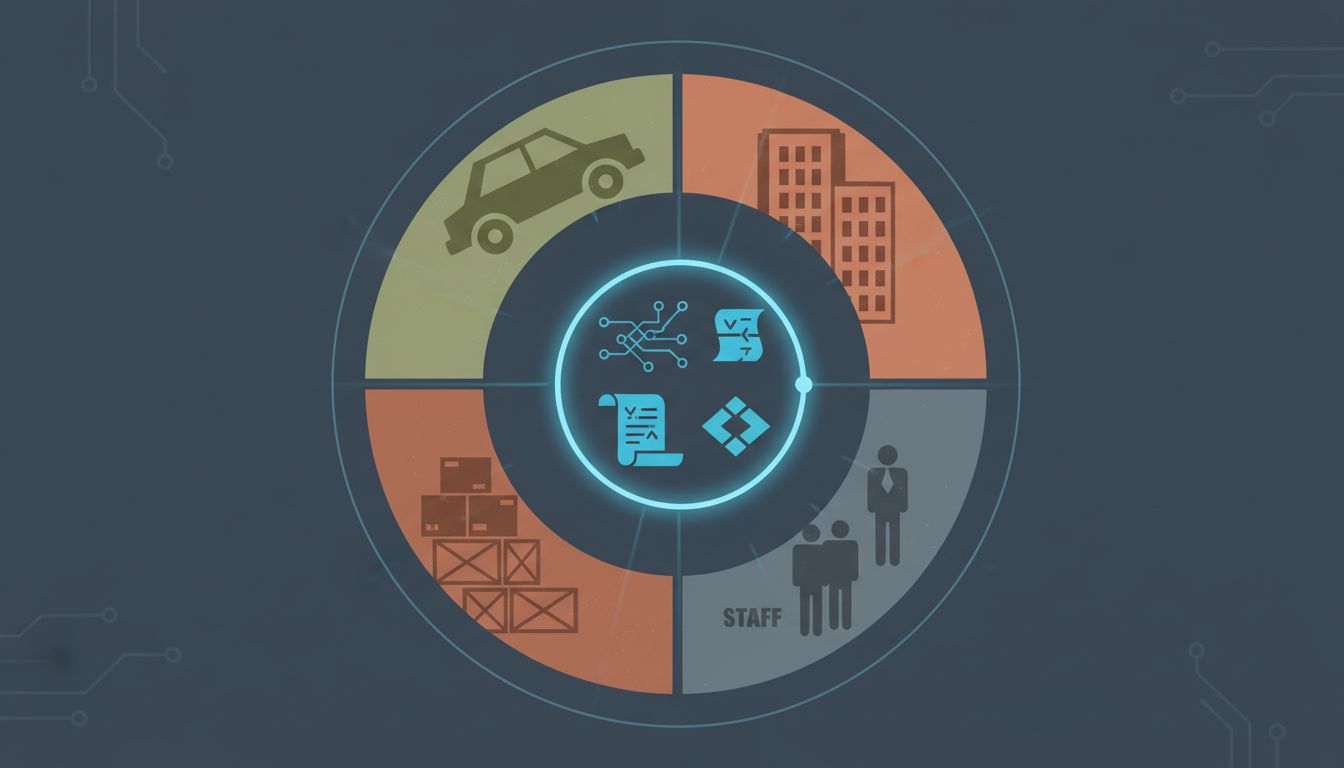
The Margin Story Is Even More Important Than the Asset Story
Here’s the part that often gets glossed over: the asset-light model doesn’t just protect you from downside risk. It fundamentally improves your margins in a way that compounds over time.
A traditional hotel earns a percentage of room revenue after paying for staff, maintenance, utilities, and debt service on the building. Airbnb earns a percentage of room revenue after paying for… software infrastructure and customer support. The cost structures are incomparable. And because software scales without proportional cost increases, every additional booking Airbnb processes is more profitable than the last, not less.
This is why tech investors have historically paid such dramatic multiples for platform businesses. They’re not just buying current earnings. They’re buying a cost structure that gets better as volume increases, attached to an asset base that doesn’t depreciate. That combination is rare in the physical world and common in software.
It also creates dynamics that look strange from the outside. Platform companies often report high revenue growth alongside losses, because they’re investing aggressively in growth while the margin improvement is still working through the model. The accounting can look alarming until you understand that the losses are often a choice, not a structural feature.
The Hidden Cost That Most Coverage Ignores
The asset-light model has a real vulnerability that doesn’t show up in the balance sheet analysis, and it’s one I think gets systematically underdiscussed.
When you don’t own the assets, you don’t control quality in the way that ownership enables. You control it through incentives, ratings, and contracts, which is a softer and more fragile form of control. Airbnb has spent enormous amounts of money and attention trying to solve the consistency problem that every hotel chain solved by just owning and operating its properties. A Marriott room in Cleveland is predictably similar to a Marriott room in Singapore. An Airbnb listing is, by design, idiosyncratic, and that creates real problems when something goes wrong.
Uber has spent years fighting a version of the same problem. When drivers are contractors rather than employees, you have limited ability to enforce standards. You can deactivate bad actors after the fact. You can’t train them the way you’d train an employee. The terms of the platform govern the relationship, but terms are not management.
This is why the asset-light model works better in some markets than others. It works extremely well when the product is inherently variable and the customer accepts that variability (short-term rentals, freelance work, peer-to-peer resale). It works less well when consistency is the core promise. Nobody wants an asset-light surgery. Nobody wants an asset-light air traffic control system.
What This Actually Means for How Companies Compete
The deeper lesson isn’t that tech companies found a clever tax structure or a way to mislead investors about their capital base. It’s that they identified a specific thing that creates value (coordinating supply with demand, setting the terms of exchange, capturing data about transactions) and built companies that do only that thing, at scale, without the overhead of everything else.
The executives who got disrupted weren’t dumb. They were optimizing for the model that had worked for decades. The problem is that model came bundled with assumptions about what you had to own to do business, and those assumptions turned out to be wrong once software existed that could replace the coordination function of ownership.
For anyone building a company now, the question worth sitting with isn’t “what do I need to own?” It’s “what am I owning that someone else could own, if I built the right rules around it?” The answer won’t always be “everything.” But it’s usually more than founders assume at the start.