There is a moment familiar to nearly every knowledge worker: a software installation crawls toward completion, the progress bar stalls at 73%, and suddenly, unprompted, the solution to a problem you have been wrestling with for days simply appears. This is not a coincidence, and it is not magic. It is a measurable cognitive phenomenon that researchers have been studying for decades, and it has significant implications for how we design both our workdays and our digital environments.
The counterintuitive finding is this: the same forced interruptions that feel like productivity theft are, in many cases, the primary conditions under which your brain performs its highest-value work. Understanding why requires a short detour into cognitive neuroscience, and the conclusions challenge some of the core assumptions of modern productivity culture. As explored in our piece on how your brain solves hard problems during software updates, the relationship between idle time and creative output is far more deliberate than most people realize.
The Default Mode Network Does Not Sleep on the Job
When your conscious attention is not locked onto a specific task, your brain activates what neuroscientists call the default mode network (DMN). This is a distinct cluster of brain regions, including the medial prefrontal cortex and the posterior cingulate cortex, that becomes significantly more active during periods of mind-wandering rather than less active. A landmark 2001 study by Marcus Raichle at Washington University identified this network as the brain’s “resting state” activity, though “resting” is a misleading term. The DMN is not resting. It is integrating.
During DMN activation, the brain draws connections between disparate pieces of stored information, tests hypothetical scenarios, and consolidates recent learning. It is, in functional terms, doing the background processing that focused attention actively suppresses. A 2012 study published in Psychological Science found that participants who engaged in an undemanding, mind-wandering task between two creative problem-solving sessions outperformed those who either rested quietly, worked on a demanding task, or took no break at all. The improvement in creative output was not marginal. Participants in the mind-wandering condition solved 41% more problems than those in the demanding task condition.
The installation progress bar, in this context, is doing you an involuntary favor. It is long enough to let the DMN engage, short enough that you do not fill the time with a competing task, and visually specific enough that your eyes have somewhere to go while your mind wanders productively.
Why Smartphones Have Nearly Eliminated This Effect
If forced wait times are cognitively useful, the obvious question is why so many people report having fewer spontaneous insights than they did ten years ago. The answer is straightforward: smartphones eliminated the wait.
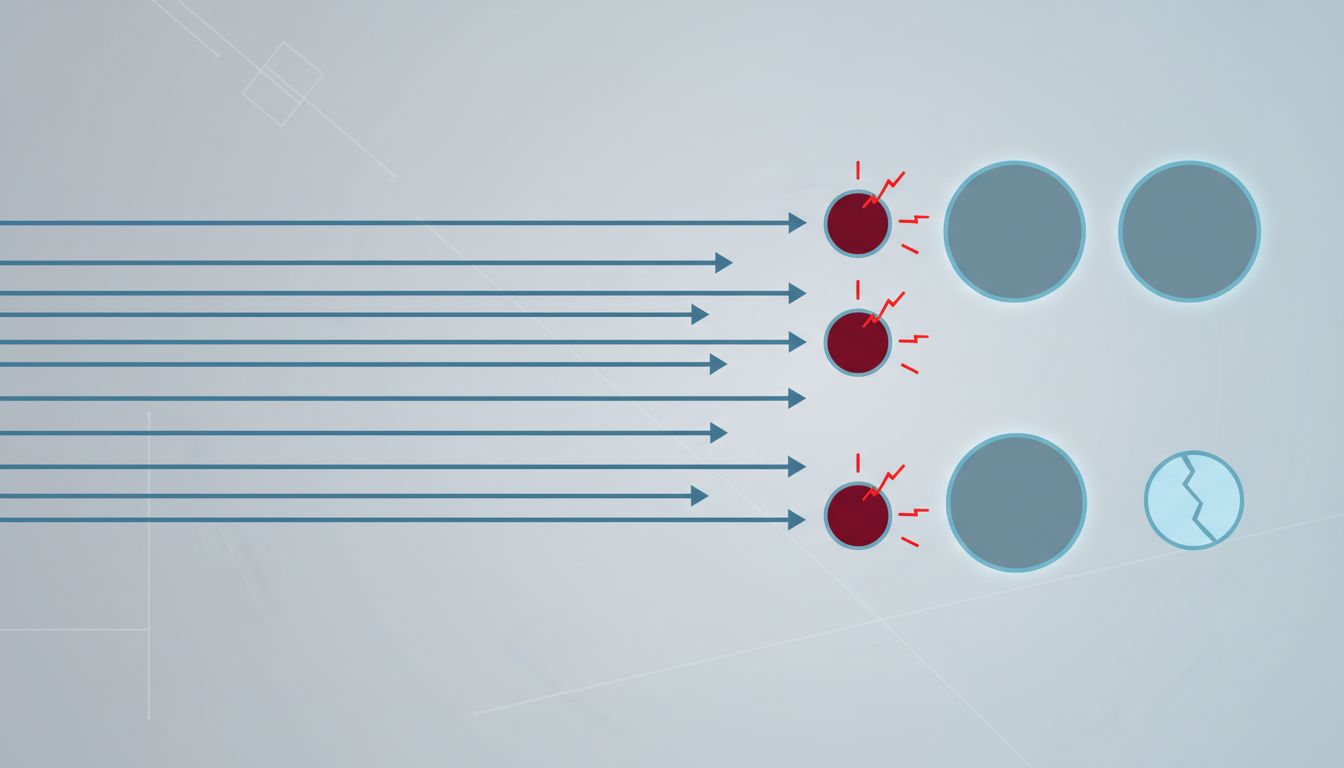
Every gap in attention that was previously unoccupied, the two-minute software install, the elevator ride, the pause before a meeting, is now immediately filled with a notification, a scroll, or a message. These micro-tasks are not equivalent to mind-wandering. They demand just enough focused attention to suppress DMN activation without delivering meaningful cognitive output. Research from the University of Texas at Austin published in 2017 found that the mere presence of a smartphone on a desk, even face-down and silenced, measurably reduced available cognitive capacity in participants performing complex tasks.
This connects to a broader pattern worth noting. The tools designed to fill your time and capture your attention are, by design, poor environments for creative thought. Multitasking apps are scientifically engineered to keep you engaged in ways that feel productive but systematically crowd out the unfocused mental space where novel ideas form.
The Productivity Paradox of Efficiency
Here is where the data becomes uncomfortable for productivity culture. The relentless optimization of software load times, while genuinely useful in most contexts, has inadvertently removed one of the few structurally enforced moments of cognitive rest in a knowledge worker’s day. When installations complete in seconds, when apps open instantly, when pages load before you consciously registered clicking the link, the brain never gets the involuntary pause it needs to consolidate and connect.
This is not an argument for deliberately slow software. But it is an argument for intentional cognitive gaps, which most modern work environments actively resist. The highest-performing knowledge workers, according to research from Florida State University psychologist Anders Ericsson, worked in focused 90-minute blocks followed by genuine rest periods rather than grinding continuously. The rest was not optional. It was the mechanism by which the focused work became useful.
The parallel to software development is instructive. The best engineers write code as if explaining it to someone unfamiliar with computers entirely, a process that requires stepping back from what you know to examine what you have built. That stepping back is cognitively identical to the mind-wandering state that installation wait times induce.
How to Replicate the Effect Intentionally
Since you cannot reliably schedule software installations as cognitive resets, there are more deliberate alternatives that produce measurable results.
First, micro-walks work. A Stanford study found that walking, even on a treadmill facing a blank wall, increased creative output by an average of 81% compared to sitting. The mechanism is identical: the brain is occupied just enough to prevent deliberate task-focus, freeing the DMN to operate.
Second, monotonous physical tasks perform similarly. Showering, dishwashing, and light gardening all appear in self-reported accounts of creative breakthroughs with striking frequency. A 2012 survey of 72 Nobel laureates found that a plurality cited physical monotony, specifically walking and bathing, as the conditions under which their most significant insights emerged.
Third, and perhaps most practically for office environments, single-tasking with deliberate transition gaps outperforms both multitasking and continuous single-tasking. Scheduling two-to-three minute unstructured gaps between tasks, the equivalent of a slow installation, captures the DMN benefit without requiring a lifestyle overhaul. Digital minimalists who outperform power users tend to build these gaps in structurally rather than relying on willpower.
The Progress Bar as Accidental Design Genius
There is something worth sitting with in the observation that one of the most cognitively productive environments modern technology accidentally created is a screen telling you to wait. The progress bar was designed to reduce anxiety about system hangs, not to improve human creativity. The cognitive benefits were entirely unintentional.
This is consistent with a recurring pattern in technology: the most significant effects on human cognition are often the ones no one planned for. The goal was to make you feel better about waiting. The result was to give your brain one of the only unstructured moments in a structured digital day.
The lesson is not to slow down your software. The lesson is to stop filling the gaps your software has already given you, and to start deliberately creating the ones it no longer provides.