Every September, a predictable cycle plays out. Apple announces a new iPhone. Within days, Reddit fills with posts from people claiming their current phone suddenly feels sluggish. The timing feels suspicious enough that many users conclude the obvious: Apple is throttling old hardware to push upgrades.
The truth is both more boring and more structurally damning than that. There is no secret throttling button Apple pushes in August. What there is, instead, is a confluence of software engineering decisions, human psychology, and intentional platform management that produces the same outcome without requiring any conspiracy at all.
What Actually Happens to Your Phone in the Weeks Before a Launch
Apple and Google both release major OS updates in the window surrounding new hardware launches. iOS 18 dropped in September 2024, just days after iPhone 16 was announced. Android’s major version updates follow the same rhythm, timed to Pixel launches. These updates are not malicious in intent, but they are almost never optimized for older hardware.
The reason is structural. When Apple engineers tune iOS performance, they test primarily on the hardware they’re shipping. The A18 chip in an iPhone 16 has more headroom, faster memory bandwidth, and better neural engine performance than the A15 in an iPhone 13. An OS built and benchmarked on A18 silicon will run acceptably on A15, but it will not run the same. Features like on-device machine learning, improved computational photography processing, and richer visual effects all consume resources that older chips handle less efficiently.
This is not unique to Apple. As this site has covered, software updates slow devices down structurally, not because of malice but because software complexity compounds faster than most users’ hardware upgrade cycles. New OS versions carry new frameworks, new background processes, and new expectations about available RAM. A phone from three years ago running software written for today’s hardware is doing exactly what you’d expect it to do: struggling.
The Confirmation Bias Layer Nobody Talks About
Here’s where it gets psychologically interesting. Even if iOS 18 ran identically on an iPhone 13 as it did on an iPhone 16, many users would still perceive their old phone as slower in September. This is not speculation. It’s a well-documented phenomenon in human perception research: when we’re primed to expect deterioration, we find it.
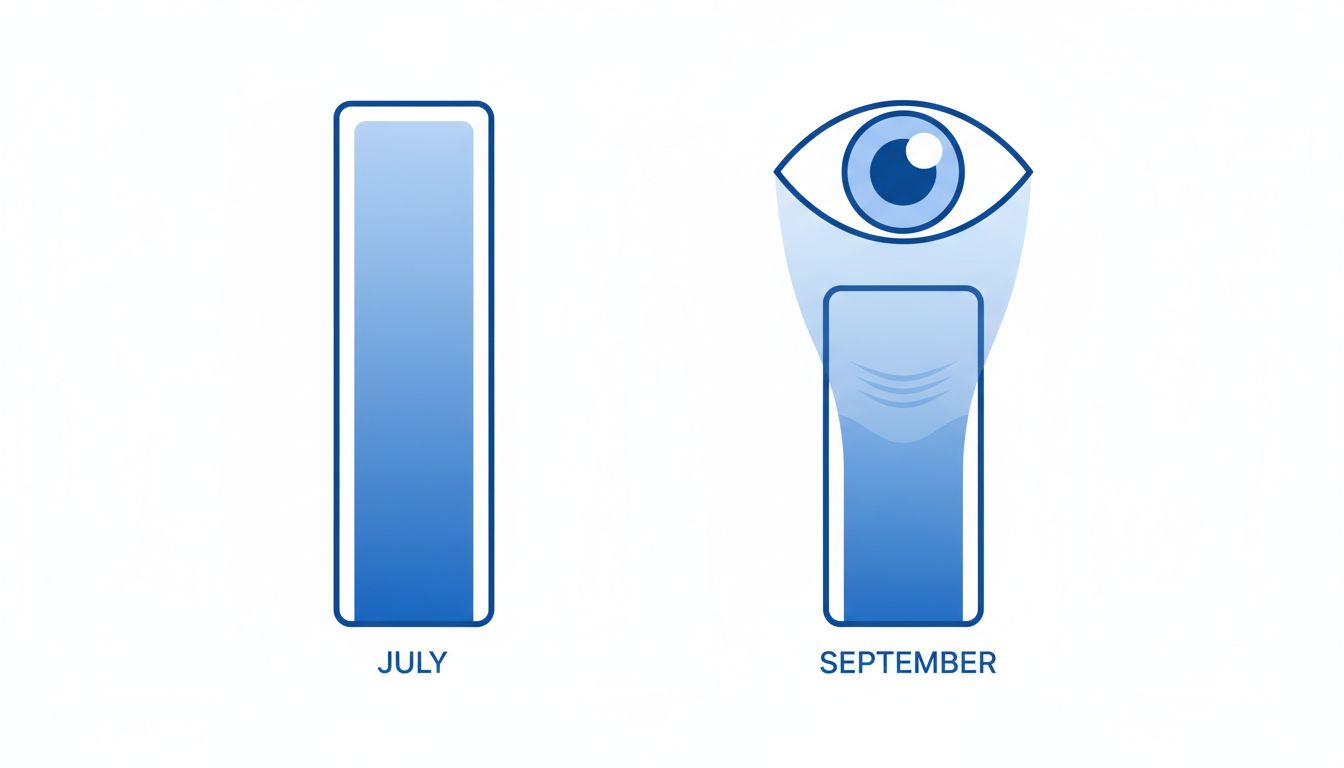
In the weeks before a major Apple launch, the product gets enormous press coverage. Benchmark comparisons appear everywhere. Review units ship. YouTube channels post side-by-side speed tests. All of this primes existing users to evaluate their current phone against a theoretical new standard. A Face ID unlock that felt instant in July feels sluggish in September, not because it got slower, but because you’re now measuring it against something you haven’t even held yet.
This is confirmation bias operating in a commercially useful direction. And the companies benefit from it without doing anything to cause it. The media cycle is doing the perceptual work for them.
The Battery Piece That Is Actually Real
There is one genuinely real mechanism that contributes to pre-launch sluggishness, and it has nothing to do with timing: battery degradation. Apple was sued over this and settled. The company had implemented CPU throttling in iOS 10.2.1 specifically to prevent older iPhones with degraded batteries from unexpectedly shutting down under peak load. The throttling was real. The disclosure about it was absent.
Battery chemistry degrades at roughly one to two percent maximum capacity per hundred full charge cycles under typical conditions. A three-year-old iPhone that’s been charged daily has completed over a thousand cycles. At that degradation rate, its battery capacity could be meaningfully reduced, triggering the exact throttling behavior Apple implemented. This isn’t correlated with launch timing because Apple schedules it. It’s correlated with launch timing because launch timing correlates with when phones are approximately two to three years old, which is also when battery degradation becomes noticeable.
The distinction matters. One explanation requires a company to actively sabotage devices with surgical timing precision across hundreds of millions of units. The other requires only chemistry and arithmetic.
Why the Conspiracy Theory Is More Comfortable Than the Reality
It’s psychologically easier to believe Apple is manipulating your phone than to accept that software complexity is an inherent, compounding problem that no one is fixing. A conspiracy has a villain, a motive, and implicitly a solution (regulation, litigation, switching brands). The structural explanation has none of those things. It just has the slow accumulation of technical debt, layered abstractions, and engineering teams optimizing for the latest hardware because that’s what their product roadmaps require.
As the argument goes with planned obsolescence through software, the outcome of deliberate manipulation and structural negligence looks identical to the consumer. Your phone is slower. You feel pushed toward an upgrade. Whether the cause is intent or indifference changes the moral analysis but not your experience.
There are things companies could do differently. Apple could maintain separate OS performance profiles for older hardware. Google could enforce stricter computational budgets on new Android features. Neither company has strong incentives to do this. A faster old phone is not a problem that improves their revenue, and the engineering cost of maintaining true backward performance optimization is substantial.
What You Can Actually Do About It
If your older phone feels sluggish after a major OS update, a few things are worth trying before assuming planned obsolescence. Replacing the battery is the single highest-impact intervention for phones two or more years old. Apple charges around $99 for this service for most iPhone models. For a phone that otherwise functions well, that’s a far better value proposition than a new device.
Delaying OS updates is also a legitimate strategy that most users never consider. Running iOS 17 on an iPhone 13 in 2024 is not the security liability it might seem: Apple continues patching critical vulnerabilities in older OS versions for a meaningful period. The latest OS is not always the fastest OS on your specific hardware.
Finally, a factory reset after a major OS update often recovers meaningful performance. OS upgrades apply changes incrementally, carrying forward cached data, preference files, and database structures from previous versions. A clean install starts from a known-good baseline and frequently feels noticeably faster on the same hardware.
None of these solutions are as satisfying as a clear villain. But they’re real, and they work. The companies that make your phone are not competent enough at coordination to throttle hundreds of millions of devices on a retail schedule. They are, however, quite good at building software that gets heavier every year while calling it progress.