
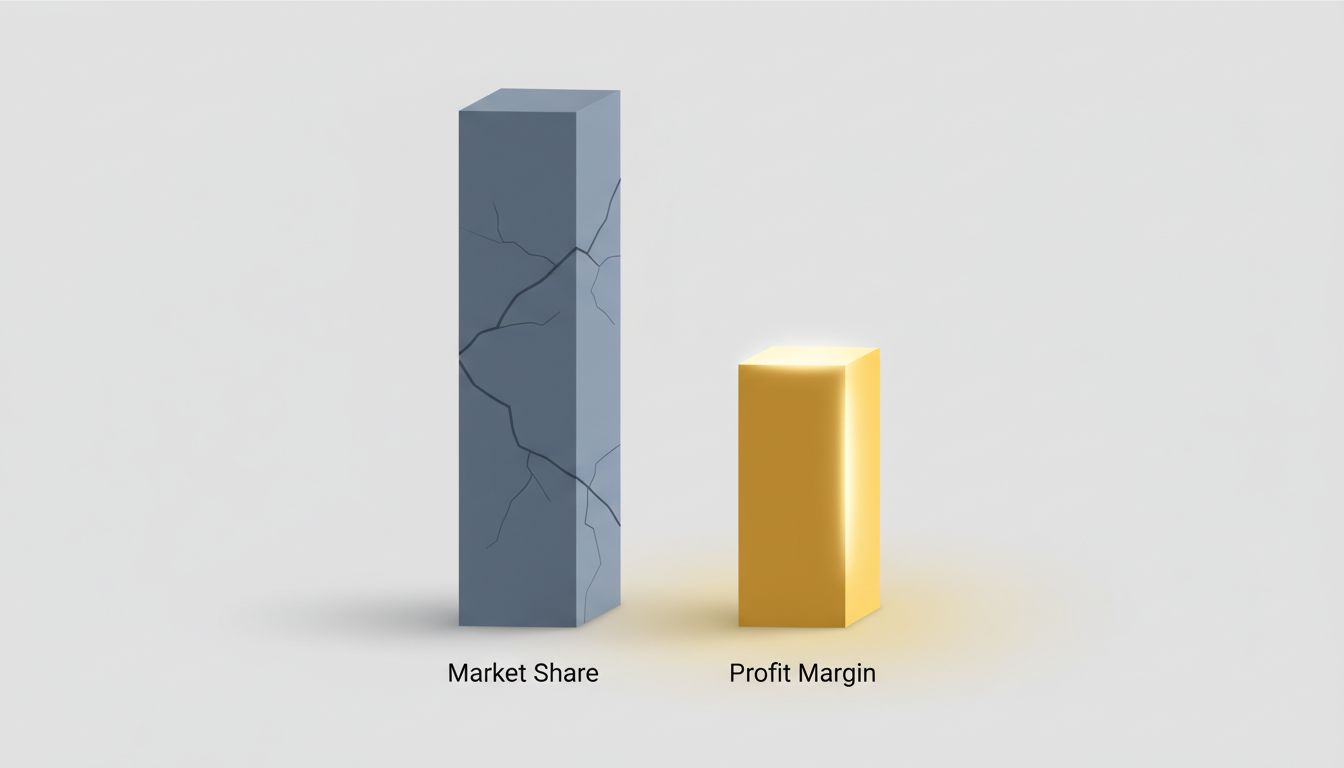
Intel spent most of the 2000s and 2010s defending a position it had already won. It held roughly 80 percent of the x86 processor market, supplied nearly every major PC manufacturer, and ran the world’s most advanced chip fabrication plants. By any conventional measure, it was the dominant company in one of the most important industries on earth.
And it was quietly being eaten alive by its own success.
By 2023, AMD, the perpetual second-place competitor with a fraction of Intel’s workforce and no fabs of its own, was posting gross margins that matched or exceeded Intel’s in several quarters. Its stock had increased more than 3,000 percent over the prior decade. Intel’s had declined. The company that had defined personal computing for a generation was now, by several financial measures, less healthy than the scrappy rival it had spent years trying to bury.
This is not an accident, and it is not unique to semiconductors.
The Setup
AMD’s near-death experience in the early 2010s is worth understanding clearly, because it reframes what followed. The company had bet heavily on a processor architecture called Bulldozer, released in 2011, that underperformed against Intel’s competing chips so badly that AMD eventually faced a class-action lawsuit over misleading marketing claims about core counts. Market share collapsed. The company sold its headquarters building in Santa Clara and leased it back for cash. Analysts wrote serious pieces about whether AMD would survive.
The survival strategy AMD chose was, on paper, an admission of weakness. It spun off its fabrication plants into a separate company (now GlobalFoundries), freeing itself from the capital costs of building and maintaining cutting-edge fabs. This is an enormous ongoing expense: Intel has spent tens of billions on fab construction and modernization in recent years, including commitments exceeding $100 billion for new plants in the United States and Europe. AMD offloaded that obligation entirely, contracting with TSMC for manufacturing instead.
At the time, this looked like retreat. It turned out to be one of the more consequential strategic decisions in recent semiconductor history.
What Happened
With fabrication costs removed from its balance sheet, AMD’s cost structure transformed. The company could invest its remaining R&D budget with unusual precision, essentially betting everything on a single architectural redesign. That redesign, the Zen architecture developed under engineer Jim Keller and released in 2017, delivered performance-per-watt improvements that surprised even AMD’s own projections.
But the architectural win only explains part of the story. The other part is structural, and it runs deeper.
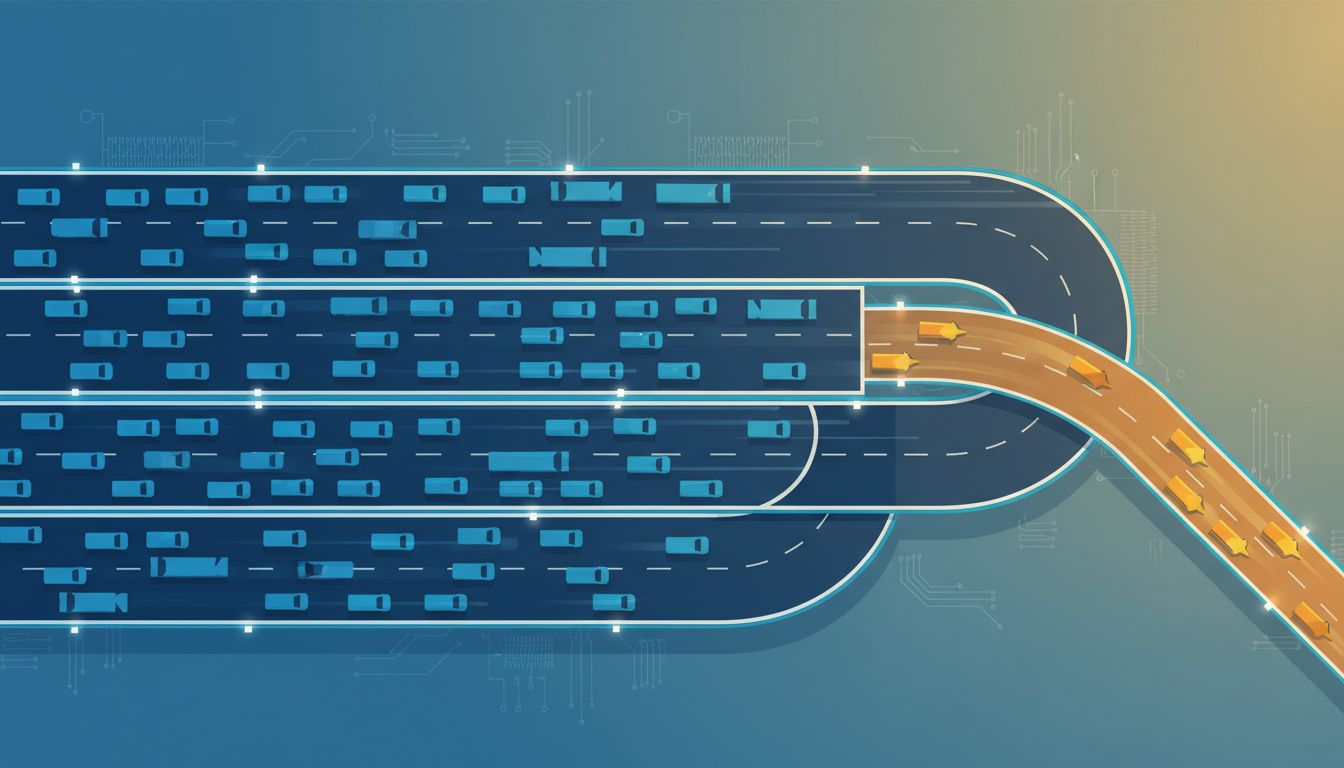
Intel, as market leader, faced obligations AMD simply didn’t have. It had to maintain compatibility with decades of enterprise software. It had to supply every major PC OEM, which meant keeping prices in a range those manufacturers could absorb. It had to defend its server market position against not just AMD but also ARM-based challengers from Amazon and others. It had to explain every product decision to customers who had built infrastructure around Intel’s roadmap.
AMD had to do none of that. It could price its chips aggressively to win design wins, then raise prices once customers had integrated AMD into their supply chains. It could target the specific market segments where Intel’s margins were fattest and attack those selectively, without needing to win everywhere. It could promise a future roadmap without the weight of a present installed base to protect.
This is the structural advantage of second place, and it shows up across the technology industry with enough regularity to be considered a pattern rather than a coincidence.
Why It Matters
Consider the pattern across other categories. Google Chrome overtook Internet Explorer in market share but Microsoft, by retreating to the Chromium-based Edge browser, largely offloaded browser engine maintenance costs while maintaining distribution. In the cloud infrastructure market, Microsoft Azure sits behind Amazon Web Services in total revenue but has consistently posted higher growth rates and arguably better margin trajectory, partly because AWS spent years building out capacity commitments that Azure then met more selectively. In gaming consoles, Sony’s PlayStation frequently outsells Microsoft’s Xbox in hardware units, but Microsoft has argued (in regulatory filings) that its gaming revenues and margins are less dependent on hardware attach rates because Game Pass creates a recurring software stream that hardware sales don’t fully capture.
The mechanism is consistent across these cases. The market leader must defend the entire perimeter. The second-place competitor chooses which perimeter to defend.
Capital allocation is the specific place where this advantage materializes. A company holding 80 percent market share has to spend to maintain that share everywhere its product touches. A company at 20 or 30 percent can concentrate investment in the areas with the highest return, ignore segments that would be expensive to contest, and accept losing battles that the leader cannot afford to concede.
AMD’s capital spending as a percentage of revenue has historically run well below Intel’s, even as AMD’s revenue grew. The fab-less model is the most obvious reason, but the deeper reason is that AMD’s competitive position permitted surgical spending in a way Intel’s did not.
What We Can Learn
The lesson is not to aim for second place. AMD did not choose its position; it nearly went bankrupt getting there. The lesson is about what second place permits that first place forecloses.
First, the leader’s pricing creates a permanent subsidy for the challenger. Intel’s high server processor prices (its highest-margin segment) gave AMD a ceiling to price against, which is why AMD initially targeted data centers aggressively with its EPYC chips despite having far lower brand recognition in that space. Wherever the leader is extracting premium margins, the challenger can offer 15 to 20 percent savings and still operate profitably. The leader either matches the price cut (destroying its own margins) or cedes volume. Neither is a good option.
Second, the leader’s installed base is a ceiling as much as a floor. Intel’s compatibility obligations meant that certain architectural changes that might have improved performance were too disruptive to ship to existing customers. AMD, with a smaller installed base, could make those changes. This is why Zen’s modular chiplet design, which AMD implemented earlier than Intel, gave it a fabrication yield advantage that compounded over several product generations.
Third, the market expects less from second place, which paradoxically creates more room to exceed expectations. AMD’s stock rerating over the past decade reflects not just improved products but a recalibration of what AMD was even capable of. Companies that exceed low expectations get larger valuation multiples than companies that merely meet high ones.
None of this means Intel is finished or that AMD will maintain its current trajectory. Intel has manufacturing assets that AMD can’t replicate quickly, and its government-backed fab investments could reset the competition in the next decade. But the financial pattern of the past ten years is clear: the company that had to fight for every percentage point of market share developed a discipline that the company which already owned the market never needed.
Defending a monopoly is expensive. Attacking one, if you survive long enough to do it right, can be very cheap.