
In 2015, AMD was in serious trouble. The company had lost money for three consecutive years. Its server chip business had collapsed from roughly 25% market share to under 1%. Intel had lapped it repeatedly on processor performance, and AMD’s stock had fallen more than 85% from its 2006 peak. Analysts were openly speculating about bankruptcy or acquisition.
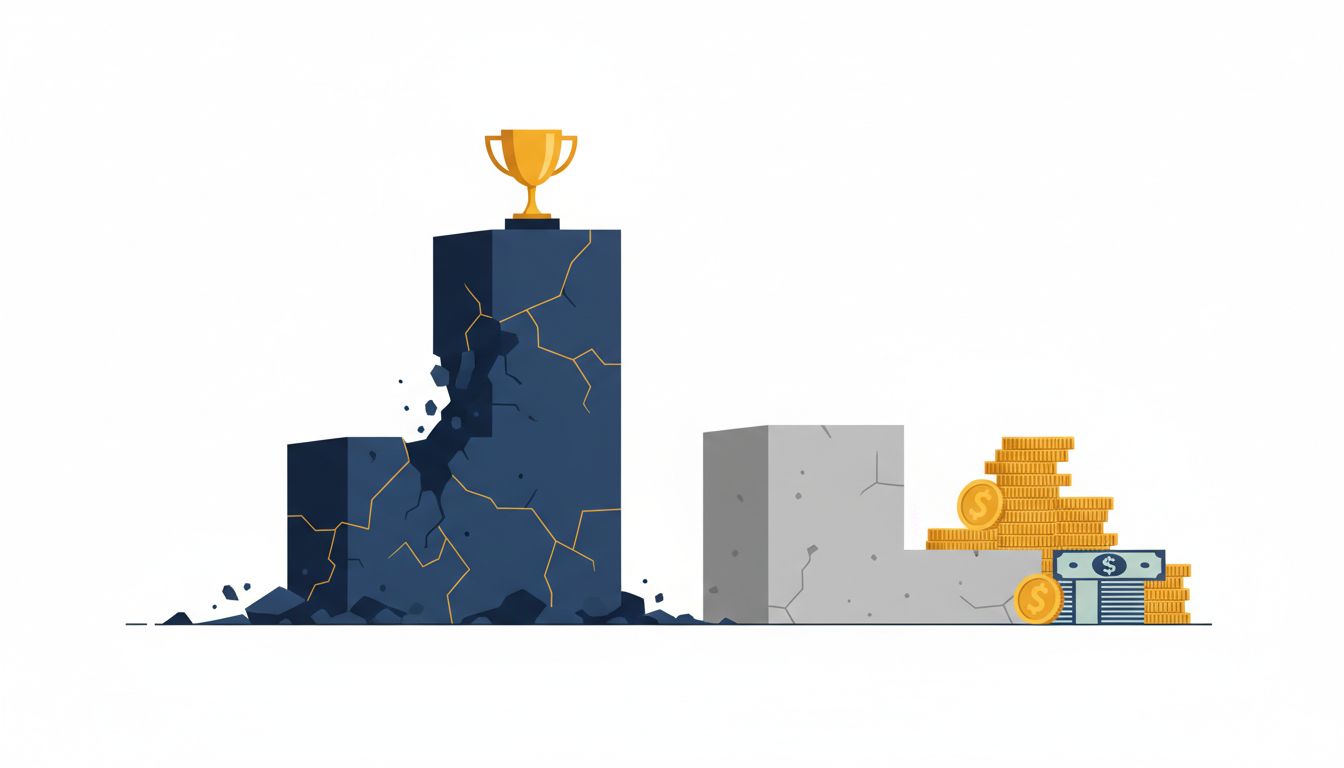
What happened over the next eight years is one of the more instructive stories in semiconductor history, not because AMD eventually “won” the chip market (it didn’t), but because it found a position where losing the volume war actually made it more money than winning it would have.
The Setup
To understand why AMD’s position was structurally interesting, you need to understand Intel’s problem. Dominant market leaders in technology tend to get trapped by their own success. Intel, sitting at roughly 80% of the PC and server CPU market through the 2010s, had to serve every customer segment. Budget laptops. Enterprise servers. Government contracts. Embedded systems. That breadth required enormous engineering resources spread across an enormous product portfolio, and it required constant price competition at the low end to defend volume.
AMD, by contrast, was fighting for survival. And survival required focus.
When Lisa Su took over as CEO in 2014, she made a decision that looked strange from the outside: she killed several product lines, reduced AMD’s addressable market on paper, and concentrated engineering resources on a single new processor architecture. That bet became Zen, which shipped in 2017.

Zen closed a meaningful performance gap with Intel. Not enough to dominate, but enough to compete credibly in the markets AMD cared about: high-performance desktop chips, workstations, and eventually data center processors where margins are highest.
What Happened
The financial results from 2019 onward tell the real story. AMD’s gross margins, which had languished in the 33-35% range for years, climbed steadily. By 2022, AMD reported gross margins above 50% on a non-GAAP basis for several quarters. More tellingly, AMD’s revenue per employee and return on R&D investment began outpacing Intel’s, despite Intel spending roughly four times as much on R&D in absolute terms.
Intel, meanwhile, faced the opposite problem. Its manufacturing process, once its greatest competitive advantage, fell behind. The company that had defined what it meant to be a chip giant was managing a sprawling empire with complex interdependencies, and the organizational weight showed. Intel’s gross margins, which had historically run 60% or higher, compressed significantly as the company struggled to defend share across every segment simultaneously.
The pattern here is not unique to chips. The second-place competitor, freed from the obligation to be everything to everyone, can optimize ruthlessly for the segments with the best unit economics. As this analysis of the broader pattern shows, market leadership often comes with structural costs that erode the profitability advantage you’d expect it to confer.
For AMD, the specific mechanism was this: Intel had to compete aggressively on price in the volume segments (cheap laptops, commodity servers) to protect market share numbers that analysts and investors watched closely. AMD largely ceded those segments. The customers AMD won tended to be buying on performance, not price, which meant AMD could price accordingly.
Why It Matters
The AMD story is a useful corrective to the way people talk about tech competition. The dominant narrative treats market share as a proxy for business health. If you have 80% share, the thinking goes, you must be extracting enormous value. If you have 20% share, you’re the underdog, struggling.
But market share is an average, and averages hide the distribution. Which 20% you have matters enormously. AMD in 2015, with sub-1% server share and collapsing desktop share, had the worst 20% imaginable, low-margin commodity segments that didn’t justify the engineering investment. AMD by 2021, with growing server share concentrated in hyperscale cloud customers and high-performance computing, had a very different 20%.
The same dynamic explains why Nvidia, despite having essentially no share in traditional PC CPUs, built a business that became more valuable than Intel. Nvidia owned a smaller market (graphics chips, then AI accelerators) but owned the high-value end of it almost entirely. The question was never “what percentage of processors does Nvidia sell” but “what percentage of the margin pool does Nvidia capture.”
This is where most competitive analysis goes wrong. Companies, investors, and journalists fixate on share because it’s easy to measure. Margin distribution across segments is harder to see from the outside, which means the real competitive picture is often invisible until it shows up in quarterly results, usually as a surprise.
What We Can Learn
The lessons AMD’s story offers are genuinely uncomfortable for companies in second place, because the instinct when you’re losing is to compete harder across the board, to chase the leader into every segment and fight for every point of share. That instinct is usually wrong.
The more disciplined move is to ask which parts of the market you can own at high margins, and let the rest go. This requires accepting, explicitly, that your revenue will be smaller than the leader’s. Most management teams find that psychologically difficult, particularly when their compensation and analyst coverage ties to revenue growth.
Su’s restructuring of AMD worked partly because the company was desperate enough that the alternative (continuing to lose money in every segment) was obviously worse. Necessity forced the focus that success rarely does.
For companies not yet at the bankruptcy precipice, the same analysis applies but requires more deliberate discipline. The question to ask is not “where are we losing share” but “where is our share worth the most.” Those are different questions with different answers, and the second one is the one that actually determines whether you build a sustainable business.
AMD is still not Intel by revenue. It probably never will be. But as a financial asset, the company that spent a decade being written off as a failed also-ran has outperformed its dominant competitor significantly over the past five years. That’s not a consolation prize for second place. It’s the actual point.