

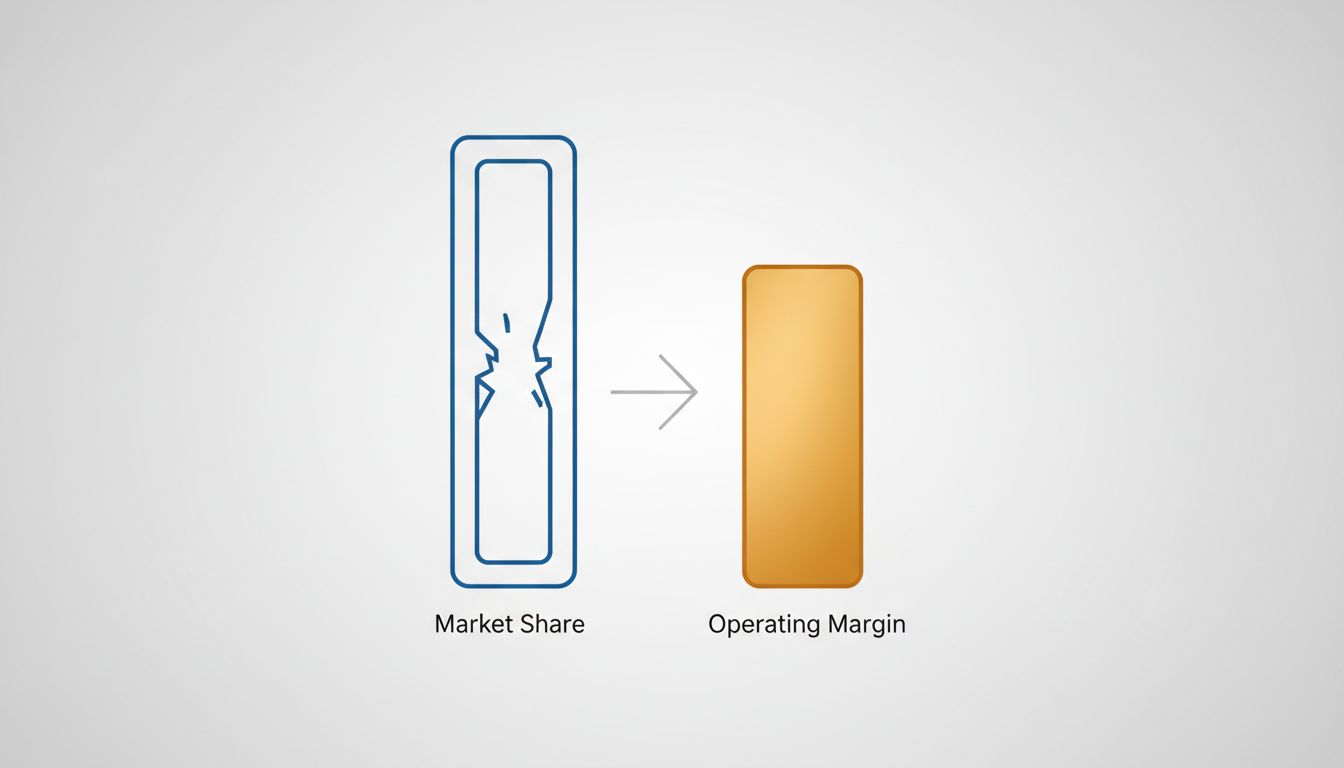
The company that wins a tech market gets the trophy. The company in second place often gets the better business.
This sounds wrong until you look at the numbers. Market leadership in technology tends to come with a set of obligations that quietly destroy margins: the obligation to defend territory, to out-invest competitors, to absorb the cost of educating a market that wasn’t ready for your product yet. The winner pays all of those bills. The runner-up does not.
The cost of the crown
Dominance in a technology market is expensive to maintain. The market leader becomes the target. It is the company that enterprise customers use as their baseline when evaluating every alternative. It is the company that regulators scrutinize first. It is the company that must bid on every deal to defend its reference status, even deals it would prefer to lose.
Salesforce built the CRM category and owns it by market share. It also spends more on sales and marketing as a percentage of revenue than almost any major software company. ServiceNow, perennially in second or third position in enterprise workflow software, has consistently run at higher operating margins than Salesforce. ServiceNow is not trying to own every conversation. It is trying to win the conversations it can win cleanly.
This pattern repeats. The number-two player gets to be selective. Selectivity is a margin driver.
Second place can copy what works and skip what didn’t
The market leader pioneers. That sounds like an advantage, and in terms of brand narrative it is. But pioneering is expensive. You build the wrong features first. You price the product incorrectly and then renegotiate painfully with early customers. You establish integrations with partners who turn out to matter less than you expected.
The second-place company watches all of that happen and builds accordingly. This is not a knock on innovation. It is a structural advantage in capital efficiency. A company that enters a market 18 months after the leader can allocate its R&D budget toward features that customers have already demonstrated they will pay for, rather than features the market might eventually want.
This is related to a well-documented pattern in tech history: the product that wins a market is rarely the one that invented the category. VHS did not invent home video. Google did not invent search. The winning product usually improves on a pioneer’s design rather than originating one. The same logic applies to the winning business.
Defending first place requires fighting on every front
A market leader cannot cede ground in any segment without sending a signal to the broader market. This forces it into product lines it cannot fully commit to and geographies it cannot fully serve. It must be credible everywhere, even where it is not actually competitive.
This is the trap that has plagued IBM for decades and created the opening for nearly every enterprise technology company that followed it. IBM had to have an answer for every category. Having an answer is not the same as having a good answer, and the cost of maintaining that coverage stretched the company in ways it never fully recovered from.
Second-place companies are expected to have gaps. Customers accept the tradeoff: you get depth in the areas this company has chosen to compete in, and you accept that the market leader owns everything else. That narrower contract is actually easier to fulfill and cheaper to maintain.
The investor premium myth
Conventional wisdom holds that market leaders command valuation premiums, and therefore the economics of being first must be worth the cost. This is partly true and partly a confusion of revenue multiples with actual business quality.
High revenue multiples reflect expected future growth, not current profitability. The market leader in a competitive technology category often carries a growth expectation it can only meet by continuing to spend aggressively. Analysts reward the revenue line and ignore the margin structure, until the growth inevitably slows and the margin structure suddenly becomes the entire story.
The second-place company with durable 30% operating margins and modest growth is a better business than a market leader with 8% operating margins and a stock price built on projections. One of those companies is pricing in a future that may not arrive. The other is already living in it.
The counterargument
The obvious objection is that this analysis ignores winner-take-all dynamics. In categories with strong network effects, like social platforms or marketplace businesses, second place is not a profitable alternative. It is a slow death. MySpace did not have decent margins while Facebook ate its lunch. Bing has not been a quietly profitable second-place search engine. It has cost Microsoft billions in ongoing subsidies in exchange for competitive relevance.
That objection is fair, and it limits the scope of the argument. This is not a universal claim about every technology market. It is a claim about markets where the product itself does not become more valuable as more people use it. In enterprise software, developer tools, hardware, and most infrastructure categories, network effects are weak or absent. In those categories, the second-place company is not fighting against compounding disadvantage. It is fighting against a first-place company that has more obligations than it does.
The position that wins the argument
The narrative around market leadership in technology has been shaped by a handful of spectacular winner-take-all outcomes: Google in search, Amazon in e-commerce, Meta in social networking. Those cases are real. They are also not representative of most technology markets.
For every Google, there are dozens of enterprise software categories where two or three companies compete reasonably well and the second-largest player runs a tighter, more profitable operation than the one on top. The winner gets the press release. The runner-up often gets the better income statement.
Chasing market leadership is a reasonable goal. Assuming that market leadership produces the best business outcomes is a different claim, and the evidence does not consistently support it.