
Paying a staff engineer $400,000 a year to maintain a script that runs once a week sounds like corporate waste. It is not. It is, in most cases, a deliberate strategic decision that reveals something fundamental about how the most valuable technology companies actually operate, and why the conventional logic of matching talent to task complexity routinely fails to explain Silicon Valley’s hiring patterns.
The instinct to optimize headcount, to hire a mid-level developer for mid-level work, assumes that engineering talent is a commodity deployed at face value. The companies that consistently win tend to think about it very differently. As the math behind compensating engineers at $400K while automating simpler work makes clear, the calculus is never purely about the task in front of you. It is about the task three product cycles from now.
The Option Value of Excess Capability
The core logic is borrowed, loosely, from financial options theory. When a company hires an engineer who is technically overqualified for their current role, they are not paying for today’s output. They are buying an option on tomorrow’s problem.
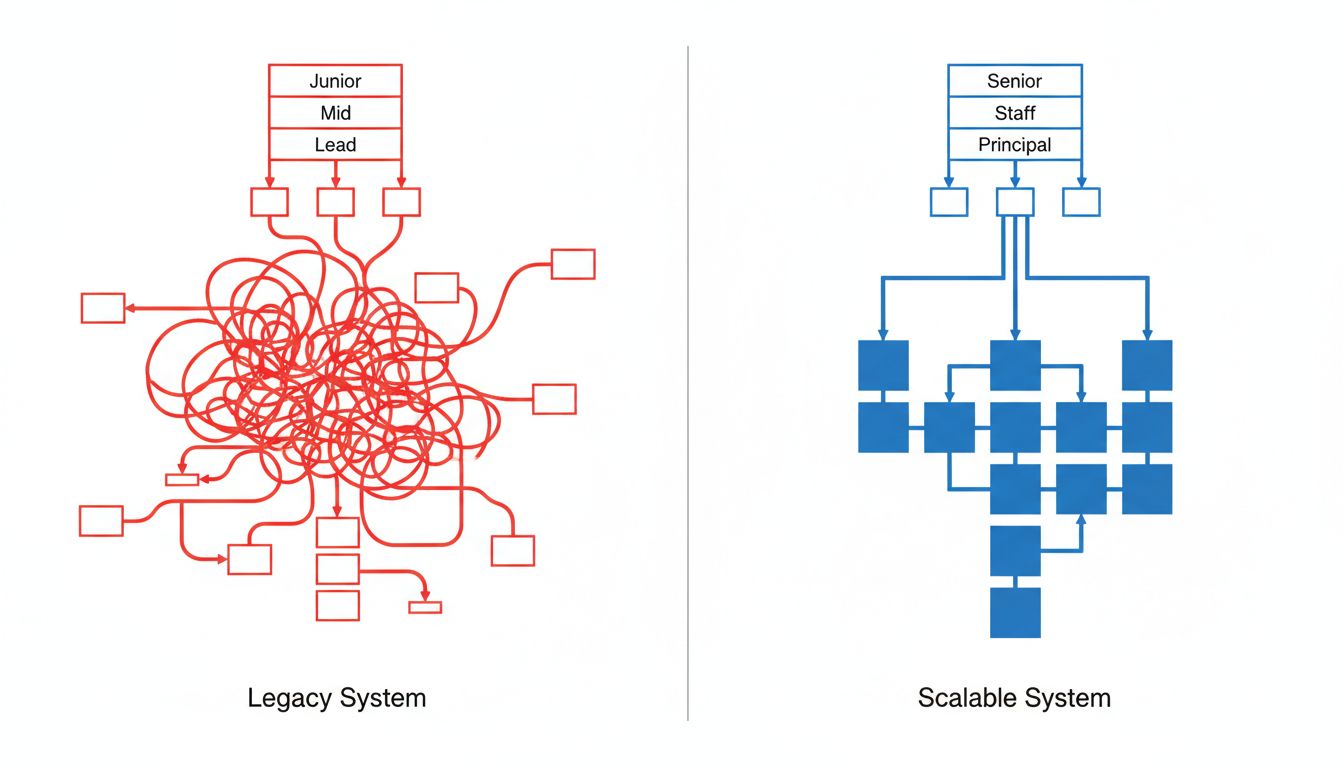
Google’s early infrastructure team is the canonical example. The engineers who built Google’s original search indexing pipeline were, by any reasonable measure, overqualified for the task. The search corpus of the early 2000s could have been handled by less sophisticated systems. But those same engineers, embedded in the codebase, fluent in its constraints, were positioned to extend that infrastructure as query volume scaled by orders of magnitude without requiring a costly and dangerous wholesale rewrite. The overqualification was the hedge.
This is why the observation that Google, Meta, and Apple still run on programming languages from the 1970s is not a punchline. Continuity of expertise compounds. An overqualified engineer who deeply understands a legacy system is worth more than a perfectly matched hire who would need years to develop that institutional knowledge.
Boredom as a Feature, Not a Bug
There is a counterintuitive cultural argument here as well. Elite engineers given underscoped work tend to optimize it. They automate the tedious parts. They instrument the system so failures surface before they become outages. They notice the adjacent problem that nobody thought to put on a roadmap.
This is not incidental. Companies like Stripe and Cloudflare have, at various points, explicitly described their hiring philosophy in terms of bringing in people who will find the official job description constraining. The assumption is not that the engineer will be bored and leave. The assumption is that boredom is productive. Bored talented people build internal tools, improve reliability, and spot opportunities that people running at 100% capacity on scoped work simply cannot see.
The analogy to why the most productive people delete apps instead of downloading them is instructive. The instinct to add, to fill capacity, is often less valuable than the discipline to preserve cognitive slack. Companies that hire exactly to task leave no room for the adjacent insight.
The Talent Market Signal
Hiring overqualified engineers also functions as a costly signal in the labor market. Top engineers evaluate employers partly by the caliber of colleagues they will work with. A company known for staffing senior talent on unglamorous but important work signals something important: it values craft and retention over optics.
This creates a flywheel. Strong engineers attract stronger engineers. The team that maintains a company’s core payments infrastructure at a major fintech is not doing glamorous work. But if that team is stacked with people who could be working anywhere, it tells candidates something about the company’s judgment and its willingness to invest in the unsexy foundations that actually determine reliability.
This connects directly to why boring technology wins. The most valuable systems in any mature tech company are rarely the newest ones. They are the ones that have been hardened, extended, and understood by people who chose to stay. Retaining that expertise requires giving talented people work that challenges them, even when the nominal task description would not suggest it.
The Hidden Cost of Matching Talent to Task
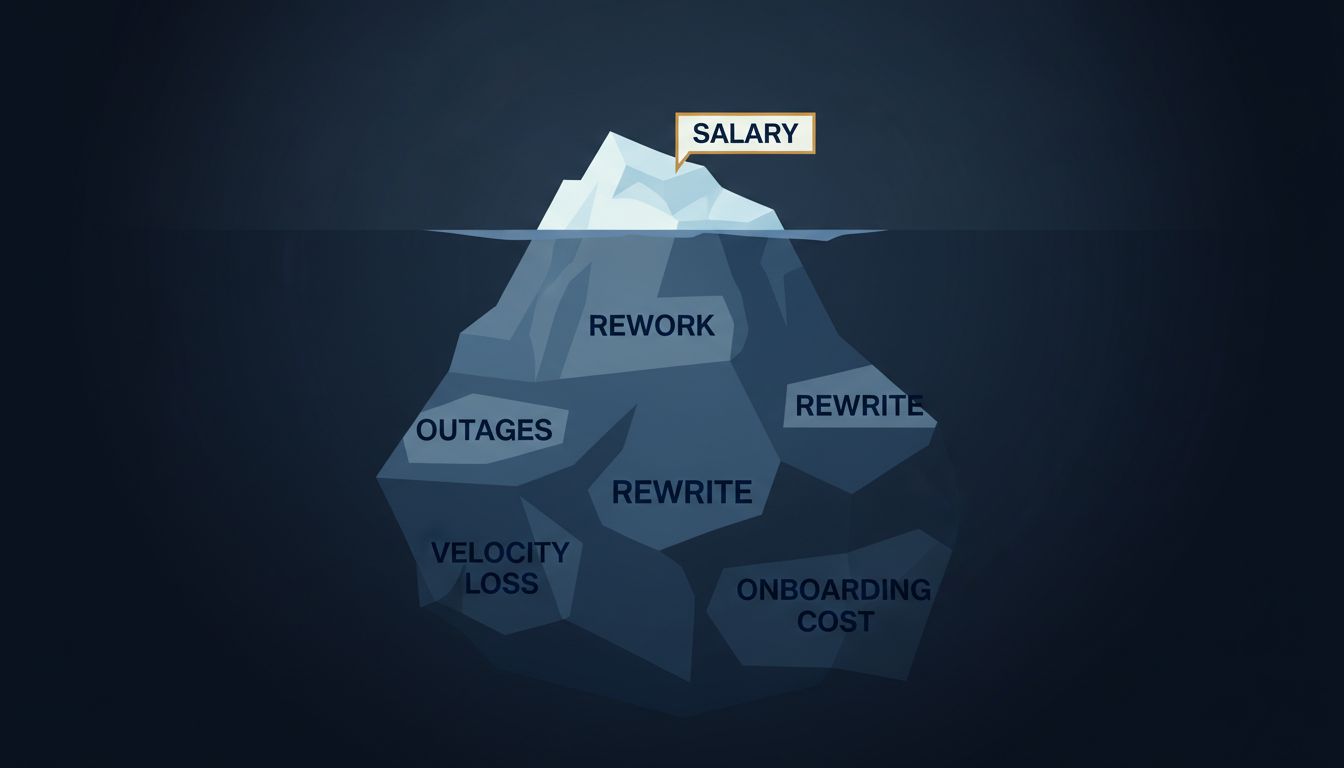
The opposing strategy, hiring precisely to the complexity of the current requirement, carries risks that are easy to undercount. When a system needs to scale, or a security vulnerability surfaces, or a compliance requirement demands a fundamental architectural change, the engineers who built it to a minimum spec are often not equipped to respond. The company then faces a choice between a costly rewrite, an expensive consultant, or months of onboarding a new hire to a codebase nobody fully understands.
The savings from the initial hire are frequently wiped out in a single remediation cycle. This is one reason why software updates keep breaking things that worked fine in organizations that ran lean on engineering investment. The system becomes brittle because the people who built it were given neither the time nor the capability to build in resilience.
What This Means for How Companies Are Valued
Investors who have studied this pattern at depth tend to weight engineering quality disproportionately when evaluating early-stage companies. The question is not whether the current product requires a staff engineer. The question is whether the company has people capable of building what comes after the current product.
This is part of why most unicorn companies were rejected by top VCs for reasons that look embarrassing in retrospect. The product at the time of the pitch was often genuinely simple. The investors who passed evaluated the task; the investors who wrote checks evaluated the team’s capability overhang, their capacity to handle problems that did not yet exist.
The practice of hiring overqualified engineers is, at its core, a statement about uncertainty. Nobody knows exactly what problem a company will face in 18 months. The rational response to that uncertainty is not to hire for today’s requirements. It is to hire people who have enough headroom to handle requirements that haven’t been written yet. The expensive engineer on the simple task is not a budget line item. It is an insurance policy, and like most good insurance, it looks wasteful until the moment you actually need it.