I once watched a founder celebrate landing a customer who had explicitly told them, during the sales call, that they chose the product because it was cheaper. The founder acted like he’d won something. He hadn’t. He’d just revealed his company’s only differentiator, and it was one his competitors could erase overnight.
Undercutting on price feels like a strategy. It has the shape of strategy: market analysis, competitive positioning, a deliberate choice. But in most cases it’s a confession disguised as a decision. It says: we haven’t figured out what we’re actually selling, so we’re competing on the only dimension that requires no explanation.
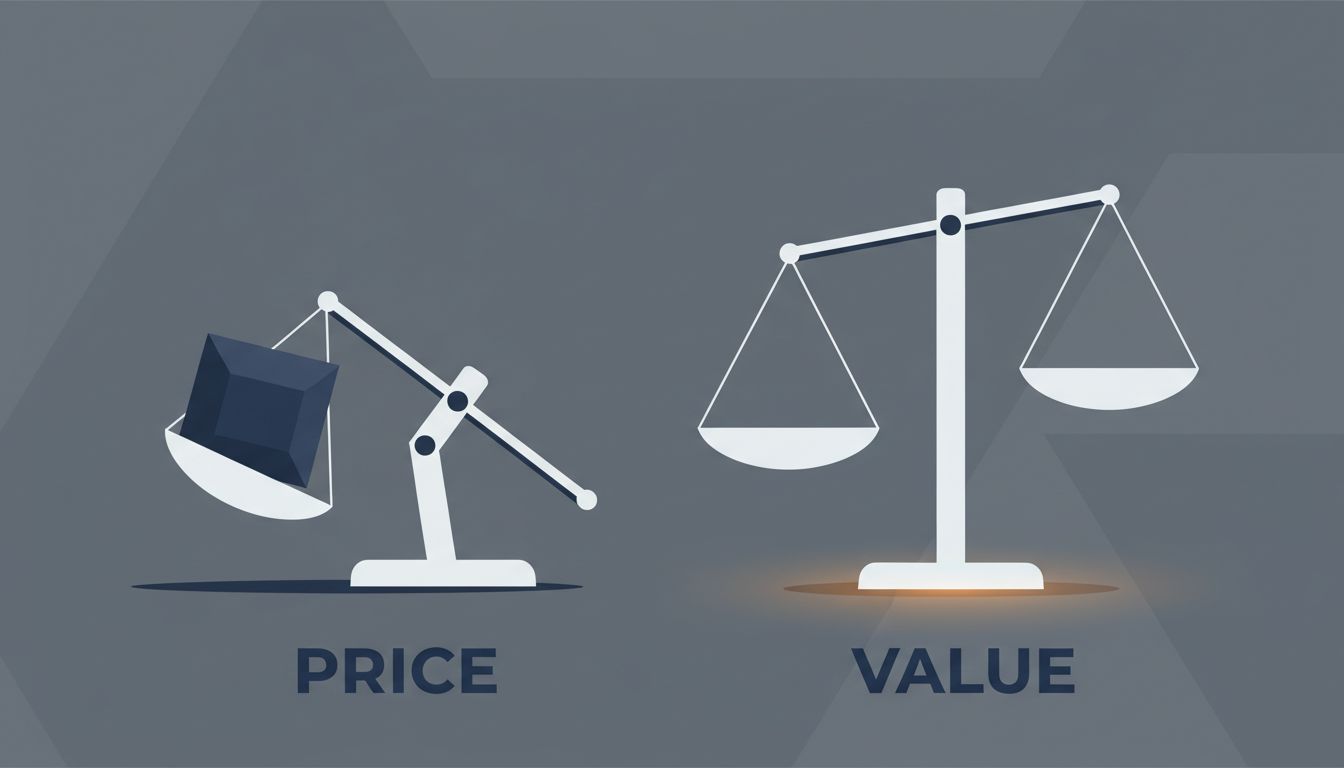
Here’s the position I want to defend: the startup charging less than its competitors is almost never winning a price war. It’s losing a value war, and hasn’t noticed yet.
Price is the last lever, not the first
When a company leads with low price, it’s telling the market something specific: that it cannot compel customers to pay more. That’s a product problem, not a pricing problem. The correct response to that signal is to fix the product, not to race to the bottom.
Look at what happens when companies build real differentiation. Stripe entered a market with existing payment processors charging similar rates. They didn’t undercut anyone. They charged comparable fees and won on integration quality, documentation, and developer experience. The price wasn’t the story. The product was.
Founters who charge before they’ve even built the thing understand this instinctively. If someone won’t pay your price for a description of the product, they’re not going to become loyal customers once the product exists. The willingness to pay is validation. Discounting to get the first customer in the door just delays the reckoning.
You’re training your customers, badly
Every pricing decision teaches customers something. If you acquire a cohort at a low introductory rate to prove traction, you’ve now created a group of customers whose entire relationship with your product is built on a price you can’t sustain. When you try to raise rates, those customers don’t think “this product has grown in value.” They think “the deal is over.”
This is the trap that kills companies slowly. They accumulate customers who chose them for price, which means they’re holding customers with the lowest switching costs. The moment a competitor matches the low price, or offers something marginally better at the same price, the whole cohort is at risk. You didn’t build loyalty. You rented attention.
The companies that own a niche rather than chase scale know their customers chose them for reasons that can’t be replicated by a price drop. That’s a defensible position. Being cheap isn’t.
Low price attracts the wrong buyers
This one gets overlooked. Price is a filter. It selects for a type of customer, and low price selects for customers who are optimizing for cost, which means they will continue to optimize for cost. They will ask for more discounts. They will negotiate every renewal. They will be the first to churn when a competitor opens at a lower price point, because they’ve shown you exactly what they care about.
High-value customers, the ones with budget, with internal buy-in, with patience for a product that takes time to implement, tend to be suspicious of the cheapest option. Not always, but often enough to matter. They’ve been burned before by cheap tools that created expensive problems. Price signals something to them about the vendor’s confidence in its own product.
If you’re selling into enterprise, this dynamic is even more pronounced. Admitting your gaps while demonstrating clear strengths closes more deals than leading with a low number that makes procurement wonder what’s wrong with you.
The unit economics make it structural
The immediate problem with undercutting is cash. The deeper problem is that it changes what’s possible for the company. Low prices mean lower margins, which means less money for engineering, for support, for sales. Which means the product improves more slowly. Which means the gap between you and a competitor who charges more and invests those margins back into the product gets wider over time, not narrower.
This is how the price war kills companies that aren’t even in a price war. You priced low to acquire customers, the product didn’t grow fast enough to justify a price increase, and now you’re stuck. Your competitor priced higher, funded better development, and built a product that customers are genuinely unwilling to leave.

The counterargument
Fair pushback: sometimes you genuinely are in a commodity market where price is the primary variable, and competing on price is rational. True. If you’re selling undifferentiated compute, or a product that is functionally identical to five competitors, price matters a lot.
But most startups are not in commodity markets. They’re in markets where differentiation is possible and is, in fact, the whole point of building a new company. If your product can’t be differentiated from the incumbents on any dimension other than price, that’s a question worth sitting with before you spend three years defending a margin you can’t survive on.
Also: penetration pricing, where you price low deliberately to grow a user base and shift to higher-margin models later, can work. Freemium works. But those are defined strategies with specific exit conditions. “We price low because we have to” is not the same thing.
Pricing is a product decision
The startup charging less than its competitors is almost always trying to solve a product problem with a pricing tool. It doesn’t work. The market doesn’t reward you for being cheap. It rewards you for being irreplaceable.
If customers won’t pay more, the answer is to make the product worth more, not to lower the number until someone says yes. Saying yes to your price isn’t the goal. Choosing you because nothing else comes close is.