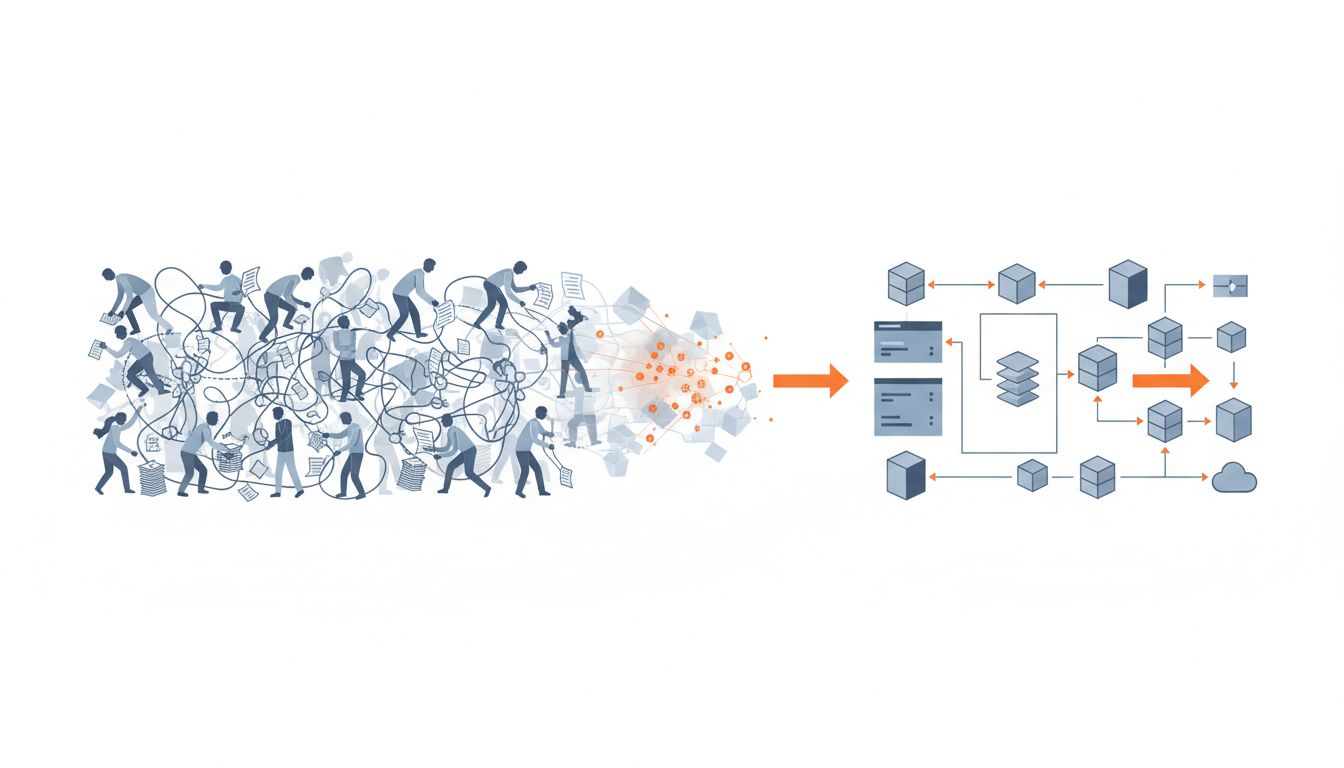
Stewart Butterfield built Slack to solve a problem his own team had while making a video game nobody wanted. The game, Glitch, shut down in 2012. The internal chat tool they built to coordinate the team survived. That’s the famous version of the story. The less-told version is what happened between “internal tool” and “company”: a period where Butterfield and his team had to figure out who, exactly, they were building for. Get that wrong, and the right product still fails.
This pattern repeats so often in startup history that it should be a named disease. You build something real, something that solves a genuine problem, and then you hand it to the wrong customer. They pull your roadmap sideways. They negotiate your pricing down. They tell you what they need, and because you’re desperate for signal, you build it. A year later you’ve built the wrong company.
Here’s what the famous cases actually teach you, stripped of the myth.
1. Slack Spent Time Chasing Enterprise Before It Understood Why Teams Loved It
Slack’s early growth came from small, technical teams, often engineering or design groups inside larger companies, who adopted it without asking permission. That bottom-up motion was the product. But the temptation for any SaaS company with early traction is to go upmarket fast, to find the big logo, the big contract, the validation that comes with a Fortune 500 name in your deck.
The problem is that enterprise customers in 2013 and 2014 didn’t want Slack. They had email. They had Microsoft Exchange. Many had internal tools that IT controlled. Slack’s actual customer, the one who loved it and paid without complaint, was the small-to-mid-size team that was drowning in email threads and needed something faster. Chasing enterprise too early would have required building compliance features, admin controls, and security certifications before Slack had figured out the core product. It would have slowed everything that made the product worth buying in the first place.
Slack eventually went enterprise, but it did it after the product was already a habit for millions of users. The order mattered.
2. Stripe Ignored Everyone Who Said Payments Were Solved
When Patrick and John Collison started Stripe in 2010, the standard advice from investors was that payments were a commodity, that PayPal and the card networks had it covered, that nobody wanted another payment company. That advice came from talking to the wrong people: established businesses that had already figured out how to integrate existing solutions, no matter how painful.
The Collisons went to developers instead. Developers hated how hard it was to add payments to an app. The existing solutions required weeks of back-and-forth with banks, piles of documentation, and integration processes that felt like they were designed in the 1990s (because they largely were). Stripe’s early customers were builders who needed seven lines of code to work, not procurement teams who needed a vendor relationship.
The Startup That Charges Too Little Dies Before It Can Fix It covers what happens when you let the wrong customer set your price. Stripe faced a version of this too: the temptation to race to the bottom on fees to win larger merchants early. They resisted it. The developer market they served was less price-sensitive than the enterprise market, and it grew into the enterprise market anyway.
3. Airbnb’s Real Customer Wasn’t Who the Founders Thought
Airbnb launched in 2008 to help people rent out space during sold-out conferences. The first proof of concept was air mattresses in Brian Chesky’s apartment during a design conference in San Francisco. The original pitch was explicitly about overflow accommodation: when hotels are full, here’s another option.
The mistake hiding in that framing was the assumption that the customer was primarily a price-sensitive traveler who needed a bed in a pinch. That customer exists, but they’re not who built Airbnb into what it became. The customer who actually drove the company was someone who wanted a different kind of travel experience entirely, someone who wanted to stay in a neighborhood instead of a hotel district, to cook breakfast instead of paying fifteen dollars for it at a business hotel, to feel like a local.
Airbnb figured this out partly through their famous decision to go to New York in 2009 and meet hosts in person. They weren’t just fixing product problems. They were figuring out who actually used the platform and why. The early hosts weren’t renting spare rooms to make ends meet during conference weekends. Many were people who genuinely wanted to share their city with travelers. That changed everything about how the company marketed itself, priced its categories, and built trust features.

4. The Wrong Customer Isn’t Bad, They’re Just Not Yours
Here’s what nobody says clearly enough: the wrong customer usually has real money and real problems. They’re not a hallucination. They’ll pay you, give you feedback, even refer you to other people just like them. That’s what makes them dangerous. They can fund a company for a year or two while quietly steering it into a market that was never going to work.
Enterprise customers before product-market fit are the classic version. They move slowly, require customization, and measure success differently than the scrappy early adopter who tells their friends about you because the product changed how they work. The Startups That Scale Fastest Stayed Small Longest gets at this from a growth angle. The underlying principle is the same: knowing who you are not selling to is as important as knowing who you are.
5. The Signal Is in Who Keeps Coming Back Without Being Asked
All three of these companies found their real customer the same way: by watching who showed up without being recruited, who used the product in ways the founders didn’t anticipate, who complained because they cared rather than walked away.
Stripe watched developers build things on the platform before the documentation was finished. Airbnb watched hosts who weren’t listing rooms for the money. Slack watched teams adopt it department by department without anyone filing a purchase order.
If you are in an early startup and you have customers who pay but require constant hand-holding, constant custom work, and who would churn the moment you stopped bending the product to their needs, that is not product-market fit. That is consulting with a SaaS wrapper. The customer who nearly killed these companies wasn’t the villain of the story. They were a mirror. The founders who survived looked honestly at what the mirror showed them and walked toward something different.